Solar leasing gives North Carolina homeowners another way to use solar energy without purchasing the system outright. Instead of owning the solar panels and other equipment, a third-party company owns the system while you make monthly payments for the energy it produces.
Think of a solar lease as an energy subscription. You pay a predictable monthly cost for the benefits of solar without taking on the responsibilities of equipment ownership.
For homeowners who want to reduce their reliance on utility electricity, limit their exposure to rising electricity rates, and avoid a large upfront purchase, solar leasing can be an attractive option.
But a lease isn’t the right choice for everyone. Before signing an agreement, it’s important to understand how solar leasing works, who owns the equipment, how payments compare with your remaining utility bill, what happens when the lease ends, and how leasing compares with buying solar.
What Is a Solar Lease?
A solar lease is an agreement that allows you to use a solar energy system owned by a third-party company. The company owns the solar panels and other leased equipment, while you make a monthly payment for the system and the energy it produces.
The basic arrangement is simple:
The solar company owns the system → the system produces electricity → your home uses that electricity → you make a monthly lease payment.
The company that owns the system typically handles monitoring, maintenance, and covered repairs during the lease term.
This makes leasing appealing to homeowners who want the benefits of solar without taking responsibility for owning and maintaining the equipment.
How Does a Solar Lease Work?
The process of going solar with a lease generally looks like this:
1. Review Your Energy Usage
Your solar provider reviews your home’s electricity usage and energy needs to determine what type of solar system may be appropriate.
2. Design Your Solar System
The system is designed around your home and expected energy production. Depending on the program, your solar system may also include battery storage.
3. Apply for the Lease
The leasing provider reviews your application and determines whether you qualify for the program.
4. Install the System
Once approved, the solar installer handles the installation process, including the necessary permitting and utility requirements.
5. Start Producing Solar Energy
Once your system is activated, your solar panels begin producing electricity for your home. You continue making your lease payment while purchasing any additional electricity you need from the utility.
Who Owns the Solar Panels in a Lease?
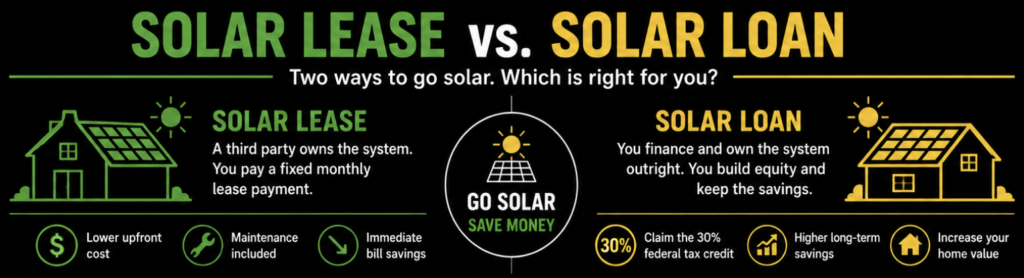
With a solar lease, the third-party leasing company owns the solar system.
This is one of the biggest differences between leasing and purchasing solar.
With a solar loan or cash purchase:
You own the system.
With a solar lease:
The leasing company owns the system.
You are paying for the use of the equipment and the energy it produces rather than purchasing the equipment yourself.
Because the leasing company owns the system, it is generally responsible for monitoring, maintenance, and covered repairs during the lease term.
Who Installs a Leased Solar System?
The company that owns the solar equipment and the company that installs it are not necessarily the same.
With an 8MSolar lease, 8MSolar handles the solar installation, while the leasing provider owns the equipment.
The installation process can include system design, permitting, installation, inspections, and utility interconnection.
This gives homeowners the benefit of working with an experienced solar installer without having to purchase the equipment themselves.
How Long Is a Solar Lease?
Residential solar leases are typically long-term agreements. Many leases run for 20 to 25 years, although the exact term depends on the program and agreement.
Before signing a lease, make sure you understand:
- The length of the agreement
- Your monthly payment
- Whether payments increase over time
- What happens if you sell your home
- Whether there is a purchase or buyout option
- What happens when the lease ends
The monthly payment is important, but the full terms of the agreement matter just as much.
What Credit Score Do You Need for a Solar Lease?
Credit requirements vary depending on the solar leasing provider and program.
A solar lease may have different qualification requirements than a traditional solar loan, so homeowners should ask about the specific requirements for the program they’re considering.
8MSolar’s current North Carolina leasing program may have different qualification requirements than traditional solar financing, so homeowners should discuss their individual situation with the team before assuming they will or won’t qualify.
How Much Does a Solar Lease Cost?
The cost of a solar lease depends on several factors, including the size of the system, your home’s energy usage, the lease term, and the specific terms offered by the leasing provider.
Rather than looking at the lease payment by itself, it’s important to look at your total monthly energy cost.
That may include:
Solar lease payment + remaining utility bill = total monthly energy cost
Your solar system may significantly reduce the amount of electricity you purchase from the utility, but it doesn’t necessarily eliminate your utility bill.
Will I Still Have an Electric Bill With a Solar Lease?
Usually, yes.
A solar lease doesn’t necessarily eliminate your utility bill. Your solar panels generate electricity for your home, but you may still need to purchase electricity from your utility when your system isn’t producing enough to meet your home’s needs.
For example, a homeowner might have:
- $120/month solar lease payment
- $40/month remaining utility bill
- $160/month total energy cost
If that homeowner previously paid $200 per month for electricity, the difference would be $40 per month, or $480 per year.
This is only a simplified example. Actual savings depend on your electricity usage, solar production, utility rates, lease terms, and how much electricity your home continues to purchase from the grid.
Why Think of Solar Leasing as an “Energy Subscription”?
A solar lease can be thought of as an energy subscription.
Instead of purchasing the solar equipment yourself, you pay a monthly amount to use a system that generates electricity for your home.
The goal is to create a more predictable monthly energy cost while reducing your reliance on utility electricity.
That can also reduce your exposure to future utility rate increases. As utility electricity becomes more expensive, generating more of your own electricity can become increasingly valuable.
Benefits of Solar Leasing
Low or No Upfront Cost
One of the biggest reasons homeowners consider leasing is the lower upfront cost. Many solar lease programs are structured with little or no money down.
This can make solar accessible to homeowners who don’t want to purchase a system outright.
Predictable Monthly Energy Costs
A solar lease can provide a more predictable monthly energy expense than relying entirely on utility electricity.
Instead of being completely exposed to changing utility rates, you have a set lease payment according to the terms of your agreement.
Maintenance Is Handled
Because the leasing company owns the system, it generally handles system monitoring, maintenance, and covered repairs during the lease term.
That can be appealing to homeowners who don’t want to take responsibility for maintaining their own solar equipment.
Reduced Exposure to Rising Utility Rates
Utility electricity rates can change over time. Generating your own electricity with solar can reduce the amount of power you need to purchase from the grid.
The less electricity you need to purchase from your utility, the less exposed you are to future rate increases.
Solar and Battery Backup
Some leasing programs can combine solar panels with battery storage.
A battery can store energy for later use and provide backup power during an outage, depending on the system and configuration.
What Are the Downsides of a Solar Lease?
Leasing isn’t automatically better than owning. There are tradeoffs to consider.
You Don’t Own the System
The leasing company owns the equipment. You’re paying for the use of the system rather than building ownership in the solar installation.
The Agreement Is Long-Term
A 20- to 25-year agreement is a significant commitment. Make sure you understand the terms before signing.
Payments Continue
With a lease, you generally continue making payments according to the agreement rather than eventually owning the system outright after paying off a loan.
Selling Your Home Can Be More Complicated
If you sell your home before the lease ends, you may need to transfer the lease to the buyer or follow the agreement’s buyout process.
Some Leases Have Payment Escalators
Some lease agreements may include annual payment increases. Review the agreement carefully so you understand whether your payment can change over time.
Solar Lease vs. Solar Loan
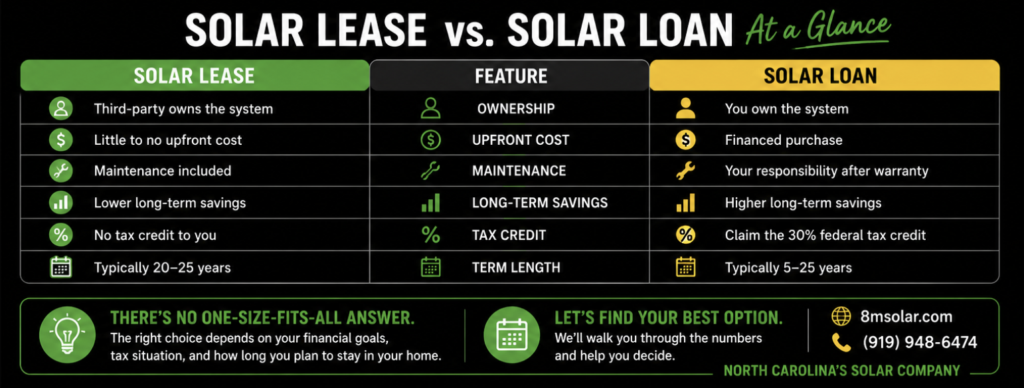
Solar leasing and solar loans both allow homeowners to go solar without paying the full system cost upfront, but they work differently.
| Feature | Solar Lease | Solar Loan |
|---|---|---|
| Who owns the system? | Third-party company | Homeowner |
| Upfront cost | Typically low or none | Typically low or none |
| Monthly payment | Lease payment | Loan payment |
| Maintenance | Generally handled by system owner | Homeowner responsibility |
| Equipment ownership | No | Yes |
| Long-term ownership benefits | Limited | Greater |
| Selling the home | Lease transfer or buyout may be required | Generally simpler |
| End of agreement | Depends on lease terms | System remains yours |
Neither option is automatically right for every homeowner. The better choice depends on your budget, goals, how long you plan to stay in your home, and whether you prefer ownership or simplicity.
Solar Lease vs. Buying Solar: Which Is Better?
If your primary goal is maximum long-term savings and ownership, purchasing your solar system may make more sense.
If your priority is low upfront cost, predictable monthly payments, and having someone else handle system ownership and maintenance, leasing may be a better fit.
The right answer depends on your individual situation.
A good comparison should look at:
- Monthly energy costs
- Total payments over the agreement
- Expected solar production
- Utility electricity rates
- Maintenance responsibilities
- Tax incentives that may apply
- How long you plan to stay in the home
- What happens if you sell the home
The current lease-vs-loan resource also emphasizes that there isn’t one universally better option; the right choice depends on financial goals, time in the home, tax circumstances, and preference for ownership.
What Happens If You Sell Your Home With a Solar Lease?
Selling a home with leased solar requires some additional planning.
Depending on the agreement, you may be able to transfer the lease to the buyer, or you may need to purchase the system or satisfy the lease through another option provided in your agreement.
If you’re considering selling your home in the future, ask about the lease transfer and buyout provisions before signing the agreement.
This is one area where the exact contract matters, so homeowners should never assume that every solar lease handles home sales the same way.
What Happens When a Solar Lease Ends?
The options at the end of a solar lease depend on the agreement.
Depending on the provider and contract, homeowners may have options such as renewing the agreement, purchasing the system, or having the equipment removed.
Before signing, review the end-of-term section of the lease so you know what happens after the initial agreement expires.
Is Solar Leasing Right for You?
A solar lease may be worth considering if you:
- Want little or no upfront cost
- Prefer a predictable monthly energy expense
- Don’t want to own or maintain the equipment
- Want to reduce your reliance on utility electricity
- Want less exposure to future utility rate increases
- Are interested in combining solar with battery backup
Buying or financing a solar system may be a better fit if you:
- Want to own your solar system
- Want the long-term benefits of ownership
- Want more control over the equipment
- Plan to stay in your home for many years
- Want to avoid a long-term lease obligation
How 8MSolar Can Help You Compare Solar Options
There’s no single financing option that’s right for every homeowner.
8MSolar offers multiple ways for North Carolina homeowners to go solar, including purchase, financing, and leasing options.
Our team can help you compare your options and understand how they affect your monthly energy costs, long-term savings, and home.
Whether leasing or ownership makes more sense for you, the goal is to choose a solar solution that fits your budget and your plans.
Ready to see what solar could look like for your home?
Schedule a Free Solar Consultation
Frequently Asked Questions
Is a solar lease worth it?
A solar lease can be worthwhile for homeowners who prioritize low upfront costs, predictable monthly payments, and minimal maintenance responsibilities. Whether it’s the best financial option depends on the specific lease terms and your goals.
Do I own my solar panels with a solar lease?
No. The leasing company owns the solar equipment. You pay to use the system and the energy it produces.
Who maintains leased solar panels?
The company that owns the system generally handles monitoring, maintenance, and covered repairs during the lease term.
How long does a solar lease last?
Many residential solar leases last 20 to 25 years, but the exact length depends on the provider and agreement.
Do I still have an electric bill with solar leasing?
Usually. Your solar panels can reduce the amount of electricity you purchase from the utility, but you may still receive a utility bill for electricity your home uses beyond what your solar system produces.
Does a solar lease require a credit check?
Credit and qualification requirements vary by provider and program.
Can I sell my house if I have a solar lease?
Yes, but you may need to transfer the lease to the buyer or satisfy the agreement through a buyout or another option specified in your contract.
What is a prepaid solar lease?
A prepaid solar lease allows a homeowner to pay the lease cost upfront rather than making monthly payments. The leasing company still owns the system.
What is the difference between a solar lease and a PPA?
With a solar lease, you generally make a monthly payment for use of the solar system. With a Power Purchase Agreement (PPA), you generally pay for the electricity the system produces based on a contracted price per kilowatt-hour.
What happens when a solar lease ends?
The options depend on the agreement. Review the contract for information about renewal, purchasing the system, removal, or other end-of-term options.