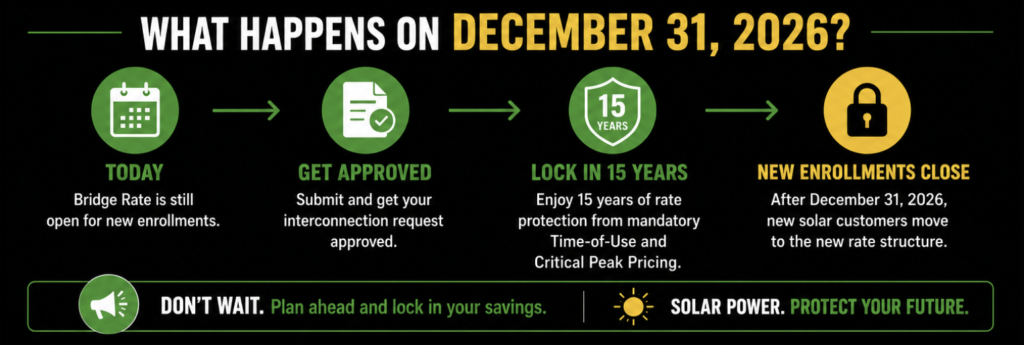
On December 31, 2026, Duke Energy’s Net Metering Bridge Rate permanently closes to new applicants. That’s not a rumor, it’s the result of a ruling by the North Carolina Utilities Commission, and it has real implications for homeowners who are thinking about going solar in the next year or two.
Here’s what the deadline actually means: homeowners who get their interconnection request submitted and approved before the cutoff can lock in the Bridge Rate for 15 years. That means 15 years of protection from mandatory Time-of-Use schedules and Critical Peak Pricing, a pricing structure that takes effect for new solar customers starting January 1, 2027, and can push electricity costs above 40 cents per kWh during extreme demand events.
Homeowners who go solar after the deadline aren’t shut out, solar still makes strong financial sense in North Carolina, and we’ll cover exactly why below. But the rate structure you get enrolled in matters, and the difference between the Bridge Rate and what replaces it is significant enough that understanding it should be part of any solar decision you’re making right now.
What Is Duke Energy’s Net Metering Bridge Rate?
Duke Energy’s Net Metering Bridge Rate is a transitional solar billing structure that sits between traditional net metering and Duke’s newer Residential Solar Choice (RSC) program. Under the Bridge Rate, homeowners receive credit for excess solar energy exported to the grid at a favorable rate, with a small minimum bill requirement. It’s a straightforward structure that makes solar savings predictable and easy to model.
The most valuable feature of the Bridge Rate isn’t just the current credit structure, it’s the 15-year enrollment period. Homeowners who get their interconnection request submitted and approved before December 31, 2026 are legally guaranteed their spot on the Bridge Rate for 15 years. That means 15 years of protection from mandatory Time-of-Use scheduling and Critical Peak Pricing, two features that become standard for new solar customers under the post-2026 Residential Solar Choice plan.
Duke Energy created the Bridge Rate as a transitional program following rapid growth in residential solar adoption. It was designed to give homeowners a stable, understandable rate structure during the period of utility modernization. It was always intended to be temporary, and now its enrollment window is closing on schedule.
Why Is the Bridge Rate Ending?
Utility rate structures for solar customers are evolving across the country, and North Carolina is part of that broader shift. As more homeowners install solar panels, utilities like Duke Energy are updating how they account for energy flowing in and out of the grid.
The core issue is that the grid wasn’t originally designed for large numbers of homes sending power back onto it at unpredictable times. Duke Energy, like many large utilities, has been working through a regulatory process to develop a longer-term compensation structure that reflects the actual value of solar energy at different times of day and in different grid conditions.
The Bridge Rate served its purpose as a stable, straightforward program during this transition period. As Duke moves toward its updated solar billing framework, sometimes referred to as the Residential Solar Choice Program, the Bridge Rate enrollment pathway is closing to new customers. This isn’t unique to North Carolina; similar transitions have happened in other states as solar adoption has matured.
The changes are part of Duke Energy’s broader transition away from traditional net metering policies and toward updated solar compensation structures.
Who Will Be Affected by the 2026 Deadline?
The impact of this deadline depends on where you are in the solar decision process.
Homeowners already enrolled in the Bridge Rate: If your solar system is installed and you’re already enrolled in the Bridge Rate, your situation is different from someone who hasn’t started yet. Existing enrollees are generally grandfathered under the program terms they enrolled under for a defined period. If this applies to you, check your enrollment agreement or contact 8MSolar to confirm how long your current rate structure remains in place.
Homeowners considering solar but not yet installed: This is the group most directly affected by the deadline. If you’re in the research or planning phase and you install a system after the Bridge Rate enrollment window closes, your system will be compensated under Duke’s updated solar billing structure rather than the Bridge Rate. Understanding what that means for your specific situation is worth doing before you make a decision.
Homeowners who install before the deadline: Homeowners who complete installation and interconnection before the deadline may be eligible to enroll in the Bridge Rate, depending on Duke Energy’s specific enrollment cutoff requirements. Timeline matters here, the permitting and interconnection process takes time, so starting early provides more options.
How Could the Change Affect Future Solar Savings?
This is the question most homeowners want answered, and it’s also the one that requires the most nuance.
Under the Bridge Rate, the credit for exported solar energy is relatively straightforward and predictable. Under the post-2026 Residential Solar Choice plan, the value of exported energy changes based on when it’s produced, and that mismatch is where the math gets complicated for new solar customers.
Here’s the core tension: solar panels produce the most electricity in the middle of the day. Under Time-of-Use billing, midday is generally considered “off-peak”, meaning Duke compensates you at a lower rate for the energy you’re sending to the grid when your panels are working hardest. Then when the sun goes down and your household draws from the grid in the evening, you’re in “on-peak” hours, buying electricity at a higher rate.
On top of that, the Residential Solar Choice plan includes Critical Peak Pricing, up to 20 designated days per year, typically during extreme summer heat events, where electricity costs can spike significantly. According to Duke Energy’s published rate schedules, CPP rates can exceed 40 cents per kilowatt-hour on those days. A household without battery storage has no defense against those spikes.
The practical result: a system designed purely for maximum production under the Bridge Rate may not be optimized for the RSC plan. Factors like battery storage, system sizing, and the timing of your household’s energy use all become more important. A well-designed system under the new structure can still deliver strong returns, but the design conversation matters more than it used to.
This is also where battery storage becomes more relevant. A battery allows you to store energy produced during the day and use it in the evening when grid rates are higher, reducing your dependence on grid exports and improving your overall economics regardless of how exported energy is compensated.
Bridge Rate vs. Residential Solar Choice
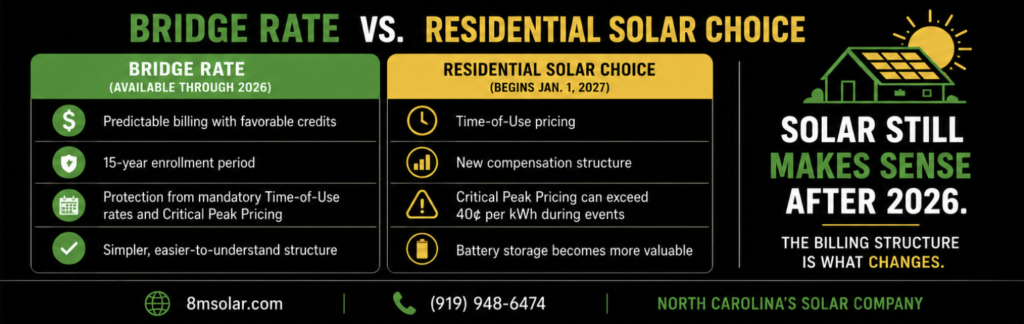
While every homeowner’s situation is different, the table below highlights some of the key differences between Duke Energy’s current Bridge Rate and the Residential Solar Choice program that new customers will generally move to after the deadline.
| Bridge Rate | Residential Solar Choice |
| Available through Dec. 31, 2026 | Applies to most new solar customers after Jan. 1, 2027 |
| Predictable billing structure | Time-of-Use pricing |
| 15-year enrollment period | Updated compensation structure |
| Straightforward solar planning | Battery storage may become more valuable |
| Consistent export credits | Energy value varies based on timing |
The right system can still provide significant savings under either structure, but understanding the differences can help homeowners make more informed decisions before investing in solar.
Is Solar Still Worth It After 2026?
Yes, for most North Carolina homeowners, solar remains a strong investment.
The case for solar has never been based solely on the Bridge Rate. It’s built on a combination of factors that remain in place regardless of how Duke Energy structures its solar billing:
- Rising utility rates: Duke Energy rates have been climbing steadily, and that trend is expected to continue. Every kilowatt-hour your solar system produces is a kilowatt-hour you don’t buy from the utility. That savings compounds over time as rates increase.
- The 30% federal tax credit: The Investment Tax Credit (ITC) covers 30% of your system cost and remains in place through 2032. This is one of the most significant financial incentives in residential solar and doesn’t depend on Duke’s billing structure.
- Energy independence: A solar system with battery backup gives your home a degree of resilience that grid-only customers don’t have. During outages, your home keeps running. During peak demand events or grid disruptions, you’re insulated from the instability.
- Long-term asset value: Solar panels have a 25 to 30-year lifespan. A system installed today will still be producing energy in the 2040s and 2050s, long after the initial payback period has passed. Studies consistently show that solar increases home resale value for NC homeowners.
What changes after 2026 is the specific billing structure for exported energy, not the fundamental economics of solar. The homeowners who will see the strongest returns going forward are those who work with an experienced installer to design a system that fits their household’s actual energy patterns, not just a maximum-panel-count estimate.
Why Some Homeowners Are Exploring Solar Before the Deadline
There are practical reasons why some NC homeowners are moving forward with solar sooner rather than later, and none of them require high-pressure tactics to explain.
Rate certainty: Enrolling in the Bridge Rate before it closes means your compensation structure is known and defined for the enrollment period. For homeowners who value predictability in their financial planning, locking in a rate structure they understand has real value.
More planning time: A solar installation isn’t an overnight process. Between site assessment, system design, permitting, utility interconnection, and installation, the timeline from initial conversation to a producing system typically runs several months. Starting earlier means you’re not rushing that process as a deadline approaches.
Avoiding a pre-deadline rush: As awareness of the Bridge Rate deadline grows, installer capacity and permitting timelines may be affected by increased demand. Getting ahead of that curve gives you more options and a calmer process.
None of this means you need to make a hasty decision. It means that if solar has been on your list, now is a reasonable time to get the information you need to decide, not because of fear, but because informed decisions take time and preparation.
Frequently Asked Questions About Duke Energy’s Bridge Rate
Do I have to complete my solar installation before December 31, 2026?
Not necessarily. Eligibility requirements are tied to Duke Energy’s enrollment and interconnection process, so homeowners should verify current requirements and timelines before making decisions based on the deadline.
Can I enroll in the Bridge Rate after the deadline?
No. The Bridge Rate closes to new applicants on December 31, 2026. Homeowners who do not qualify before the enrollment window closes will generally move to Duke Energy’s updated solar billing structure.
How long does the solar installation process take?
Every project is different, but the process typically includes system design, permitting, utility approvals, installation, and final interconnection. Starting early gives homeowners more flexibility as the deadline approaches.
How 8MSolar Helps Homeowners Navigate Duke Energy Programs
At 8MSolar, we’ve been working with Duke Energy’s interconnection and billing programs for over two decades. We know the process, the paperwork, and the people involved, and we handle all of it on your behalf.
When you work with 8MSolar, here’s what that looks like in practice:
- Custom system design: We design your system based on your actual energy usage, not a generic estimate. That means accounting for your daily patterns, your roof’s orientation, any shading, and how the updated billing structure affects your specific situation.
- Financing guidance: We walk you through all available solar financing options, loans, cash purchase, and lease/PPA programs like LightReach, so you can choose the path that fits your budget and financial goals.
- Permitting and utility coordination: We handle the permitting process with your county and the interconnection application with Duke Energy. You don’t have to navigate that on your own.
- Long-term support: Our relationship with you doesn’t end at installation. We monitor system performance, address warranty issues, and remain your point of contact for anything solar-related for the life of your system.
We’re not here to sell you a system, we’re here to help you make a good decision. If solar makes sense for your home, we’ll show you why and how. If it doesn’t, we’ll tell you that too.
If you’re a North Carolina homeowner trying to understand how the Bridge Rate deadline affects your options, a free consultation with our team is the right first step. We’ll look at your energy bills, your roof, and your goals, and give you a clear picture of what solar looks like for your specific situation, before you make any commitments.
Call us at (919) 948-6474 or schedule a free consultation online. There’s no obligation, just honest answers from a local team that’s been doing this for over 20 years.