
Most North Carolina homeowners who go solar save between $1,000 and $2,500 per year on electricity, depending on their energy usage, utility rates, system size, and roof conditions. Over a 25-year system lifespan, that adds up to $25,000 to $60,000 or more in cumulative savings for many households.
Those are realistic ranges, not marketing numbers. The actual figure for your home depends on factors specific to your property and energy habits. This guide walks through what NC homeowners can actually expect in 2025, why savings vary, and how to estimate what solar could do for your electricity costs.
How Much Can Solar Panels Save NC Homeowners Per Year?
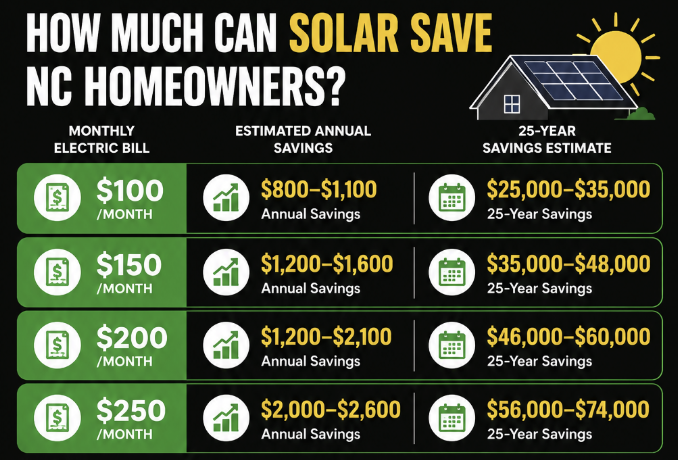
The honest answer is that savings depend heavily on your individual situation. But here are realistic estimates based on typical NC electricity rates and household energy profiles:
Average Annual Savings by Monthly Bill
| Monthly Electric Bill | Estimated System Size | Estimated Annual Savings | 25-Year Savings Estimate |
| $100/month | 5-7 kW | $800-$1,100 | $25,000-$35,000 |
| $150/month | 7-9 kW | $1,200-$1,600 | $35,000-$48,000 |
| $200/month | 9-12 kW | $1,600-$2,100 | $46,000-$60,000 |
| $250/month | 11-14 kW | $2,000-$2,600 | $56,000-$74,000 |
These are estimates based on NC average electricity rates and typical system performance. Your actual savings will vary based on roof conditions, utility rate structure, and system design. The 25-year figures account for typical annual utility rate increases of 3 to 4 percent per year.
One thing worth noting: Duke Energy has been raising rates consistently, and those increases are expected to continue. Every time the utility raises rates, the value of the solar energy your system produces goes up. Savings calculated today are likely to be conservative compared to what you will actually save over the full system life.
What Determines How Much Solar Saves You?
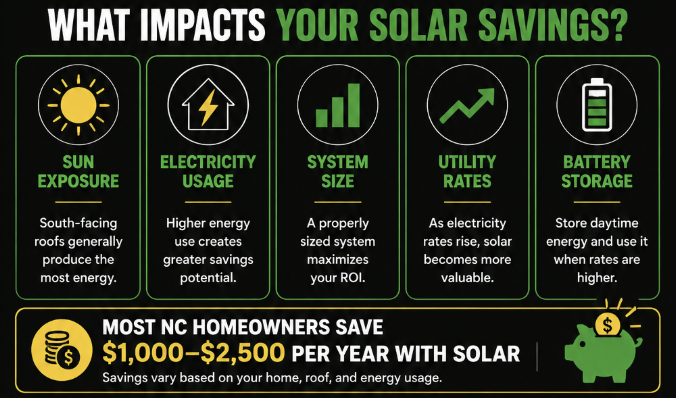
Solar savings are not one-size-fits-all. Two homes in the same neighborhood with the same monthly electric bill can have very different outcomes from solar, depending on the following factors.
Your Electricity Usage
Your annual kilowatt-hour consumption is the single biggest factor in determining how much solar can save you. A home using 15,000 kWh per year has much more savings potential than a home using 8,000 kWh annually. Higher usage means a larger system is justified, and more of your bill can be offset by solar production.
NC homeowners average around 1,100 to 1,200 kWh per month, which is higher than the national average, largely due to summer air conditioning loads. That higher baseline usage actually makes solar more financially attractive for many NC households compared to homeowners in cooler climates.
Roof Orientation and Sun Exposure
South-facing roofs in North Carolina receive the most direct sunlight throughout the year and produce the most energy per panel installed. East and west-facing roofs can still be productive but typically generate 10 to 20 percent less energy than a comparable south-facing installation.
Shading has a significant impact too. Trees, chimneys, and neighboring structures that cast shadows on panels reduce output. A professional site assessment identifies shading issues and factors them into your savings estimate so you get a realistic projection, not an optimistic one.
Utility Rates
North Carolina’s residential electricity rates are currently below the national average, which is one reason savings projections are sometimes lower than what homeowners in California or New England see. But that gap is narrowing. Duke Energy has implemented multiple rate increases in recent years and has signaled more are coming.
Every rate increase makes your solar system more valuable. A system that saves you $1,500 today could save you $2,000 or more annually in ten years if rates continue climbing at historical rates. Long-term savings projections should always account for rate escalation, not just today’s rates.
System Size
A larger system produces more energy and offsets a greater share of your electricity usage, but bigger is not always better. The goal is to size your system to match your actual consumption, not to maximize panel count. Oversizing a system beyond your usage does not increase savings proportionally, since the excess energy exported to the grid is compensated at a lower rate than what you pay for electricity.
Battery Storage
A battery storage system increases the value of your solar installation by allowing you to use more of the energy you produce rather than exporting it to the grid. Instead of sending midday solar production to the grid at a lower export rate, you store it and use it in the evening when grid rates are higher. Battery storage is especially valuable for homeowners who will be on Duke Energy’s post-2026 Residential Solar Choice plan with Time-of-Use billing.
How Much Can Solar Save Over 25 Years?
Solar panels are a long-term investment, and the cumulative savings over a 25 to 30-year system lifespan tell a much more compelling story than year-one savings alone.
| Year | Annual Savings (avg. home) | Cumulative Savings |
| Year 1 | $1,400 | $1,400 |
| Year 5 | $1,600 | $7,500 |
| Year 10 | $1,900 | $17,000 |
| Year 15 | $2,200 | $29,000 |
| Year 25 | $2,900 | $55,000+ |
Based on a typical NC family home with a $175 monthly electric bill and a 3.5 percent annual utility rate increase. Figures are illustrative estimates.
Notice how the annual savings figure grows over time. That is the effect of utility rate increases. As Duke Energy raises rates, the electricity your solar system produces becomes more valuable. A system that breaks even in year eight or nine then spends the next 15 to 20 years generating pure financial return.
What Is the Average Solar Payback Period in North Carolina?
The payback period is the amount of time it takes for your cumulative energy savings to equal the cost of your solar system. In North Carolina, most homeowners see a payback period of 7 to 12 years, with the average landing around 8 to 10 years after applying the federal tax credit.
That means for a system with a 25 to 30-year lifespan, the typical NC homeowner spends roughly a third of the system’s life paying it off and the remaining two-thirds generating pure savings. It is a front-loaded investment that keeps paying back long after the loan or payback period ends.
How Utility Rate Increases Affect Payback
Utility rate increases shorten the payback period. Every time Duke Energy raises rates, the electricity your solar system produces is worth more, which means you recover your investment faster.
A system with an estimated 10-year payback at today’s rates might have an effective payback of 8 years if rates increase at 3 to 4 percent annually, which is consistent with recent Duke Energy rate history. Payback projections that do not account for rate escalation underestimate the speed of return.
Are Solar Panels Worth It in North Carolina in 2025?
For most NC homeowners, yes. Here is why the fundamentals are strong in 2025:
Rising Utility Costs
Duke Energy has been raising rates, and the trajectory shows no sign of reversing. Locking in your energy costs through solar protects you from future increases for the life of your system. Homeowners who went solar five years ago are watching their savings grow with every rate hike that passes them by.
Federal Tax Credit
The 30% federal solar tax credit is one of the most significant financial incentives available to homeowners right now. On a $30,000 system, that is $9,000 back at tax time, reducing your net cost to $21,000. The credit applies to the full system cost including installation and battery storage when added at the same time as the panels. It is available through 2032, giving homeowners several years to take advantage of it.
Long System Lifespan
Modern solar panels carry manufacturer warranties of 25 years and are designed to last 30 or more. The investment you make today will still be producing energy and savings in the 2050s. That long-term horizon changes the ROI calculation significantly compared to most home improvements.
Energy Independence
Beyond the financial return, solar provides a degree of energy independence that grid-only customers do not have. Paired with a battery, your home continues to operate during grid outages, which are becoming more frequent in North Carolina due to storm activity and grid strain. That resilience has real value that does not show up in a simple savings calculation.
Real-World NC Homeowner Examples
These are illustrative examples based on typical NC homes. They are designed to show how savings vary by household size and usage, not to guarantee specific outcomes for your home.
Example 1: Small Home, Lower Usage
Profile: 1,400 sq ft home, two occupants, $110 average monthly bill, Duke Energy territory, south-facing roof with good sun exposure.
System size: 6 kW
Estimated gross cost: $18,000 to $22,000
After 30% federal tax credit: $12,600 to $15,400
Estimated annual savings: $900 to $1,200
Estimated payback period: 10 to 14 years
25-year savings estimate: $28,000 to $38,000
Example 2: Average Family Home
Profile: 2,200 sq ft home, family of four, $175 average monthly bill, Duke Energy territory, mostly south-facing roof with minor shading from one tree.
System size: 9 kW
Estimated gross cost: $27,000 to $33,000
After 30% federal tax credit: $18,900 to $23,100
Estimated annual savings: $1,400 to $1,900
Estimated payback period: 9 to 13 years
25-year savings estimate: $42,000 to $56,000
Example 3: Large Home, High Energy User
Profile: 3,500 sq ft home, family with multiple occupants and an EV, $260 average monthly bill, Duke Energy territory, large south-facing roof with no significant shading.
System size: 13 kW with battery storage
Estimated gross cost: $42,000 to $52,000
After 30% federal tax credit: $29,400 to $36,400
Estimated annual savings: $2,100 to $2,800
Estimated payback period: 10 to 14 years
25-year savings estimate: $60,000 to $80,000
Wondering how much your home could save? Get a free custom solar savings estimate from 8MSolar. Schedule a free consultation.
How to Estimate Your Solar Savings
Here is the step-by-step process for understanding your solar savings potential before you commit to anything:
- Gather 12 months of electric bills. You need your actual annual kWh usage, not just your average monthly dollar amount. This is the most important number in any solar savings estimate.
- Determine your annual usage in kilowatt-hours. Add up the kWh usage from each monthly bill. This tells your installer how large a system you actually need.
- Review your roof’s suitability. Consider the orientation, pitch, and any shading from trees or neighboring structures. A south-facing, unshaded roof will produce the most energy and the fastest payback.
- Get a professional system design. An experienced installer uses your actual usage data, your roof’s conditions, and local solar irradiance data to model a system sized specifically for your home. Avoid estimates based on square footage alone.
- Compare your solar financing options. Whether you pay cash, take a solar loan, or enroll in a financing program like LightReach, your financing choice affects how quickly you see net savings. A loan structured so that the monthly payment is less than your current electric bill means you save from day one.
How 8MSolar Helps NC Homeowners Maximize Savings
At 8MSolar, we design every system based on your actual energy data, not generic estimates. Here is what that means in practice for NC homeowners:
- Custom system design. We size your system to your actual usage and roof conditions, not to maximize panel count. A properly sized system pays back faster and performs better over time.
- Battery storage options. We help you evaluate whether battery storage makes financial sense for your situation, particularly given Duke Energy’s evolving rate structure and the upcoming Bridge Rate deadline.
- Financing guidance. We walk you through cash purchase, solar loans, and lease or PPA programs so you can choose the path that fits your budget and goals.
- Utility coordination. We handle permitting and Duke Energy interconnection on your behalf, including navigating the Bridge Rate enrollment process for homeowners who want to lock in before the 2026 deadline.
- Long-term support. Our relationship with you does not end at installation. We monitor system performance, address warranty issues, and remain your point of contact for the life of your system.
Every home is different. The best way to determine your potential savings is with a custom solar design based on your actual energy usage and property. Contact 8MSolar today for a free solar consultation and personalized savings estimate.
Frequently Asked Questions
How much do solar panels save per month in North Carolina?
Most NC homeowners save between $75 and $220 per month depending on system size, electricity usage, and utility rates. Higher electric bills generally mean larger monthly savings from solar.
How much can solar save over 25 years?
A typical NC family home can expect $35,000 to $60,000 or more in cumulative savings over 25 years, accounting for typical annual utility rate increases. Larger energy users may see higher totals.
What is the average solar payback period in NC?
Most North Carolina homeowners see a payback period of 7 to 12 years after applying the 30% federal tax credit. Homes with higher electricity usage, south-facing roofs, and minimal shading tend toward the shorter end of that range.
Do solar panels eliminate electric bills completely?
Most homeowners significantly reduce rather than eliminate their electric bill. Duke Energy requires a minimum monthly charge regardless of solar production. Most solar customers see bills in the $10 to $30 range during high-production months, with slightly higher bills during winter when production is lower.
Are solar panels still worth it in North Carolina in 2025?
Yes, for most homeowners. Rising utility rates, the 30% federal tax credit, and a 25 to 30-year system lifespan make solar a strong long-term investment for NC homes with adequate sun exposure and electricity usage above $100 per month.
Do batteries increase solar savings?
Batteries increase the amount of solar energy you use directly rather than exporting to the grid, which improves savings. They are especially valuable under Time-of-Use billing structures, where the timing of energy use affects how much you pay. Battery storage also qualifies for the 30% federal tax credit when installed with solar panels.
How much does the federal solar tax credit reduce costs?
The federal Investment Tax Credit (ITC) covers 30% of your total system cost, including installation. On a $28,000 system, that is $8,400 back at tax time, reducing your net cost to $19,600. The credit is available through 2032 and applies to both panels and battery storage added at the same time.