
Time-of-use (TOU) electricity rates charge different prices for electricity depending on the time of day. Electricity costs more during peak demand periods, typically late afternoon and evening, and less during off-peak periods when demand on the grid is lower. Solar panels naturally produce the most electricity during the day, which overlaps with periods that can offset expensive electricity. When evening arrives and production slows, homeowners on TOU plans draw from the grid at higher rates unless they have battery storage to cover that gap.
TOU rates are increasingly relevant for North Carolina homeowners because Duke Energy’s post-2026 Residential Solar Choice plan, which applies to all new solar customers after the Bridge Rate deadline, includes mandatory TOU billing and Critical Peak Pricing. Understanding how TOU rates interact with solar production and home energy use is one of the most important things a homeowner can know before making a solar decision in 2026. The full solar installation and permitting process takes several months, so homeowners who want to beat the Bridge Rate deadline should start that conversation now.
Quick answers to the most common TOU questions:
- What are TOU rates? A pricing structure where electricity costs vary by time of day, with higher rates during peak demand hours.
- Do solar panels still save money under TOU pricing? Yes, often significantly, because solar offsets expensive daytime electricity.
- Does battery storage help? Substantially. A battery stores excess solar energy produced during the day and deploys it during expensive evening peak hours.
- Should homeowners act before TOU rates become standard? Homeowners who install solar and file their interconnection application before December 31, 2026 may qualify for the Bridge Rate and avoid mandatory TOU billing for 15 years.
What Are Time-of-Use Electricity Rates?
Under a standard flat-rate electricity plan, you pay the same price per kilowatt-hour regardless of when you use it. Under a time-of-use plan, the price changes based on the time of day and sometimes the season. The goal is to encourage energy use during periods when the grid has more capacity and discourage it during periods of peak demand.
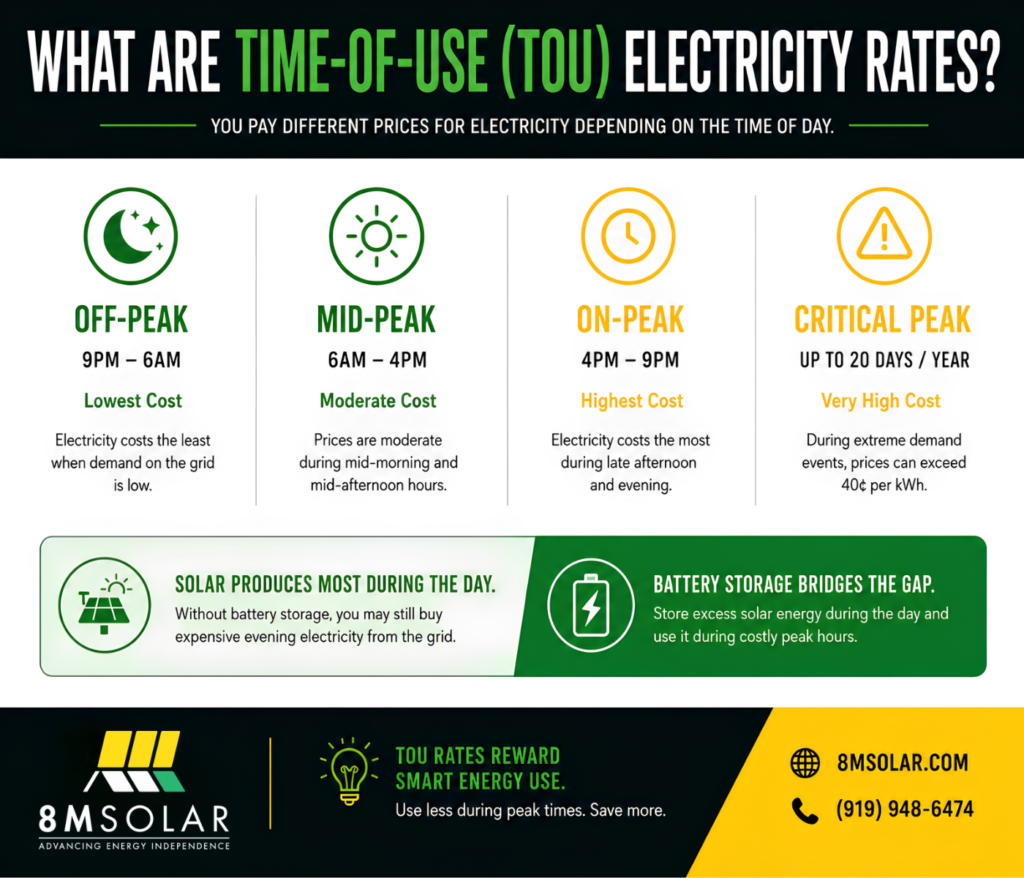
| Time Period | Typical Hours | Electricity Cost |
| Off-Peak | Late night and early morning (9pm to 6am) | Lowest |
| Mid-Peak | Mid-morning and mid-afternoon (varies) | Moderate |
| On-Peak | Afternoon and evening (typically 4pm to 9pm) | Highest |
| Critical Peak | Up to 20 designated days per year during extreme demand events | Can exceed 40 cents per kWh |
The specific hours and rates vary by utility and plan. Under Duke Energy’s Residential Solar Choice plan, new solar customers are required to use TOU billing including Critical Peak Pricing (CPP), which can push electricity costs significantly higher on hot summer days when grid demand is highest. Understanding these tiers is essential for modeling what your solar system will actually save you under this structure.
Why Are Utilities Moving to Time-of-Use Rates?
Growing Electricity Demand
North Carolina’s electricity demand has been growing steadily, driven by population growth, electrification of transportation, and increasing use of air conditioning during hot summers. Utilities need tools to manage that demand, and TOU pricing is one of the most effective. By charging more during peak hours, utilities reduce the spike in demand that would otherwise require expensive additional generation capacity.
Grid Reliability
A grid that sees sudden surges in demand is harder to operate reliably. TOU pricing smooths out usage patterns by incentivizing customers to shift discretionary energy use, like running dishwashers, washing machines, and EV chargers, to off-peak hours when the grid has more capacity available.
Encouraging Energy Use During Off-Peak Hours
Lower off-peak rates reward customers who can be flexible with their energy use. For solar homeowners with batteries, this creates an opportunity to charge the battery from the grid during cheap overnight hours when solar is not producing, and use that stored energy during expensive peak periods.
Supporting Renewable Energy Integration
As more solar capacity comes online, midday electricity is increasingly abundant and lower cost to produce. TOU pricing reflects that reality by setting lower rates during the midday period when solar is producing most. This also means that homeowners who use more energy during the day while their panels are producing can save more, while those who primarily use energy in the evening bear more cost without storage.
How Do Time-of-Use Rates Affect Solar Savings?
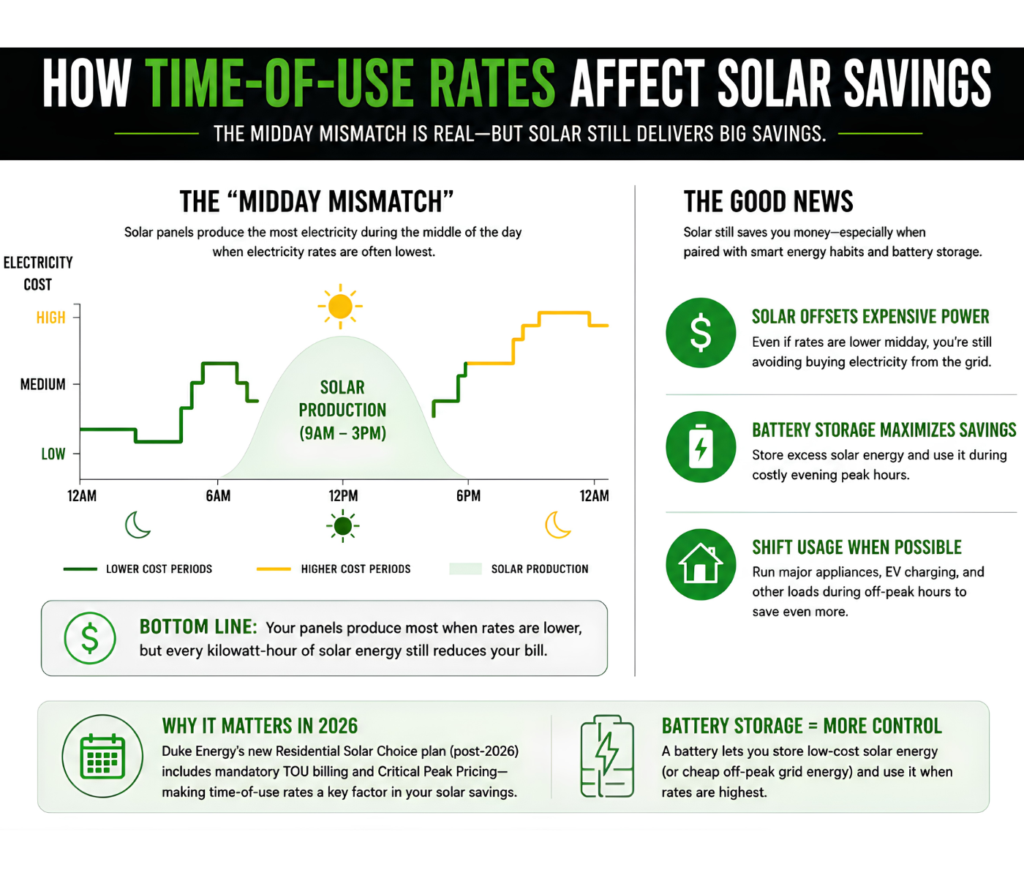
Solar panels produce the most electricity between roughly 9am and 3pm, which typically coincides with mid-peak or off-peak pricing under most TOU schedules. This creates what is sometimes called the “midday mismatch”: your panels are working hardest precisely when the grid values that electricity least.
However, there are two important counterpoints. First, even at mid-peak or off-peak rates, solar energy your system produces is still energy you are not buying from the utility. Every kilowatt-hour of solar production reduces your bill regardless of the time it occurs. Second, solar production in the morning and early afternoon, before the on-peak window opens, can still coincide with moderate pricing periods depending on your utility’s specific schedule.
The net result for most homeowners: solar still provides meaningful savings under TOU pricing, but the savings calculus is more nuanced than under a flat-rate structure. System design, how and when your household uses energy, and whether you have battery storage all affect how well your system performs under TOU billing. This is one reason why residential solar installation in 2026 requires more careful system design than it did five years ago.
What Happens After the Sun Goes Down?
This is where TOU pricing creates the most meaningful challenge for solar-only households. Most families use the most electricity in the late afternoon and evening: cooking dinner, running the dishwasher, watching television, charging devices. This is precisely when TOU rates are highest and when solar panels are producing little or no electricity. Understanding how your solar interconnection agreement and utility billing program are structured helps you plan for this gap before your system is activated.
A household without battery storage must purchase all of its evening electricity from the grid at on-peak rates. Under Duke Energy’s Critical Peak Pricing structure, on up to 20 designated days per year, that electricity can cost more than 40 cents per kilowatt-hour, more than triple the standard off-peak rate. For a home running central air conditioning through a hot North Carolina summer evening, that exposure adds up quickly.
The practical implication: for homeowners going solar after the 2026 Bridge Rate deadline who will be on the Residential Solar Choice plan, the question is not just how much solar to install but whether battery storage should be part of the system from the start.
Why Battery Storage Becomes More Valuable Under TOU Rates
Under a flat-rate structure, battery storage provides backup power and energy independence but has a relatively modest impact on monthly savings because the electricity it replaces costs the same whether you bought it from the grid or discharged it from your battery. Under TOU pricing, that calculus changes significantly.
Store Solar Energy During the Day
A battery storage system charges during the day when your panels are producing excess electricity at low or mid-peak rates. Instead of exporting that energy to the grid at a discounted export rate, you store it for later use.
Use Stored Energy During Peak Pricing
In the evening when on-peak rates kick in, your battery discharges and powers your home instead of drawing from the grid. The electricity that would have cost you 15 to 20 cents or more per kilowatt-hour from the utility costs you nothing because it came from your own panels earlier in the day.
Greater Energy Independence
A solar and battery system reduces your exposure to utility rate volatility, including Critical Peak Pricing days. Rather than paying 40+ cents per kilowatt-hour during a heat wave, your battery covers evening demand while your home uses stored solar energy.
Backup Power During Outages
Battery storage also provides resilience that solar-only systems cannot. During grid outages, a battery-equipped home continues operating while neighbors without storage go dark. This has become increasingly valuable in North Carolina as severe weather events have become more frequent and grid disruptions more common.
| Feature | Solar Only | Solar + Battery |
| Daytime electricity savings | Yes | Yes |
| Evening electricity savings | No | Yes, from stored solar |
| Grid reliance at night | Full | Significantly reduced |
| Protection from peak rates | Partial (daytime only) | Full (day and evening) |
| Critical Peak Pricing protection | None | Yes, battery covers evening demand |
| Backup power during outages | No | Yes |
Do Time-of-Use Rates Mean Solar Is Less Valuable?
No. TOU rates do not make solar less valuable, though they do change how that value is distributed across the day and influence how systems should be designed. Here is why solar remains a strong financial choice under TOU pricing:
- Solar offsets the electricity you buy. Every kilowatt-hour your panels produce is one you do not purchase from the grid, regardless of the time it is produced. That savings is real whether the offset rate is peak or off-peak.
- Morning production can coincide with mid-peak periods. Depending on your utility’s specific TOU schedule, solar production in the morning hours may still offset electricity at moderate to higher rates before the full off-peak midday window opens.
- Rising utility rates compound savings. Duke Energy rates have been increasing consistently. Every future rate hike across all tiers, including peak rates, makes your solar production more valuable. Homeowners who install solar today lock in protection against those increases for the life of their system.
- Battery storage closes the gap. The evening mismatch that TOU pricing creates is precisely the problem that battery storage solves. Pairing solar with a battery turns the midday production surplus into evening savings at peak rates.
How Can Homeowners Maximize Savings Under TOU Rates?
Install the Right Size Solar System
A system sized to your actual energy usage, not just to maximize panel count, performs better under TOU pricing because it is more likely to fully offset your consumption during production hours without excessive export at low rates. Your installer should model your system’s performance against your specific TOU rate schedule, not just against a flat rate.
Shift Energy Usage to Daytime
Running dishwashers, washing machines, and other high-draw appliances during solar production hours means your panels power them directly rather than drawing from the grid during on-peak evening hours. Even without a battery, shifting usage to midday reduces peak-hour grid consumption and improves your overall savings.
Add Battery Storage
The single most effective way to maximize savings under TOU pricing is pairing your solar system with battery storage. A battery converts midday surplus production into evening energy independence, protecting you from the highest-rate hours of the day and from Critical Peak Pricing events. Battery storage also qualifies for the 30% federal tax credit when installed alongside solar panels, reducing its net cost significantly. Whether you are considering a loan or lease, explore your solar financing options to see how battery storage fits into your budget.
Improve Home Energy Efficiency
Reducing your home’s overall electricity consumption means your solar system covers a larger share of your total usage and you draw less from the grid at peak rates. Energy-efficient HVAC, LED lighting, smart thermostats, and good insulation all reduce the amount of expensive peak electricity you need to buy.
Monitor Energy Usage
Most solar monitoring systems, including those paired with the Tesla Powerwall and other battery products, provide real-time visibility into your production, consumption, and grid interaction. Understanding when you are drawing from the grid, and at what rate, helps you optimize your habits to reduce peak-hour exposure over time.
How 8MSolar Designs Systems for Long-Term Savings
At 8MSolar, we design every system with your specific rate structure in mind, not just today’s rates but the direction those rates are heading. Here is how we approach system design for NC homeowners in 2026:
- Customized energy analysis. We review your actual 12-month electricity usage, your utility rate schedule, and your specific TOU tier structure to model real savings estimates, not national averages.
- Roof orientation evaluation. We account for how your roof’s orientation affects production timing. A west-facing panel array, for example, produces more electricity in the afternoon and early evening, which can improve alignment with on-peak rate periods under some TOU schedules.
- Production modeling. We use professional solar modeling software to project your system’s output hour by hour throughout the year, matched against your utility’s specific TOU schedule, so you know what to expect before you commit.
- Battery recommendations. We evaluate whether battery storage makes financial sense for your specific situation and usage patterns, factoring in the TOU structure you will be on after installation.
- Future-ready system design. We design systems that deliver strong returns under current rate structures and remain well-positioned as utility rate structures continue to evolve. The homeowners who benefit most from solar in the years ahead are those whose systems were designed with that evolution in mind.
As utility rate structures continue to evolve, producing and storing your own energy can provide greater control over your monthly electric bills. Understanding solar savings in North Carolina under TOU pricing requires a site-specific analysis, not generic projections. 8MSolar designs customized systems that help NC homeowners maximize savings today while preparing for tomorrow’s energy landscape. Schedule your free consultation today.
Frequently Asked Questions
What are time-of-use electricity rates?
Time-of-use rates are an electricity pricing structure where the cost per kilowatt-hour changes based on the time of day. Electricity costs more during high-demand peak hours and less during off-peak periods, typically overnight and midday.
How do TOU rates affect solar savings?
TOU rates affect solar savings by changing the value of electricity your system produces and offsets at different times of day. Solar production typically peaks midday when TOU rates may be lower, while household demand peaks in the evening when rates are highest. Battery storage addresses this mismatch by storing daytime solar energy for evening use.
Are solar panels still worth it with time-of-use pricing?
Yes. Solar still offsets real electricity costs under TOU pricing, and rising utility rates across all tiers make solar production increasingly valuable over time. The case for solar under TOU pricing is strongest when combined with battery storage.
Can battery storage reduce peak electricity costs?
Yes. A battery stores solar energy produced during the day and discharges it during on-peak evening hours, replacing expensive grid electricity with stored solar power. This is the most effective way to reduce exposure to peak and Critical Peak Pricing rates.
Does Duke Energy use time-of-use rates?
Yes. Duke Energy’s Residential Solar Choice plan, which applies to all new solar customers after the December 31, 2026 Bridge Rate deadline, includes mandatory TOU billing and Critical Peak Pricing. Homeowners who install solar and complete interconnection before the deadline may qualify for the Bridge Rate and avoid mandatory TOU billing for 15 years.
What time of day is electricity most expensive?
Under most TOU plans, electricity is most expensive during the late afternoon and evening, typically 4pm to 9pm, when household demand peaks. Critical Peak Pricing events, which can occur up to 20 days per year under Duke Energy’s plan, push rates even higher, sometimes exceeding 40 cents per kilowatt-hour.
Can I avoid peak electricity rates with solar?
Partially with solar alone, more completely with solar plus battery storage. Solar panels reduce daytime grid consumption and can shift your net usage pattern, but evening peak hours require battery storage or grid purchases to cover. A battery allows you to use stored solar energy during peak hours instead of buying from the grid.
Should I install a battery with my solar system?
For homeowners who will be on Duke Energy’s post-2026 Residential Solar Choice plan with TOU billing, battery storage is increasingly important for maximizing savings. The higher the peak-to-off-peak rate differential, the more a battery improves your financial return. Talk to an 8MSolar advisor about whether battery storage makes sense for your specific situation. You can also explore no-money-down financing options that can make adding a battery more accessible.