Commercial solar systems in North Carolina typically cost between $1.75 and $2.25 per watt installed for rooftop systems, with ground mounts running $2.25 to $2.75 per watt and carport structures from $3.75 to $4.75 per watt. For a 100 kW rooftop system, that translates to roughly $175,000 to $225,000 before incentives. After applying the 30% federal Investment Tax Credit and accelerated depreciation, many businesses recover 50% or more of their system cost within the first two years through tax savings alone.
Every commercial project is different, and pricing varies significantly based on your facility’s energy usage, roof conditions, and goals. This guide covers realistic cost ranges by system size, what drives pricing, what incentives are available in 2026, and how to evaluate whether commercial solar makes financial sense for your business.
Commercial Solar Cost Breakdown
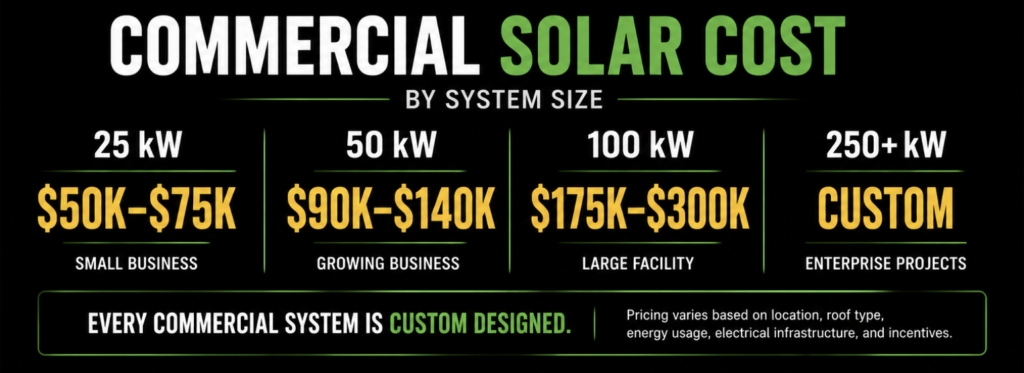
Here are typical installed cost ranges for commercial solar systems in North Carolina before incentives, based on 8MSolar’s current pricing:
| System Size | Estimated Gross Cost | After 30% ITC | Best Fit For |
| 50 kW | $87,500 to $112,500 | $61,250 to $78,750 | Small offices, retail, churches, small warehouses |
| 100 kW | $175,000 to $225,000 | $122,500 to $157,500 | Mid-size commercial buildings, schools, agricultural |
| 250 kW | $437,500 to $562,500 | $306,250 to $393,750 | Warehouses, manufacturing, large agricultural operations |
| 500 kW | $875,000 to $1,125,000 | $612,500 to $787,500 | Large industrial, municipal, multi-building campuses |
| 1 MW+ | Custom pricing | Custom pricing | Utility-scale commercial and industrial |
Rooftop system pricing ranges from $1.75 to $2.25 per watt installed depending on size and scope. Ground-mounted systems range from $2.25 to $2.75 per watt. Solar carport structures range from $3.75 to $4.75 per watt due to additional structural requirements. All figures are before incentives. Tax credit amounts depend on your business’s tax liability.
The ITC figures above are a starting point. When combined with MACRS depreciation and bonus depreciation, which we cover below, many businesses recover 50 to 65 cents of every dollar invested within the first year or two. That dramatically changes the effective cost and payback timeline.
What Impacts Commercial Solar Pricing?
System Size
The size of the system is the primary cost driver. Larger systems cost more in absolute terms but are generally more cost-efficient per watt because installation labor, permitting, and interconnection costs do not scale linearly with system size. For rooftop systems in the 50 kW to 1 MW range, 8MSolar’s pricing runs $1.75 to $2.25 per watt installed depending on size and scope. A 1 MW system will come in at the lower end of that range; a 50 kW system at the higher end. Ground-mounted systems typically run $2.25 to $2.75 per watt due to the additional structural and trenching work involved. Solar carport structures, which add covered parking in addition to energy generation, range from $3.75 to $4.75 per watt reflecting the more complex structural requirements.
Roof Type
Roof-mounted systems on standard flat commercial roofs with TPO or EPDM membranes use ballasted racking systems that require no penetrations and are among the most cost-efficient installations. Pitched roofs, metal roofs, tile, or roofs with significant penetrations or HVAC equipment require more complex mounting solutions that can add cost. Ground-mounted systems on open land are sometimes more cost-effective than complex roof installations and allow for optimal panel orientation regardless of building geometry.
Electrical Infrastructure
The condition and capacity of your existing electrical infrastructure matters significantly. A building with a modern, adequately sized electrical panel and metering equipment that can accommodate a large solar interconnection requires less electrical work. Older facilities with undersized panels, outdated wiring, or metering arrangements that need upgrading add cost to the project. This is one of the factors that a site assessment identifies early so there are no surprises at installation.
Building Height and Roof Access
Taller commercial buildings require additional safety equipment and logistics for rooftop installation, which affects labor costs. Single-story warehouses and agricultural buildings are generally the most straightforward and cost-efficient installations. Multi-story office buildings and industrial facilities may incur higher installation labor costs due to access complexity.
Ground Mount vs. Roof Mount
Ground-mounted commercial systems offer flexibility in orientation and tilt angle, which can improve production. They also avoid any roof penetration or loading considerations. However, ground mounts require land preparation, trenching for electrical conduit, and more robust structural foundations, which can add to upfront costs. For many agricultural operations and rural businesses with available land, ground mounts are the preferred solution.
Battery Storage
Adding battery storage systems to a commercial solar installation increases upfront cost but can significantly improve financial performance, particularly for businesses subject to demand charges or Time-of-Use billing. Commercial battery systems typically add $50,000 to $200,000 or more to a project depending on capacity. Battery storage also qualifies for the 30% ITC when installed alongside solar panels, reducing the net cost of the addition.
Commercial Solar Incentives Available in 2026
Federal and utility incentives are what make commercial solar such a compelling financial decision in 2026. Understanding how they stack is essential for calculating your true net cost.
Federal Investment Tax Credit (ITC)
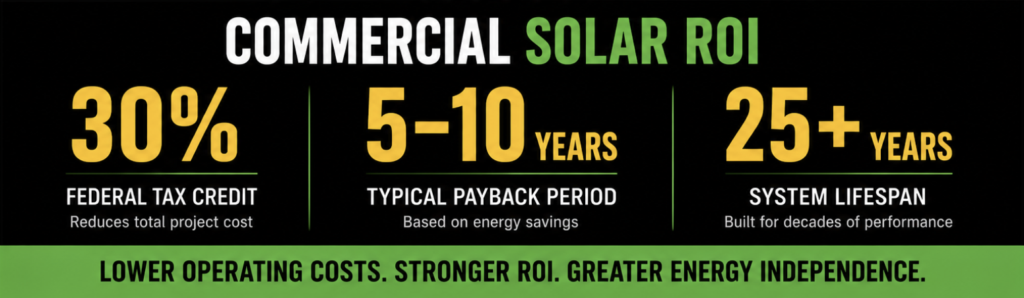
The 30% federal Investment Tax Credit applies to the full installed cost of a commercial solar system, including equipment, labor, engineering, and permitting. On a $200,000 system, that is $60,000 directly off your federal tax liability. The ITC is available through 2032 at the current 30% rate. Businesses must have sufficient tax liability to use the full credit, though unused portions can be carried forward to future tax years.
Accelerated Depreciation (MACRS)
The Modified Accelerated Cost Recovery System allows commercial solar owners to depreciate their system over five years rather than the full 25 to 30-year useful life. This front-loads significant tax deductions in the early years of ownership and substantially improves cash flow. Combined with the ITC, MACRS is one of the most powerful financial tools available to commercial solar owners.
Bonus Depreciation
In 2026, bonus depreciation is set at 40%, meaning businesses can deduct 40% of the system’s depreciable basis in the first year of ownership in addition to standard MACRS depreciation. This accelerates the tax benefit further. Bonus depreciation percentages have been declining from 100% in prior years, so acting sooner captures a larger first-year deduction. Your CPA can model exactly how MACRS and bonus depreciation apply to your business’s specific tax situation, and an experienced solar installer can help you coordinate that conversation before installation.
Local Utility Incentives
Duke Energy’s Commercial PowerPair incentive offers rebates for qualifying solar and battery installations. Program availability and funding vary, so confirming current program status with your installer is an important step in financial modeling. Additional state and local incentive programs may be available depending on your business type, location, and project size. The USDA Rural Energy for America Program (REAP) provides loan guarantees of up to 75% of eligible project costs plus grants covering up to 25% for rural small businesses and agricultural producers, making it one of the most powerful available programs for farms and rural commercial operations.
Commercial Solar ROI Examples
These are illustrative examples based on typical NC commercial projects. Actual results depend on your facility’s energy usage, roof conditions, and tax situation.
Example 1: Small Business Office
Profile: Professional services firm, 5,000 sq ft building, $1,800 average monthly electric bill, Duke Energy territory, flat commercial roof.
System size: 30 kW
Estimated gross cost: $65,000
After 30% ITC: $45,500
MACRS and bonus depreciation benefit (estimated): $18,000 to $22,000
Effective net cost after year-one tax benefits: $23,500 to $27,500
Estimated annual savings: $16,000 to $20,000
Estimated payback period: 1.5 to 2 years effective after tax benefits
25-year savings estimate: $450,000 to $550,000
Example 2: Warehouse Operation
Profile: Distribution facility, 50,000 sq ft, $8,500 average monthly electric bill, Duke Energy territory, large flat roof with good sun exposure.
System size: 150 kW
Estimated gross cost: $280,000
After 30% ITC: $196,000
MACRS and bonus depreciation benefit (estimated): $75,000 to $90,000
Effective net cost after year-one tax benefits: $106,000 to $121,000
Estimated annual savings: $65,000 to $85,000
Estimated payback period: 1.5 to 2 years effective after tax benefits
25-year savings estimate: $1.8M to $2.3M
Example 3: Agricultural Operation
Profile: Mid-size poultry farm, multiple barn buildings, $4,200 average monthly electric bill, rural Duke Energy territory, REAP grant eligible.
System size: 100 kW roof-distributed across barns
Estimated gross cost: $220,000
REAP grant (up to 25%): $55,000
After 30% ITC on remaining cost: additional $49,500
MACRS and bonus depreciation benefit (estimated): $38,000 to $45,000
Effective net cost after incentives and year-one tax benefits: $32,500 to $37,500
Estimated annual savings: $40,000 to $52,000
Estimated payback period: Under 1 year effective after all incentives
25-year savings estimate: $1.1M to $1.4M
Tax benefit figures are estimates and depend on your business’s specific tax profile. Consult your CPA to model the exact impact for your situation before making a final decision.
How Much Can Commercial Solar Save?
| System Size | Est. Monthly Savings | Est. Annual Savings | 25-Year Savings Estimate |
| 25 kW | $1,000 to $1,500 | $12,000 to $18,000 | $350,000 to $520,000 |
| 50 kW | $2,000 to $3,000 | $24,000 to $36,000 | $700,000 to $1.0M |
| 100 kW | $4,000 to $6,000 | $48,000 to $72,000 | $1.4M to $2.1M |
| 250 kW+ | $10,000+ | $120,000+ | $3.5M+ |
25-year figures account for estimated annual utility rate increases of 3 to 4 percent per year. Duke Energy commercial rates have been rising consistently, and that trend is expected to continue. Every rate increase improves the financial return on a solar investment made today.
What Is the Payback Period for Commercial Solar?
The simple payback period for commercial solar, calculated as net system cost divided by annual savings, typically ranges from 5 to 10 years before accounting for tax incentives. When ITC, MACRS, and bonus depreciation are factored in, the effective payback period for many businesses shrinks dramatically, sometimes to 2 to 4 years or even less for agricultural operations with REAP eligibility.
Payback period is also shortened by utility rate escalation. Every time Duke Energy raises commercial electricity rates, the energy your system produces becomes more valuable. A business with a 7-year simple payback at today’s rates may have an effective payback of 5 to 6 years once rate increases are modeled accurately. Payback projections that use only current rates underestimate the speed of return.
After payback, a commercial solar system with a 25 to 30-year lifespan continues producing energy savings for 15 to 20 or more additional years. The companies that made this decision several years ago are not second-guessing it. They are watching their energy costs remain stable while competitors absorb rate increases.
Commercial Solar Financing Options
Most businesses do not pay cash for a commercial solar system, nor should they have to. Several solar financing options are available that allow businesses to go solar with little or no upfront capital while still capturing ownership benefits and tax incentives.
Cash purchase produces the highest total return because there is no interest to pay, but it ties up capital that most businesses prefer to keep working in operations. The right choice for businesses with available capital and a strong preference for the simplest ownership structure.
Commercial solar loan allows businesses to own their system and claim all tax incentives while spreading the cost over time. 8MSolar now offers commercial solar loans directly, with terms designed so that monthly loan payments are structured to be offset by energy savings from day one. Loan terms typically run 7 to 20 years with current interest rates ranging from 4.5% to 9% depending on project size and borrower profile.
Power Purchase Agreement (PPA) allows a third-party company to own and operate the system on your property while you purchase the electricity it produces at a rate below your current utility rate. No upfront cost and no ownership responsibilities, but the tax incentives go to the system owner, not your business.
Solar lease is similar to a PPA in ownership structure. You pay a fixed monthly lease payment rather than a per-kWh rate. Lower upfront cost and predictable payments, but tax benefits go to the leasing company. Reviewing the solar lease vs. solar loan comparison can help you understand which structure fits your business’s goals.
Is Commercial Solar Worth It in North Carolina in 2026?
For most businesses with consistent electricity usage and adequate roof or ground space, yes. Here is why the fundamentals are compelling right now:
- Rising utility costs. Duke Energy commercial rates have been climbing and are expected to continue increasing. Every rate hike makes your solar investment more valuable and your payback period shorter.
- Significant tax advantages. The combination of the 30% ITC, MACRS depreciation, and 40% bonus depreciation in 2026 means businesses can recover a substantial portion of their investment through tax savings in year one. These incentives are not permanent at current levels.
- Long-term savings. A commercial solar system is a 25 to 30-year asset. The savings it generates compound over time as utility rates increase, producing returns that grow each year.
- Energy independence and resilience. Solar with battery storage reduces your exposure to grid disruptions that can halt operations. For businesses where power continuity is critical, energy resilience has real operational value beyond the financial return.
- Property value. Commercial properties with solar systems and documented energy savings are increasingly valued by buyers and tenants who factor operating costs into their decisions.
How 8MSolar Designs Commercial Solar Projects
8MSolar has been installing commercial solar across North Carolina and Virginia for over 20 years. Here is what the process looks like for a commercial project:
- Site assessment. Our engineering team evaluates your facility’s roof, electrical infrastructure, utility metering, and available space. We model your energy usage against production potential to design a system sized for your actual needs.
- Utility analysis. We review your rate structure, demand charges, and any applicable utility programs including Duke Energy’s commercial incentives to identify savings opportunities beyond basic energy offset.
- Engineering and design. Our in-house engineers produce a fully engineered system design including structural load calculations, electrical diagrams, and production modeling. Every design is reviewed and stamped by a licensed engineer before permit submission.
- Incentive guidance. We walk you through the ITC, MACRS, bonus depreciation, and applicable utility incentives, and we coordinate with your CPA so you have the documentation needed to claim every available benefit.
- Installation. Our team handles permitting, utility interconnection, and installation. You do not manage subcontractors or coordinate between multiple vendors.
- Long-term support. We monitor system performance, address warranty issues, and remain your service contact for the life of the system.
Every commercial solar project is different, but the potential savings can be significant. Schedule a free commercial solar consultation with 8MSolar to explore your options and see what incentives may be available for your business.
Frequently Asked Questions
How much does commercial solar cost per watt?
8MSolar’s rooftop commercial solar pricing runs $1.75 to $2.25 per watt installed for systems between 50 kW and 1 MW, depending on size and scope. Ground-mounted systems range from $2.25 to $2.75 per watt. Solar carport structures run $3.75 to $4.75 per watt due to additional structural requirements. All figures are before incentives.
How much does a 100 kW solar system cost?
A 100 kW rooftop commercial solar system in North Carolina typically costs $175,000 to $225,000 installed before incentives based on 8MSolar’s current pricing of $1.75 to $2.25 per watt. After the 30% ITC, the net cost drops to approximately $122,500 to $157,500. MACRS and bonus depreciation can reduce the effective cost further in the first year. A comparable ground-mounted system at $2.25 to $2.75 per watt would run $225,000 to $275,000 before incentives.
What incentives are available for commercial solar?
In 2026, the primary incentives are the 30% federal ITC, MACRS five-year accelerated depreciation, and 40% bonus depreciation. Duke Energy commercial utility incentives and USDA REAP grants for rural businesses and agricultural operations add additional value for qualifying projects.
How long does commercial solar take to pay for itself?
Simple payback without incentives is typically 5 to 10 years for most NC commercial projects. After accounting for the ITC, MACRS, and bonus depreciation, effective payback for many businesses shrinks to 2 to 4 years. Agricultural operations using REAP grants may see effective payback under 2 years.
Can businesses finance solar?
Yes. Commercial solar loans, PPAs, and leases are all available. 8MSolar offers commercial solar loans directly, structured so monthly payments are designed to be offset by energy savings from day one. Businesses that finance through a loan retain full ownership and all tax benefits.
Is commercial solar tax deductible?
Yes. Commercial solar qualifies for the 30% ITC, which directly reduces federal tax liability. The system also qualifies for MACRS depreciation and bonus depreciation, which generate additional tax deductions in the years following installation. Consult your CPA to model the exact impact for your business.
Does commercial solar increase property value?
Commercial properties with owned solar systems and documented energy savings are increasingly viewed as more valuable by buyers and tenants who factor operating costs into their decisions. The impact varies by market and property type, but a solar system that reduces operating costs by $50,000 or more annually has clear value on a commercial property’s income statement.
How much can commercial solar reduce electric bills?
Energy offset varies significantly depending on available roof or ground space, maximum demand, energy usage patterns, and the rate structure your business is on. In practice, 8MSolar designs commercial systems that offset anywhere from 30% to 90% of a facility’s electricity consumption. Businesses with high energy usage relative to available roof space tend toward the lower end of that range; those with large roofs and moderate usage can achieve higher offsets. Your exact offset potential is determined during the site assessment and utility analysis.