Understanding Solar Panel and Battery Storage Compatibility
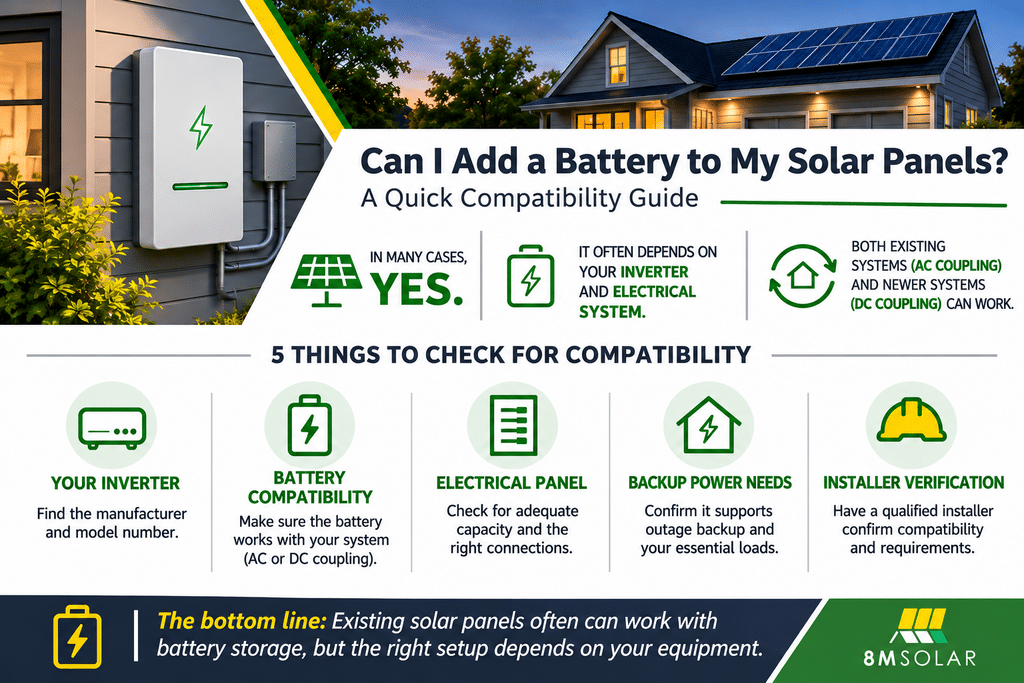
Can you add battery storage to existing solar panels? In most cases, yes. Many existing solar panel systems can be upgraded with battery storage, even if they weren’t originally designed for batteries. However, compatibility depends primarily on the solar inverter, electrical configuration, and battery system you choose.
Homeowners with string inverters or microinverters may be able to add an AC-coupled battery without replacing their existing solar panels. Systems using compatible hybrid inverters may support DC-coupled battery storage, although some installations require additional equipment or inverter upgrades.
Before adding a battery, it’s important to identify your inverter model, review your solar system’s specifications, and determine whether you want backup power during outages or simply to store excess electricity for later use.
Below, we’ll explain how to check battery compatibility, compare inverter types, and explore the options for adding storage to an existing solar installation.
Table of Contents
- Understanding Solar Panel and Battery Storage Compatibility
- How to Check if Your Solar Panels Are Battery Compatible
- Solar Panel Specifications That Affect Battery Compatibility
- Types of Battery Storage Systems
- Factors Affecting Compatibility
- Types of Solar Battery Systems
- Inverter Technology and Compatibility
- Retrofitting Existing Solar Systems
- Popular Solar and Battery Storage Combinations
- Future-Proofing Your Solar Installation
- Frequently Asked Questions About Solar Panel and Battery Compatibility
- Can I Add a Battery to My Existing Solar Panels?
- Do I Need to Replace My Solar Panels to Add a Battery?
- Can Any Solar Battery Work With Any Solar Panel?
- Can I Add a Tesla Powerwall to an Existing Solar System?
- Can I Use Solar Panels During a Power Outage With a Battery?
- Is AC Coupling or DC Coupling Better for an Existing Solar System?
- The 8MSolar Advantage

How to Check if Your Solar Panels Are Battery Compatible
Before choosing a solar battery, review these five factors:
- Identify your solar inverter. Find the manufacturer and model number of your existing inverter. This is one of the most important details for determining battery compatibility.
- Check the battery’s compatibility requirements. Some battery systems work with existing solar inverters through AC coupling, while others require specific hybrid inverters or approved equipment combinations.
- Review your electrical system. Your main electrical panel, available breaker capacity, service configuration, and existing solar connections can affect installation requirements.
- Determine whether you need backup power. If you want electricity during outages, confirm that the battery system supports backup operation and includes the necessary isolation and control equipment.
- Ask a qualified installer to verify the system. An installer can review equipment specifications, manufacturer compatibility requirements, local electrical codes, and utility interconnection rules.
The key takeaway: Having an older solar installation does not automatically mean you need to replace your panels to add battery storage.
Solar Panel Specifications That Affect Battery Compatibility
Before integrating battery storage with your solar system, it’s important to understand the key solar panel specifications that influence compatibility:
Power Output (Watts)
The power output of your solar panels, measured in watts (W), indicates how much electricity they can produce under ideal conditions. Most residential solar panels today range from 350W to 500W, with high-efficiency models reaching up to 550W. Your solar array’s total output influences how much electricity is available to power your home and charge a battery, but actual charging speed also depends on sunlight conditions, battery charging limits, inverter capacity, and household electricity use.
Voltage (V)
Solar panels produce direct current (DC) electricity, and their operating voltage depends on the specific panel model and installation conditions. In a grid-connected solar system, multiple panels may be connected together to create a higher-voltage string, while microinverter systems convert electricity at the individual panel level. Battery compatibility depends on the electrical specifications of the complete system and the equipment connecting the solar array to the battery, rather than simply matching an individual panel’s voltage to the battery’s voltage.
Current (Amperes)
The current, measured in amperes (A), represents the flow of electricity from your solar panels. It’s calculated by dividing the power output by the voltage. Battery charging systems have to be able to handle the current produced by your solar array.
Maximum Power Point (MPP)
The MPP is the prime operating point where your solar panel produces maximum power. This is crucial for matching with charge controllers and inverters that manage the flow of energy between your panels and batteries.
Temperature Coefficient
This specification indicates how much your panel’s performance decreases as temperature increases, usually expressed as a percentage per degree Celsius. Lower temperature coefficients are beneficial for battery charging consistency, especially in hot climates.
Types of Battery Storage Systems
Several battery technologies are available for pairing with solar panels, each with unique characteristics:
Lithium-Ion Batteries
Currently the most popular choice for solar storage, lithium-ion batteries offer high energy density, excellent efficiency, and long cycle life. The main types are Lithium Iron Phosphate (LiFePO4), known for safety and long cycle life (typically 5,000-8,000 cycles), and Lithium Nickel Manganese Cobalt Oxide (NMC), which offers high energy density and is common in electric vehicles and some home storage systems.
Lead-Acid Batteries
A more traditional and affordable option, lead-acid batteries require more maintenance and have shorter lifespans than lithium-ion batteries. These include Flooded Lead-Acid (FLA), Sealed Lead-Acid (SLA), and Absorbent Glass Mat (AGM) variants, each with different maintenance requirements and performance characteristics.
Emerging Battery Technologies
Newer options include Flow Batteries, suitable for large-scale applications with long discharge times, and Sodium-Ion Batteries, a promising technology with potential for lower costs and improved sustainability.
Factors Affecting Compatibility
Several factors determine whether your solar panels will work well with a battery storage system:
Voltage Matching
The voltage of your solar array should be compatible with your battery system’s voltage. For instance, a 48V battery system would typically require a solar array with a voltage output that can be appropriately managed to match the battery voltage.
Power Output
Your solar array’s power output should be sufficient to charge your battery system effectively. An undersized array may not fully charge your batteries, while an oversized array may require additional charge controllers.
Charge Controller Compatibility
The charge controller mediates between your solar panels and batteries. It needs to be compatible with your solar array’s specifications and your battery system’s requirements. Modern MPPT (Maximum Power Point Tracking) controllers are preferred for their efficiency and versatility.
Inverter Type
The inverter in your system plays a crucial role in compatibility. Three main types include:
- String Inverters: Traditional inverters that convert DC from the entire solar array to AC.
- Microinverters: Small inverters attached to each individual solar panel.
- Hybrid Inverters: Specifically designed to work with both solar panels and battery storage systems.
Hybrid inverters offer the most straightforward integration of solar panels with batteries, but other configurations are possible with additional equipment.
System Architecture
The overall architecture of your solar-plus-storage system affects compatibility:
- AC Coupled: Solar panels and batteries are connected on the AC side of the system.
- DC Coupled: Solar panels and batteries are connected on the DC side of the system.
Each architecture has advantages and may be more suitable for certain systems or retrofits.
| Feature | AC-coupled battery | DC-coupled battery |
|---|---|---|
| Existing solar inverter | Often retained | May need modification or replacement |
| Typical use | Existing solar retrofits | New solar-plus-storage installations and some retrofits |
| Energy conversion | Additional conversions may occur | May reduce some conversion losses |
| Backup power | Possible with compatible equipment | Possible with compatible equipment |
| Key consideration | Battery and inverter integration | Hybrid inverter and DC-side compatibility |

Types of Solar Battery Systems
When considering battery storage for your solar panels, you’ll encounter various system types:
Off-Grid Systems
Off-grid systems operate independently of the electrical grid, relying entirely on solar panels and batteries for power. These systems require careful sizing of the solar array and battery bank to guarantee sufficient power generation and storage.
Compatibility Considerations:
- Solar panels have to be sized to power immediate loads and charge batteries.
- Battery capacity must be large enough to provide power during periods of low solar production.
- All components must be rated for off-grid use and compatible with each other.
Grid-Tied Systems with Battery Backup
These systems remain connected to the grid but include battery storage for backup power during outages or for optimizing energy use.
Compatibility Considerations:
- The inverter needs to be capable of managing both grid and battery connections.
- The system may require additional hardware for seamless switching between grid and battery power.
- Solar panel output should be balanced with battery storage capacity and typical energy usage patterns.
Self-Consumption Systems
These systems prioritize using solar energy on-site and storing excess for later use, minimizing reliance on the grid.
Compatibility Considerations:
- The energy management system must be compatible with the solar inverter and battery system.
- Solar panel capacity should be matched with typical daily energy consumption and battery storage capacity.
Virtual Power Plant (VPP) Ready Systems
These advanced systems allow homeowners to participate in grid services by aggregating their solar and battery resources.
Compatibility Considerations:
- All components must be compatible with the VPP platform’s communication protocols.
- The system may require specific inverter and battery models approved by the VPP operator.
Inverter Technology and Compatibility
| Existing inverter type | Can you add battery storage? | Typical approach |
|---|---|---|
| String inverter | Usually, yes | Add an AC-coupled battery system or upgrade equipment |
| Microinverters | Usually, yes | Use a compatible AC-coupled battery |
| Hybrid inverter | Often, yes | Connect an approved battery using the supported configuration |
| Battery inverter | Part of the storage system | Works alongside compatible solar equipment |
Inverters are critical in solar-plus-storage systems, and their compatibility with both solar panels and batteries is essential:
String Inverters
String inverters convert DC electricity from a string of solar panels into AC electricity for home use or grid export.
Compatibility with Battery Storage:
- Not directly compatible with batteries.
- Require additional components (e.g., battery inverter, charge controller) to integrate battery storage.
- May be suitable for AC-coupled battery systems.
Microinverters
Microinverters are small inverters attached to each individual solar panel, converting DC to AC at the panel level.
Compatibility with Battery Storage:
- Not directly compatible with DC-coupled battery systems.
- Can work with AC-coupled battery solutions.
- May require additional equipment for battery integration.
Hybrid Inverters
Hybrid inverters are designed to work with solar panels and battery storage systems, making them ideal for integrated solar-plus-storage installations.
Compatibility with Battery Storage:
- Built-in battery charging and management capabilities.
- Often compatible with specific battery models or chemistries.
- May support both AC and DC coupling of batteries.
Battery Inverters
Battery inverters convert DC power from batteries to AC power for home use and are often used with string inverters in retrofit situations.
Compatibility with Solar Panels:
- Not directly connected to solar panels.
- Work alongside existing solar inverters in AC-coupled systems.
When assessing inverter compatibility, consider the power rating (ensuring it can handle your solar array and battery system), voltage range compatibility, and communication protocols. Also evaluate monitoring capabilities, availability of firmware updates, and certification to relevant safety and grid connection standards.
Retrofitting Existing Solar Systems
Many homeowners with existing solar installations want to add battery storage. Here’s what you need to know about retrofitting:
Assessing Your Current System
- Inverter Type: Determine if you have a string inverter, microinverters, or power optimizers.
- System Age: Older systems may require more significant modifications.
- Available Space: Ensure you have space for batteries and additional equipment.
- Electrical Panel Capacity: Your panel may need upgrades to accommodate battery storage.
Retrofit Options
AC Coupling
- Connects battery storage to the AC side of an existing solar installation.
- Can allow homeowners to keep their existing solar panels and solar inverter.
- Often provides a practical option for adding batteries to established grid-connected systems.
- Requires compatible battery equipment, electrical connections, and controls, particularly when backup power is desired.
DC Coupling
- Connects solar generation and battery storage through compatible DC-side equipment, often including a hybrid inverter.
- Can reduce some electricity conversion losses in appropriately designed systems.
- May require replacing or modifying existing equipment, depending on the solar inverter and battery configuration.
- Requires verification of equipment compatibility, voltage limits, and manufacturer requirements.
Partial System Replacement
- Replace key components (e.g., inverter) while keeping existing solar panels.
- Can improve overall system efficiency and compatibility.
- May be cost-effective for older systems nearing inverter replacement time.
Considerations for Retrofitting
When retrofitting, be aware of potential efficiency loss in AC-coupled systems and ensure inverter compatibility with new components. Choose appropriate battery sizing for your existing solar system, investigate available incentives and permit requirements, and select solutions that allow for future expansion as your energy needs grow.

Popular Solar and Battery Storage Combinations
Several manufacturers offer integrated solar and storage solutions designed for peak compatibility:
Tesla
Tesla offers integrated solar and storage with their Solar Roof or solar panels and Powerwall battery.
Compatibility Notes:
- Tesla solar panels are designed to work seamlessly with Powerwall batteries.
- The system uses a Tesla inverter that manages solar and battery operations.
- Tesla Powerwall 3 can be integrated with new or existing solar installations using supported AC-coupled or DC-coupled configurations. It includes an integrated solar inverter and can work with many third-party solar inverter systems, although compatibility depends on the existing equipment and installation requirements.
FranklinWH
FranklinWH offers residential battery storage systems that can be integrated with compatible solar installations, including certain existing grid-connected systems.
FranklinWH’s residential storage lineup includes the aPower 2 and aPower S, providing additional options for homeowners considering solar battery storage or upgrading an existing system.
Compatibility Notes:
- FranklinWH battery systems can support solar-plus-storage installations using compatible AC-coupled configurations.
- The system’s energy management equipment coordinates battery operation, solar generation, and household electricity use.
- Compatibility and backup capabilities depend on the existing solar inverter, electrical configuration, and selected FranklinWH equipment.
Homeowners considering this option can learn more about the Franklin aPower2 battery.
Enphase
Enphase offers microinverters and residential battery storage systems, including the IQ Battery 5P and the newer IQ Battery 10C.
Compatibility Notes:
- The IQ Battery 10C provides 10 kWh of storage capacity and can be expanded up to 80 kWh.
- Enphase IQ Batteries can integrate with compatible Enphase microinverter systems.
- As of 2026, the IQ Battery 10C also supports certain existing third-party solar installations without requiring homeowners to replace their current solar equipment.
- Battery integration and backup capabilities depend on the system’s configuration and approved equipment.
Panasonic
Panasonic previously offered EverVolt solar panels and battery storage systems designed for residential solar installations. However, the company has discontinued its solar and battery storage business line.
Homeowners with existing Panasonic EverVolt systems can continue receiving customer support, and Panasonic has stated that applicable product warranties will be honored.
Compatibility Notes:
- Existing Panasonic EverVolt batteries may be compatible with certain solar installations using approved inverter configurations.
- Compatibility depends on the specific battery model, inverter, and system architecture.
- Homeowners with existing Panasonic equipment should confirm support and replacement options before expanding their systems.
LG Energy Solution (Batteries)
LG Energy Solution produces battery storage solutions compatible with various solar systems.
Compatibility Notes:
- LG Energy Solution batteries (e.g., RESU series) can be paired with many solar panel brands using compatible hybrid inverters.
- Their batteries work with a wide range of solar systems.
Q CELLS
Q CELLS offers solar panels and integrated home energy storage solutions, including the Q.HOME CORE and Q.HOME CORE G3 systems.
Compatibility Notes:
- The Q.HOME CORE G3 is an AC-coupled residential battery system with 13.1 kWh of storage capacity, expandable to approximately 26.2 kWh.
- The system provides up to 7.6 kW of continuous backup power and includes a 15-year product warranty.
- Q.HOME CORE G3 integrates with compatible Qcells solar equipment and energy management components.
- Qcells solar panels can also be paired with certain third-party battery systems using compatible inverters.
When considering brand-specific solutions, keep in mind warranty integration (some brands offer more comprehensive coverage for integrated systems), performance optimization benefits, expansion flexibility for future needs, and monitoring integration for unified system oversight.

Future-Proofing Your Solar Installation
When installing a new solar system or upgrading an existing one, consider these factors to guarantee compatibility with future battery storage options:
1. Choose a Hybrid Inverter
Even if you’re not ready for battery storage yet, opting for a hybrid inverter can make future integration easier. Look for inverters with built-in battery management capabilities, compatibility with different battery chemistries, and the ability to handle various system architectures.
2. Plan for Adequate Panel Capacity
Install enough solar panel capacity to meet both current energy needs and future battery charging requirements. Consider higher wattage panels and high-efficiency options to maximize power generation, especially if your roof space is limited.
3. Consider Your Electrical Panel
Make sure your electrical panel has the capacity to accommodate future battery installation. This may mean checking for available breaker spaces or considering an upgrade to a 200A or 400A panel if needed. Smart electrical panels with integrated energy management are also worth exploring.
4. Plan for Battery Location and Scalability
Identify a suitable location for future battery installation like garages or basements with appropriate temperature control, and choose scalable solutions that allow for system expansion. Look for modular battery systems and inverters that can handle increased capacity as your energy needs grow.

Frequently Asked Questions About Solar Panel and Battery Compatibility
Can I Add a Battery to My Existing Solar Panels?
Yes, many existing solar installations can be upgraded with battery storage. Compatibility depends on the inverter, battery system, electrical equipment, and installation requirements. Some systems can retain their existing solar inverter through AC coupling.
Do I Need to Replace My Solar Panels to Add a Battery?
Usually not. Many battery retrofits can use the solar panels already installed on your roof. However, your inverter or other electrical components may need to be upgraded or modified.
Can Any Solar Battery Work With Any Solar Panel?
Not automatically. The most important compatibility requirements generally involve the inverter, battery controls, electrical specifications, and approved equipment combinations rather than the solar panel brand alone.
Can I Add a Tesla Powerwall to an Existing Solar System?
A Tesla Powerwall can be added to many existing solar installations, subject to model-specific compatibility and installation requirements. A qualified installer can determine whether your current inverter and electrical system are suitable.
Can I Use Solar Panels During a Power Outage With a Battery?
Yes, if the system includes compatible equipment configured for backup operation. The available backup power depends on battery capacity, inverter output, household electricity demand, and the system’s ability to operate safely when disconnected from the grid.
Is AC Coupling or DC Coupling Better for an Existing Solar System?
AC coupling is often a practical option for retrofitting an existing solar installation because it may allow the current solar inverter to remain in place. DC coupling may be appropriate in other situations, particularly when installing or upgrading compatible hybrid inverter equipment.
The 8MSolar Advantage
At 8MSolar, we don’t just install solar panels; we create integrated energy systems tailored to your specific needs, budget, and sustainability goals. Our approach combines customized solutions that maximize energy independence, cutting-edge technology through partnerships with leading manufacturers, and support from initial consultation to post-installation service. We offer regulatory expertise to navigate local requirements and incentives, while maintaining a long-term partnership to keep you informed about technological advancements that could enhance your system’s performance.
By choosing 8MSolar, you’re gaining a partner in your journey towards energy independence and sustainability. Our team’s expertise ensures that your solar-plus-storage system is not only compatible and efficient but also future-ready.
Whether you’re looking to power your home or business, 8MSolar has the knowledge, skills, and dedication to transform your property into an energy-efficient, resilient power station. We harness the power of the sun and modern battery technology to create a sustainable energy solution that serves you for years to come.
Don’t navigate the complex world of solar energy alone. Trust 8MSolar’s professional team to guide you towards a brighter and more sustainable energy future. Contact us today to start your solar journey with the experts who truly understand the power of the sun.