
LG RESU solar batteries are designed to store electricity from residential solar panel systems, helping homeowners use more of their solar energy and maintain backup power when properly configured. The RESU lineup includes models such as the 10H, 10H Prime, and 16H Prime, with different storage capacities and power outputs.
Are LG solar batteries worth it? LG RESU batteries offer compact energy storage, established lithium-ion technology, and compatibility with certain solar inverter systems. However, homeowners should also consider installation costs, model-specific warranties, inverter compatibility, product recall history, and current availability before choosing an LG battery.
This review examines LG RESU battery specifications, performance, costs, warranties, and potential alternatives to help homeowners decide whether an LG solar battery is right for their needs.
Table of Contents
- The Evolution and Impact of LG RESU Batteries
- Performance Characteristics and Real-World Applications
- LG Solar Battery Pros and Cons
- Warranty Coverage and Long-Term Reliability
- LG RESU Battery Recalls and Safety Considerations
- Financial Considerations and Market Positioning
- Installation Considerations and Technical Requirements
- Practical Applications and Use Cases
- Future Outlook and Technology Evolution
- Making the Decision: Is RESU Right for You?
- Frequently Asked Questions About LG Solar Batteries
- The Future of Home Energy Storage
- Final Verdict: Is an LG Solar Battery Right for You?
The Evolution and Impact of LG RESU Batteries
When LG ventured into the home energy storage market in 2018, it brought with it six decades of electronics expertise. This strategic move positioned the company as a leading force in residential battery solutions. The centerpiece of this expansion is the LG Residential Energy Storage Unit (RESU), a battery system that has revolutionized how homeowners store and utilize solar energy.
LG’s involvement in residential energy storage has evolved alongside changes in its broader energy business. LG Electronics exited solar panel manufacturing in 2022, while LG Energy Solution, which was spun off from LG Chem in 2020, has continued developing lithium-ion batteries and energy storage technologies. Although LG Electronics has separately announced plans to phase out its energy storage systems business, LG Energy Solution maintains its own battery operations, including the RESU product family. Homeowners considering an LG battery should confirm current model availability and support with an authorized installer.
Understanding the Technical Excellence of LG RESU Batteries
Advanced Battery Chemistry and Architecture
At the heart of the RESU series lies advanced lithium-ion battery technology featuring nickel-manganese-cobalt (NMC) cells.
These batteries distinguish themselves through superior safety features, enhanced efficiency, and extended lifespans compared to conventional lead-acid alternatives. The NMC chemistry provides higher energy density, allowing for more compact storage solutions while maintaining impressive power output capabilities.
Each RESU unit incorporates LG’s proprietary Battery Management System (BMS), a control system that optimizes energy flow, protects against overcharging or deep discharge, and ensures longevity. The BMS works with the Power Conditioning System (PCS) to maintain peak performance and convert stored energy for household use with minimal losses.
Storage Capacity and Model Options
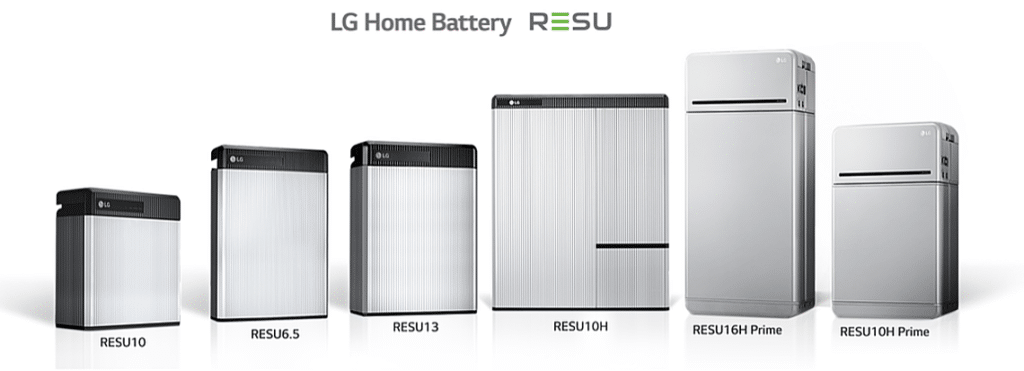
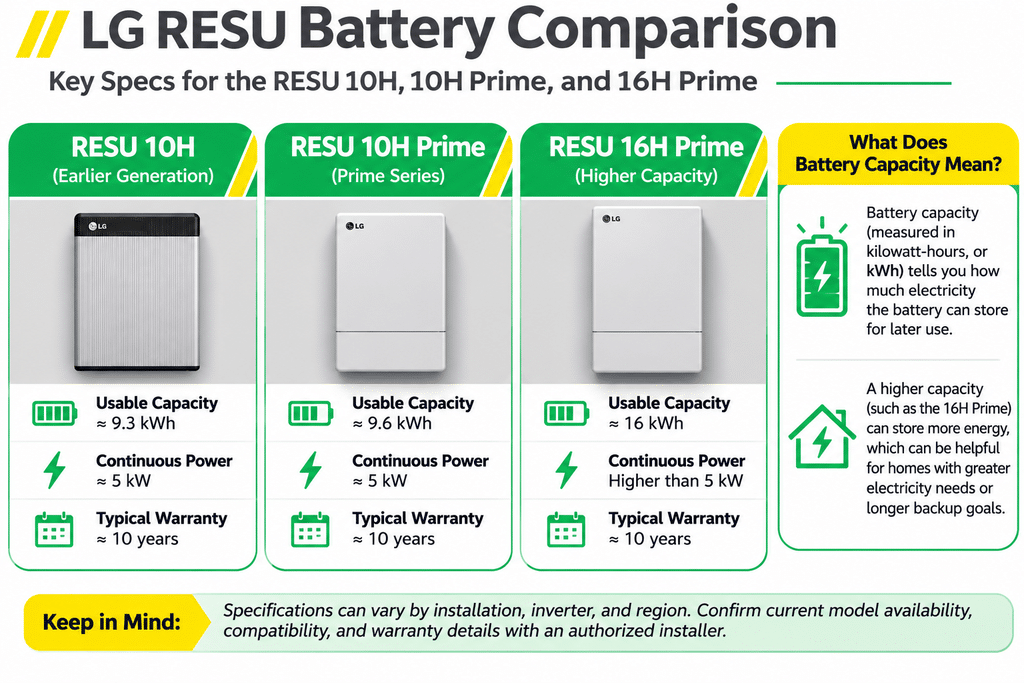
The LG RESU lineup includes several battery models with different storage capacities. The original RESU 10H provides approximately 9.3 kWh of usable storage, while the RESU 10H Prime offers approximately 9.6 kWh and the RESU 16H Prime offers approximately 16 kWh. These differences matter because battery capacity determines how much electricity a system can store, while power output determines how many appliances it can support simultaneously. Homeowners should also confirm whether a specific model is currently available and compatible with their solar equipment.
These capacities translate to practical energy storage suitable for partial and whole-home backup solutions. The Prime models feature enhanced specifications, including improved round-trip efficiency that reaches 94.5% in some models, guaranteeing minimal energy loss during charge and discharge cycles.
Performance Characteristics and Real-World Applications
Power Output and Efficiency
LG RESU batteries offer different power outputs depending on the model. The RESU 10H and 10H Prime are commonly listed with approximately 5 kW of continuous power output, while the 16H Prime offers higher output capabilities. These specifications influence how many household appliances a battery can support at once, especially during a power outage. Actual system performance also depends on the connected inverter, installation configuration, and operating conditions.
The superior round-trip efficiency of these systems makes sure that very little energy is lost during the conversion process. This efficiency translates directly to cost savings and better system performance over the battery’s lifespan.
Environmental Resilience and Installation Flexibility
With an IP55 enclosure rating, RESU batteries demonstrate remarkable resilience to environmental factors. They can withstand dust ingress and water jets from any direction, making them suitable for indoor and outdoor installations.
The compact design and relatively lighter weight compared to competitors simplify installation processes, reducing associated labor costs and expanding installation locations.
Compatibility and Integration
RESU batteries are designed with broad compatibility in mind. Broad Compatibility: LG batteries are compatible with various brands of solar inverters, including SMA, Fronius, Huawei, and SolarEdge StorEdge, seeing that they fit into your existing solar setup.
Some LG RESU batteries can be integrated into existing solar installations, depending on the battery model and inverter compatibility. However, not every inverter supports every LG battery. Homeowners should have a qualified installer review their existing equipment to determine whether additional components or upgrades are necessary.
| LG RESU advantages | LG RESU disadvantages |
|---|---|
| Compact lithium-ion battery design | Model-specific inverter compatibility |
| Multiple storage-capacity options | Professional installation required |
| Can support solar self-consumption | Significant upfront installation cost |
| Backup power when properly configured | Warranty terms vary by model |
| Established battery manufacturer | Recall history for certain older models |
LG Solar Battery Pros and Cons
LG solar batteries offer several advantages for homeowners interested in storing solar energy, but there are also important considerations before purchasing a system.
Pros of LG Solar Batteries
- Multiple storage capacities: LG offers battery options suitable for different household energy requirements.
- Backup power potential: When installed with compatible backup equipment, LG batteries can help keep essential appliances operating during power outages.
- Established battery manufacturer: LG Energy Solution has extensive experience developing lithium-ion battery technology.
- Energy management flexibility: Battery storage can help homeowners use more of their solar electricity and reduce grid consumption during higher-rate periods.
- Warranty coverage: LG provides manufacturer warranties, with terms that vary by model.
Cons of LG Solar Batteries
- Installation costs: Battery storage requires an upfront investment, and additional equipment or electrical upgrades may increase the total price.
- Compatibility requirements: Not every LG battery works with every solar inverter, so system compatibility must be verified.
- Limited backup duration: A single battery may not provide enough energy to power an entire home through an extended outage.
- Model availability: Availability can vary depending on the product generation, region, and installer.
- Safety and recall history: Certain older LG RESU batteries have been subject to recalls, making model and serial-number verification important.
For homeowners comparing solar batteries, the best choice depends on storage capacity, power output, compatibility, warranty terms, and the total installed cost rather than brand reputation alone.
Warranty Coverage and Long-Term Reliability
Comprehensive Protection
LG RESU batteries have historically been offered with limited warranties of approximately 10 years, although the specific terms depend on the model, purchase date, installation requirements, and applicable warranty document. Earlier RESU models have been associated with a minimum retained capacity of 60% under specified conditions, while certain Prime models have offered higher capacity-retention guarantees.
Battery warranties may also include limits on total energy throughput, along with requirements for proper installation and operation. Homeowners should review the warranty for their exact RESU model rather than assuming that all LG batteries provide identical coverage.
This enhanced warranty demonstrates LG’s confidence in their product quality and commitment to customer satisfaction.
Real-World Performance and Degradation
Independent testing has shown that RESU batteries often exceed manufacturer specifications. LG Chem batteries show only a 16% capacity drop after the 3-year worth of cycles tested which makes the approximate 10-year lifespan pretty doable. This performance data suggests that RESU batteries should easily meet their warranty obligations under normal operating conditions, providing homeowners with reliable energy storage throughout the warranty period.

LG RESU Battery Recalls and Safety Considerations
LG Energy Solution has issued safety recalls and replacement programs for certain residential energy storage batteries because of potential overheating and fire hazards. These recalls affect specific models and production batches rather than every LG RESU battery.
Homeowners who already own an LG RESU battery should check their model and serial number against LG Energy Solution’s official recall information. If a battery is affected, owners should follow the manufacturer’s instructions and contact an authorized service provider rather than attempting to inspect or repair the battery themselves.
For anyone considering an LG RESU installation, it’s important to confirm the battery’s recall status, available warranty coverage, installer qualifications, and compatibility with the rest of the solar system.
Financial Considerations and Market Positioning
Investment Analysis
The investment in a RESU system has been a good decision for many homeowners. The 10H models range from $9,000 to $12,000 installed, while the larger 16H model can reach $16,000 with installation. This translates to approximately $900-1,100 per kWh of storage capacity. The LG Chem RESU 10H costs between $9,500 and $13,000 with a full system installation. The RESU 10H battery model has 9.3 kWh of usable capacity, along with a power rating of 5 kW. The LG Chem RESU 16H Prime costs between $11,000 and $15,000 with a full system installation.
While these costs exceed some newer market entrants, the premium pricing reflects superior build quality, established reliability, and the backing of a globally recognized brand. The return on investment comes from energy savings and enhanced energy security.
LG Solar Battery vs. Tesla Powerwall: Which Is Better?
When comparing LG solar batteries with alternatives such as the Tesla Powerwall and Generac PWRcell, homeowners should consider more than storage capacity alone.
LG’s RESU batteries offer multiple storage capacities and can integrate with compatible solar equipment. However, inverter requirements, backup capabilities, and installation costs vary by model and system configuration.
Homeowners comparing LG RESU batteries with newer storage options should evaluate more than battery capacity alone. Systems such as the Tesla Powerwall 3, Franklin aPower2, and Enphase IQ Battery offer different approaches to power output, expansion, inverter integration, and backup capabilities. An LG RESU system may still be worth considering when compatible equipment and qualified support are available, but the best choice depends on current product availability, installation costs, and the home’s energy requirements.
The Tesla Powerwall offers an alternative approach to home battery storage, with integrated energy management and backup capabilities. Generac’s PWRcell system provides another option for homeowners interested in solar energy storage and backup power.
Installation Considerations and Technical Requirements
Professional Installation Necessity
While RESU batteries feature relatively straightforward installation processes compared to some competitors, professional installation is essential.
The high-voltage DC nature of these systems, combined with complex grid integration requirements, demands certified installers who understand electrical code requirements and manufacturer specifications.
Site Preparation and Environmental Factors
Successful RESU installations require careful site preparation. The chosen location has to provide ventilation, protection from direct sunlight to prevent thermal stress, and structural support to handle the battery’s weight. Indoor installations benefit from climate control, while outdoor installations may require weatherproofing measures beyond the built-in IP55 protection.
Practical Applications and Use Cases
Residential Backup Power
RESU batteries excel in providing backup power during grid outages. The combination of high power output and energy storage capacity allows homeowners to maintain essential services during power disruptions. Critical systems like refrigeration, lighting, communications, and medical equipment can operate seamlessly, providing peace of mind during emergencies.
Time-of-Use Optimization
For homeowners subject to time-of-use electricity rates, RESU systems offer big cost-saving opportunities. By storing excess solar energy during low-rate periods and deploying it during peak pricing hours, households can reduce their electricity bills while minimizing grid dependence.
Grid Independence and Net Metering
In regions with favorable net metering policies or those seeking more energy independence, RESU batteries provide the storage capacity necessary to maximize solar self-consumption. This reduces reliance on utility power and can accelerate the return on investment for solar installations.
Future Outlook and Technology Evolution
Continuous Innovation
LG Energy Solution continues investing in research and development, with a focus on improving energy density, reducing costs, and extending battery lifespans. The transition from standard 10H models to the Prime series demonstrates this commitment to innovation, with each generation bringing improvements in performance and reliability.
Market Trends and Adoption
As electricity prices rise and grid reliability becomes challenged by extreme weather events, the demand for home energy storage is expected to grow. RESU batteries are well-positioned to capture this growing market, supported by LG’s global reach and established distribution networks.

Making the Decision: Is RESU Right for You?
Evaluating Your Needs
When considering an RESU system, homeowners should evaluate their energy consumption patterns, backup power requirements, and budget constraints. The modular nature of RESU batteries allows for scalable solutions—starting with a single unit and expanding as needs grow or finances permit.
Installation and Support Network
LG’s network of certified installers ensures professional installation and ongoing support across most regions. This infrastructure provides peace of mind for homeowners, knowing that expert help is available for installation, maintenance, and any potential warranty claims.

Frequently Asked Questions About LG Solar Batteries
Are LG RESU Batteries Good?
LG RESU batteries offer compact lithium-ion energy storage, multiple capacity options, and compatibility with selected solar inverter systems. However, homeowners should evaluate the specific model’s warranty, availability, installation cost, and compatibility before purchasing.
How Long Do LG Solar Batteries Last?
LG RESU batteries have historically been offered with warranties of approximately 10 years. Actual battery lifespan depends on operating conditions, energy throughput, and usage patterns. Battery capacity gradually decreases over time.
How Much Does an LG RESU Battery Cost?
LG RESU installation costs depend on battery capacity, compatible inverter equipment, labor, and electrical requirements. Older published estimates generally placed installed systems in the $9,000–$16,000 range, but homeowners should obtain current quotes rather than relying on historical pricing.
Can an LG RESU Battery Power a House During an Outage?
An LG RESU battery can provide backup electricity when installed with compatible backup-power equipment. The appliances it can support and the duration of backup depend on usable battery capacity, inverter output, and household electricity consumption.
Have LG RESU Batteries Been Recalled?
Yes. Certain LG residential energy storage battery models and production batches have been subject to safety recalls. Homeowners should check their exact model and serial number against the manufacturer’s official recall information.
Can You Add an LG Battery to Existing Solar Panels?
Potentially. LG RESU batteries can be integrated with certain existing solar installations, but compatibility depends on the battery, inverter, and system configuration. A qualified installer should verify compatibility before installation.
The Future of Home Energy Storage
LG RESU batteries have played an important role in residential solar energy storage, offering homeowners compact lithium-ion technology and options for storing excess solar electricity. Their performance, storage capacity, and integration capabilities make them worth evaluating, particularly for compatible existing systems. However, homeowners considering an LG RESU battery in 2026 should carefully review current product availability, installation costs, warranty coverage, and recall status before making a decision.
LG’s solar and battery businesses have undergone significant changes. LG Electronics exited solar panel manufacturing and has separately announced plans to phase out its own energy storage systems business. LG Energy Solution remains a distinct company with its own battery operations. These developments make it especially important to confirm which LG battery products and support services are available before selecting a system.
For homeowners seeking a premium solar solution, 8MSolar proudly recommends Canadian Solar as a top choice. Their high-performance panels are manufactured in the United States using advanced N-Type TOPCon technology, offering industry-leading efficiency, excellent durability, and superior energy yields. With a commitment to American manufacturing and a growing domestic supply chain, Canadian Solar delivers long-term value and cutting-edge innovation—making it the ideal foundation for your solar and battery system.
Final Verdict: Is an LG Solar Battery Right for You?
LG solar batteries offer several storage capacities, established lithium-ion technology, and options for integrating solar energy storage into residential electrical systems. Models such as the RESU Prime, Prime+, and enblock S provide different configurations for homeowners with varying energy needs.
However, choosing the right battery involves more than comparing capacity and efficiency. Installation cost, inverter compatibility, warranty coverage, backup power requirements, and product availability all influence the decision.
If you’re considering adding battery storage to your solar system, 8MSolar can help you evaluate your home’s energy needs and explore available storage solutions.
Explore 8MSolar’s solar battery storage solutions to learn more about creating a solar system designed around your home.