Duke Energy has proposed a rate increase that could raise residential electricity costs for North Carolina Solar is one of the strongest facility investments available to North Carolina warehouse owners, and the reason is structural: warehouses combine massive unused roof space with high, predictable daytime electricity demand. That combination is close to ideal for commercial solar. A well-designed warehouse system can offset anywhere from 30% to 90% of a facility’s electricity consumption, and after federal tax incentives, many commercial projects recover a substantial portion of their cost within the first few years.
Here is what warehouse decision-makers need to know up front:
- Is solar a good investment for warehouses? For most facilities with consistent daytime operations and adequate roof space, yes. Warehouses have among the most favorable economics in commercial solar.
- How much does warehouse solar cost? Rooftop commercial systems in North Carolina run approximately $1.75 to $2.25 per watt installed before incentives. A 150 kW system typically falls between $262,500 and $337,500 before incentives.
- How long is the ROI? Simple payback typically ranges from 5 to 10 years. After the 30% federal tax credit and accelerated depreciation, effective payback for many warehouses shrinks to roughly 3 to 6 years.
- Can warehouses qualify for tax incentives? Yes. Commercial solar qualifies for the 30% federal Investment Tax Credit, MACRS accelerated depreciation, and bonus depreciation, which together can offset a large share of the system cost.
- What affects savings? Roof size and condition, energy usage, rate structure, system size, and available incentives all influence the return. Adding commercial battery storage can further improve savings for facilities with demand charges.
The rest of this article breaks down the costs, ROI expectations, incentives, installation process, and the factors that determine whether solar is right for your specific facility.
Why Warehouses Are Ideal Candidates for Solar
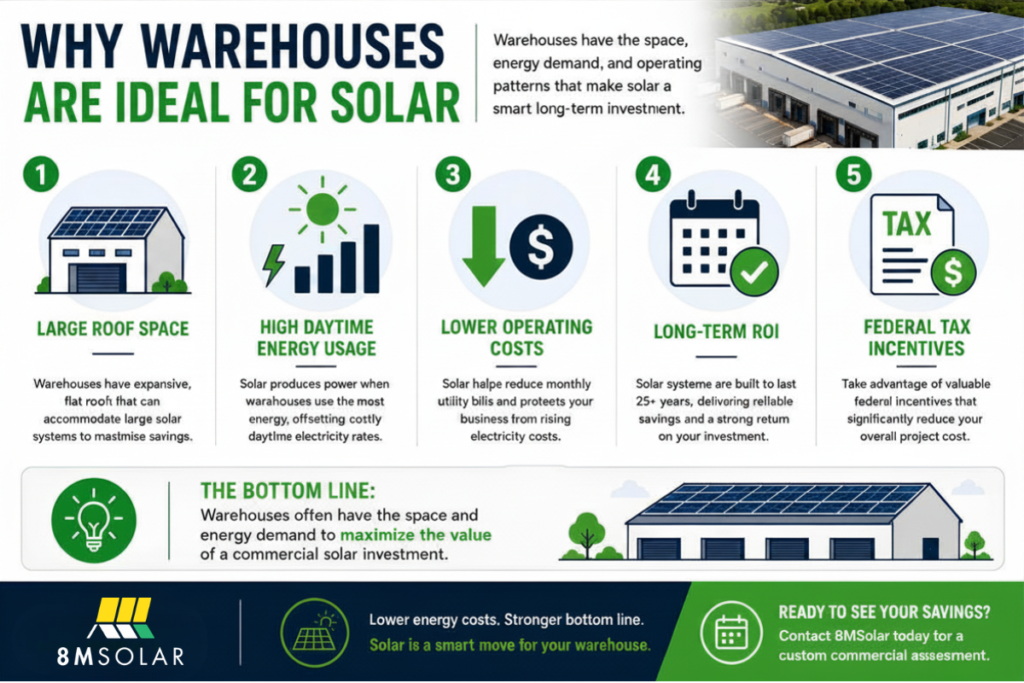
Not every commercial building is well-suited to solar, but warehouses tend to check nearly every box that makes a solar investment work. Understanding why helps explain the favorable economics.
- Large roof space: Warehouses have expansive, often flat rooftops with few obstructions. That translates directly into room for a large solar array, and flat commercial roofs are among the most cost-efficient surfaces to install on using ballasted racking systems that require no penetrations.
- High daytime energy usage: Warehouses consume most of their electricity during daylight hours when lighting, HVAC, refrigeration, conveyor systems, and equipment are running. This aligns almost perfectly with when solar panels produce, meaning more of the energy is used directly rather than exported at lower rates.
- Long building lifespan: Commercial buildings are long-term assets. A solar system with a 25 to 30-year production life fits naturally with a building the owner expects to hold for decades.
- Predictable energy demand: Unlike some businesses with highly variable usage, warehouses tend to have stable, forecastable energy consumption, which makes system sizing and savings projections more accurate.
- Opportunity to offset operating expenses: Electricity is a significant and rising operating cost for most warehouses. Solar converts a portion of that variable, increasing expense into a fixed, predictable one.
The alignment between when warehouses use power and when solar produces it is the single biggest reason warehouse solar economics tend to be strong. A facility running daytime operations is essentially consuming solar production in real time, which is the most efficient and valuable use of a solar system.
How Much Does Solar Cost for a Warehouse in North Carolina?
There is no single price for warehouse solar because every facility is different. Rather than quote one number, it is more useful to understand the factors that determine cost and the per-watt ranges that apply. For rooftop commercial systems in North Carolina, 8MSolar’s pricing runs approximately $1.75 to $2.25 per watt installed depending on the size and scope of the project, with larger systems trending toward the lower end of that range. Ground-mounted systems run $2.25 to $2.75 per watt, and solar carport structures run $3.75 to $4.75 per watt.
| System Size | Estimated Gross Cost (Rooftop) | After 30% ITC |
| 50 kW | $87,500 to $112,500 | $61,250 to $78,750 |
| 100 kW | $175,000 to $225,000 | $122,500 to $157,500 |
| 250 kW | $437,500 to $562,500 | $306,250 to $393,750 |
| 500 kW | $875,000 to $1,125,000 | $612,500 to $787,500 |
| 1 MW+ | Custom pricing | Custom pricing |
Several factors determine where a specific project falls within these ranges.
System Size
Larger systems cost more in absolute terms but less per watt, because fixed costs like permitting, interconnection, and mobilization are spread across more capacity. A warehouse sizing a system to offset a large share of its usage benefits from this economy of scale.
Energy Usage
Your facility’s electricity consumption drives the appropriate system size. A warehouse with high usage justifies a larger system and typically sees stronger overall economics, since there is more expensive grid power to offset. Your energy usage and rate structure also determine what offset percentage is achievable, which ranges from 30% to 90% depending on the facility.
Roof Type and Condition
Flat commercial roofs with TPO or EPDM membranes are ideal and most cost-efficient, using ballasted systems that require no penetrations. Metal roofs are also excellent, particularly standing seam, which allows clamp-based mounting. Roofs with significant existing wear, numerous penetrations, or those nearing replacement add cost or may need to be addressed before installation.
Electrical Infrastructure
The condition and capacity of your existing electrical infrastructure matters. A facility with a modern, adequately sized electrical service and metering that can accommodate a large solar interconnection requires less electrical work. Older facilities with undersized panels or outdated equipment may require upgrades that add to project cost.
Installation Complexity
Roof height, access logistics, structural considerations, and whether the system is roof-mounted, ground-mounted, or a carport structure all affect installation labor and cost. Single-story warehouses with clear roof access are generally the most straightforward and cost-efficient installations.
Because of these variables, every warehouse receives a customized proposal based on an actual assessment of the facility rather than a generic per-square-foot estimate. This is standard for commercial solar and ensures the system is sized and priced accurately for your building.
Wondering whether your warehouse is a good candidate for solar? Schedule a commercial solar assessment with 8MSolar to receive a customized savings estimate based on your facility’s energy usage.
What ROI Can Warehouses Expect?
Return on investment is the question that matters most to warehouse decision-makers, and it is driven by four components working together: utility bill savings, the federal tax credit, accelerated depreciation, and long-term electricity savings as rates rise.
Utility Bill Savings
The most direct return is the reduction in your monthly electricity bill. A warehouse system sized to offset 50% to 90% of consumption produces immediate, ongoing savings that scale with the size of your energy bill. For a facility spending $8,000 or more per month on electricity, those savings are substantial from month one.
Federal Investment Tax Credit
The 30% federal Investment Tax Credit applies to the full installed cost of a commercial solar system, including equipment, labor, and engineering. On a $300,000 system, that is $90,000 directly off your federal tax liability. The ITC is one of the single largest factors in commercial solar ROI.
Accelerated Depreciation
The Modified Accelerated Cost Recovery System (MACRS) allows commercial solar owners to depreciate the system over five years, front-loading significant tax deductions. Combined with bonus depreciation, this can offset an additional substantial portion of the system cost in the first year or two of ownership. The combination of ITC and depreciation is why effective payback for many commercial systems is dramatically shorter than simple payback.
Long-Term Electricity Savings
Utility rates in North Carolina have been rising consistently. Every rate increase makes the electricity your system produces more valuable, which means your savings grow over time and your payback period effectively shortens. A system with a 25 to 30-year production life continues generating savings long after it has paid for itself.
Putting it together: simple payback for commercial solar in North Carolina typically ranges from 5 to 10 years before incentives. After factoring in the 30% ITC, MACRS, and bonus depreciation, effective payback for many warehouses shrinks to roughly 3 to 6 years, with some well-positioned projects seeing even faster returns. After payback, the system produces essentially free electricity for the remainder of its life. Actual ROI varies based on your energy usage, system size, roof conditions, rate structure, and the incentives your business qualifies for, which is why a customized assessment is essential for accurate projections.
Note: Payback ranges are general estimates for the current NC commercial market. Verify current incentive levels and consult your CPA to model the exact tax impact for your business.
Available Incentives for Commercial Solar in North Carolina
Incentives are central to warehouse solar economics. Here are the primary programs available to North Carolina commercial solar owners.
- Federal Investment Tax Credit (ITC): A credit equal to 30% of the total installed system cost, applied directly against federal tax liability. Available through 2032 at the current rate. Unused credit can generally be carried forward to future tax years.
- MACRS Accelerated Depreciation: Allows the system to be depreciated over five years, generating significant tax deductions that improve early-year cash flow.
- Bonus Depreciation: Allows a percentage of the system’s depreciable basis to be deducted in the first year, on top of standard MACRS depreciation. The bonus percentage has been phasing down over time, so the current-year figure should be verified with your CPA.
- Utility incentives: Duke Energy has offered commercial solar and battery incentives at various times. Program availability and funding change, so current status should be confirmed as part of your assessment.
- USDA REAP grants: Warehouses and businesses in eligible rural areas may qualify for the USDA Rural Energy for America Program, which offers grants and loan guarantees for renewable energy projects. Eligibility depends on location and business type.
Because incentive programs and percentages change over time, and because their value depends on your specific tax situation, we always recommend verifying current eligibility and consulting your accountant before finalizing a project. An experienced commercial installer will help you identify and document every incentive your project qualifies for.
What to Expect During a Warehouse Solar Installation
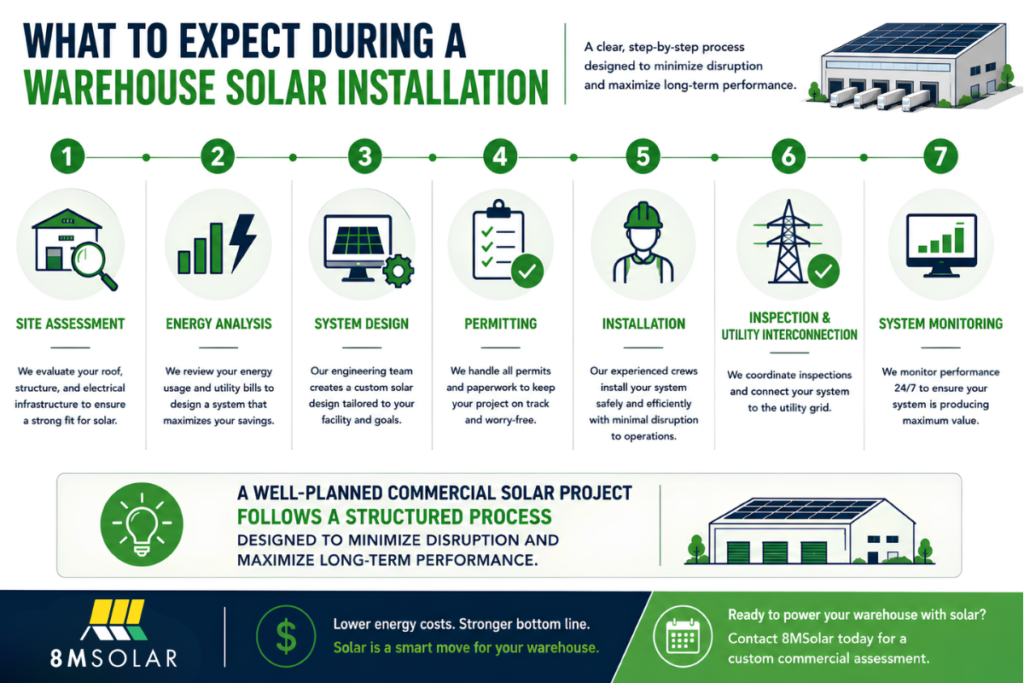
Understanding the installation process removes much of the uncertainty for facility managers concerned about disruption. Here is what a typical warehouse solar project involves from start to finish.
Initial Site Assessment
The process begins with an evaluation of your facility, including roof condition and type, available space, structural capacity, electrical infrastructure, and any obstructions. This assessment determines what is feasible and informs the system design.
Energy Usage Analysis
Your installer reviews your historical electricity usage, typically 12 months of utility bills, along with your rate structure and demand charges. This data determines the appropriate system size and the achievable offset percentage for your facility.
Engineering and Design
Licensed engineers produce a fully engineered system design, including structural load calculations, electrical diagrams, panel layout, and production modeling. Every design is reviewed and stamped before permit submission.
Permitting
Your installer handles the permitting process with your local building department, submitting all required documentation. Commercial permitting can be more involved than residential, and an experienced commercial installer manages this on your behalf. You can learn more about the timeline in our guide to solar permitting in North Carolina.
Installation
The physical installation is completed by the installation team. For most warehouses, this work is performed on the roof and does not require interrupting operations inside the building. The duration depends on system size, but even large commercial installations are typically completed in a matter of days to a few weeks.
Inspection and Interconnection
After installation, the local building department inspects the completed work, and the utility completes its interconnection review before issuing Permission to Operate. The system cannot be activated until this final utility approval is received. Our guide to solar interconnection agreements explains this step in detail.
System Monitoring
Once activated, the system includes monitoring that tracks production and performance in real time. This allows both you and your installer to confirm the system is performing as designed and to identify any issues quickly.
Common Questions Warehouse Owners Ask
Will operations need to shut down during installation?
In most cases, no. Warehouse solar installation is performed on the roof and typically does not require interrupting interior operations. There may be brief, scheduled electrical work that requires coordination, but a good installer plans this to minimize any disruption to your business.
Can an older warehouse support solar?
Often yes, but it depends on the roof and electrical infrastructure. Older warehouses with structurally sound roofs and adequate electrical capacity are frequently good candidates. A structural assessment during the site evaluation confirms whether the roof can support the system or whether any reinforcement is needed.
What if the roof needs replacement?
If your roof is nearing the end of its life, it is usually best to replace it before installing solar to avoid the cost of removing and reinstalling panels later. Many warehouse owners coordinate a roof replacement with their solar installation for exactly this reason. The same principle applies to metal roof installations, which are common on warehouses and pair well with solar. Your installer can advise on timing.
Can battery storage be added later?
Yes. Many warehouses start with solar and add battery storage later, though designing with future storage in mind from the start can simplify the addition. Battery storage is particularly valuable for facilities with demand charges or those on time-of-use rate structures.
What maintenance is required?
Commercial solar requires minimal maintenance. Panels have no moving parts, and periodic cleaning and occasional inspections are generally sufficient. Monitoring systems flag any performance issues, and reputable installers provide ongoing support and address warranty items as needed.
Is Solar Right for Your Warehouse?
While warehouses are among the strongest solar candidates, every building is different. The following factors determine whether solar makes sense for your specific facility.
- Building age: The age of the building itself matters less than the condition of the roof and electrical systems. A well-maintained older warehouse can be an excellent candidate.
- Roof condition: The roof should have enough remaining lifespan to support a system for decades, or be replaced as part of the project. Structural capacity to support the array is also assessed.
- Electricity usage: Higher electricity usage generally means stronger solar economics, since there is more grid power to offset. Facilities with significant daytime consumption see the best alignment with solar production.
- Business goals: Whether your priority is reducing operating costs, hedging against rate increases, meeting sustainability commitments, or improving property value, your goals shape the right system design.
- Ownership versus leasing: Owned buildings are the most straightforward. If you lease your facility, solar is still possible but requires coordination with the property owner and consideration of lease terms.
The only way to know with certainty whether solar is right for your warehouse is a customized assessment based on your actual building, energy usage, and financial goals. Comparing your options across solar financing structures is also part of determining the right fit.
Why North Carolina Businesses Choose 8MSolar
8MSolar has been designing and installing commercial solar across North Carolina and Virginia for over 20 years. For warehouse and commercial projects, that experience translates into a few specific advantages.
- Commercial solar expertise: We understand the distinct engineering, financial, and operational considerations of commercial and industrial projects, which differ significantly from residential work. Our commercial solar pricing and cost guide covers this in more detail.
- Custom system design: Every warehouse system is designed around your specific roof, energy usage, and goals, not a generic template.
- Engineering support: Our in-house engineering team produces fully engineered, code-compliant designs stamped by licensed engineers.
- Incentive guidance: We help you identify and document the ITC, MACRS, bonus depreciation, and any applicable utility or REAP incentives, and coordinate with your CPA so you capture every available benefit.
- Local experience: We know North Carolina permitting, Duke Energy interconnection, and the specific requirements of commercial projects across the state.
- Long-term customer support: Our relationship continues after installation with monitoring, maintenance, and support for the life of your system.
For facilities also evaluating manufacturing space or other commercial buildings, many of the same principles apply, and we handle the full range of commercial solar installations across North Carolina.
Understanding the Financial Case for Warehouse Solar
For decision-makers who need to justify the investment internally, the case for warehouse solar rests on a few durable facts. Electricity is a significant and rising operating expense. Solar converts a portion of that variable cost into a fixed, predictable one while the federal tax incentives offset a large share of the upfront investment. The alignment between warehouse daytime operations and solar production maximizes the value of every kilowatt-hour generated. And the long lifespan of both the building and the system means the investment continues paying returns for decades.
How time-of-use electricity rates apply to your facility is another factor worth understanding, as commercial rate structures increasingly reward the ability to manage when energy is consumed. For facilities with demand charges, this is where pairing solar with storage using systems like the Tesla Powerwall 3 or larger commercial battery solutions can further improve the financial return.
Take the Next Step for Your Warehouse
Every warehouse has unique energy demands, building characteristics, and financial goals. A customized commercial solar assessment can help determine the right system size, available incentives, and potential long-term savings for your specific facility. Rather than relying on generic estimates, an actual evaluation of your building and energy usage gives you the accurate numbers you need to make an informed decision.
Contact 8MSolar to explore whether solar is the right investment for your North Carolina warehouse. Our team will assess your facility, analyze your energy usage, identify the incentives you qualify for, and provide a customized proposal with realistic ROI projections, no pressure and no inflated promises.