Manufacturing facilities are among the strongest candidates for commercial solar in North Carolina, and the reason comes down to how they use energy. Manufacturers combine high, sustained electricity demand with long daytime operating hours and large roof or ground space, which is close to an ideal profile for solar. A well-designed system can offset anywhere from 30% to 90% of a facility’s electricity consumption, and after the 30% federal tax credit and accelerated depreciation, many manufacturers recover a significant portion of their investment within the first few years.
Here is what manufacturing decision-makers need to know up front:
- Is solar worth it for manufacturing facilities? For most facilities with high energy usage and consistent daytime operations, yes. Manufacturers often have the most favorable commercial solar economics of any building type.
- How much does commercial solar cost? Rooftop commercial systems in North Carolina run approximately $1.75 to $2.25 per watt installed before incentives. Ground-mounted systems run $2.25 to $2.75 per watt, and solar carports run $3.75 to $4.75 per watt.
- How much can manufacturers save? Savings scale with energy usage. A facility spending tens of thousands per month on electricity can offset a large share of that cost, producing savings that compound as utility rates rise.
- Are tax incentives available? Yes. Commercial solar qualifies for the 30% federal Investment Tax Credit, MACRS accelerated depreciation, and bonus depreciation, which together offset a substantial portion of the system cost.
- Will installation interrupt operations? In most cases, no. Solar installation is typically performed on the roof or on adjacent land and is planned around production schedules to minimize disruption. Flexible financing options can also spread the investment over time.
The rest of this guide covers costs, ROI, incentives, the installation process, battery storage considerations, and how to determine whether solar is right for your specific facility.
Why Manufacturing Facilities Are Great Candidates for Solar
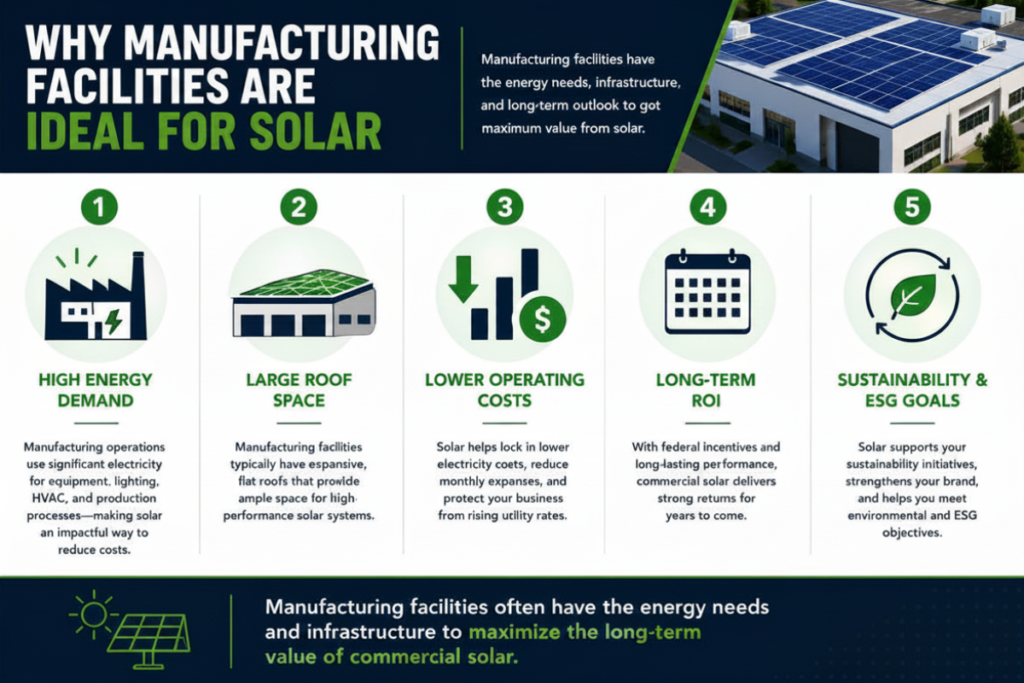
Manufacturing facilities have a distinct energy profile that makes them particularly well-suited to solar. Understanding these characteristics helps explain why the economics tend to be strong.
High Energy Consumption
Manufacturing is energy-intensive. Production equipment, motors, compressors, HVAC, process heating and cooling, and lighting all draw significant power. Because solar savings scale with the amount of electricity you offset, high-consumption facilities have more to gain from solar than lower-usage businesses. The larger your electricity bill, the more a solar system can reduce it in absolute dollars.
Large Roof Space
Manufacturing facilities typically have expansive rooftops or adjacent land available for ground-mounted arrays. That space translates directly into capacity for a large solar system. Flat industrial roofs are among the most cost-efficient surfaces to install on, and facilities with open land have the option of ground mounts oriented for optimal production.
Consistent Daytime Operations
Many manufacturers operate during daytime hours or run continuous shifts, which means substantial electricity demand during the hours when solar panels produce. This alignment is important: energy consumed directly as it is produced is the most valuable and efficient use of a solar system, avoiding lower export rates for surplus energy. A facility running daytime production is essentially consuming solar output in real time.
Long-Term Cost Predictability
Electricity is a significant and rising operating expense for manufacturers, and it is one of the few major costs that is largely outside a business’s control. Solar converts a portion of that variable, increasing cost into a fixed, predictable one. For manufacturers managing tight margins and long-term budgets, that predictability has real strategic value beyond the direct savings.
Sustainability Goals
Many manufacturers face growing pressure from customers, supply chain partners, and stakeholders to reduce their environmental impact. On-site solar is a visible, measurable step toward sustainability commitments and can support corporate ESG reporting, customer requirements, and competitive positioning in industries where sustainability increasingly factors into purchasing decisions.
How Much Does Solar Cost for a Manufacturing Facility?
There is no single price for manufacturing solar because every facility is different. It is more useful to understand the per-watt ranges and the variables that determine where a specific project lands. For rooftop commercial systems in North Carolina, 8MSolar’s pricing runs approximately $1.75 to $2.25 per watt installed depending on the size and scope of the project. Ground-mounted systems run $2.25 to $2.75 per watt, and solar carport structures run $3.75 to $4.75 per watt.
| System Size | Estimated Gross Cost (Rooftop) | After 30% ITC |
| 100 kW | $175,000 to $225,000 | $122,500 to $157,500 |
| 250 kW | $437,500 to $562,500 | $306,250 to $393,750 |
| 500 kW | $875,000 to $1,125,000 | $612,500 to $787,500 |
| 1 MW+ | Custom pricing | Custom pricing |
The following factors determine where a specific manufacturing project falls within these ranges.
Facility Size
Larger facilities generally support larger systems, which are more cost-efficient per watt because fixed costs like permitting, interconnection, and mobilization spread across more capacity. Manufacturing facilities often justify large systems, which benefits the per-watt economics.
Energy Usage
Your electricity consumption drives the appropriate system size. High-usage manufacturers justify larger systems and typically see stronger overall economics. Your usage and rate structure also determine what offset percentage is achievable, which ranges from 30% to 90% depending on the facility and how much roof or ground space is available relative to consumption.
Roof Condition
Flat commercial roofs with TPO or EPDM membranes and metal roofs are ideal for solar. Roofs with significant wear, numerous penetrations, or those nearing replacement add cost or should be addressed first. A structural assessment confirms the roof can support the array. Facilities with limited or unsuitable roof space can often use ground-mounted systems instead.
Electrical Infrastructure
Manufacturing facilities often have complex, high-capacity electrical systems. The condition and configuration of that infrastructure affects how straightforward the solar interconnection will be. Facilities with modern, adequately sized electrical service require less additional work, while older systems may need upgrades that add to project cost.
System Size
The size of the system, driven by your energy goals and available space, is the primary cost determinant. A system sized to offset a large share of a high-consumption facility’s usage will cost more in absolute terms but often delivers the strongest return because it displaces more expensive grid electricity.
Because of these variables, every manufacturing facility receives a customized proposal based on an actual assessment rather than a generic estimate. This ensures the system is sized and priced accurately for your operation.
Curious whether your manufacturing facility is a good fit for solar? Schedule a commercial solar assessment with 8MSolar to receive a customized energy analysis and savings estimate.
What ROI Can Manufacturers Expect?
Return on investment for manufacturing solar is driven by four components working together: reduced electricity expenses, the federal tax credit, accelerated depreciation, and long-term savings as utility rates climb.
Reduced Electricity Expenses
The most direct return is the reduction in your monthly electricity bill. For manufacturers with large energy bills, a system offsetting 50% to 90% of consumption produces substantial, ongoing savings from the first month of operation. Because electricity is such a significant operating cost for manufacturers, these savings are often larger in absolute terms than for other business types.
Federal Investment Tax Credit
The 30% federal Investment Tax Credit applies to the full installed cost of the system, including equipment, labor, and engineering. On a $500,000 system, that is $150,000 directly off your federal tax liability. The ITC is one of the largest single factors in commercial solar ROI.
MACRS Accelerated Depreciation
The Modified Accelerated Cost Recovery System allows commercial solar to be depreciated over five years, front-loading significant tax deductions. Combined with bonus depreciation, this offsets an additional substantial portion of the system cost in the early years of ownership. The combination of the ITC and depreciation is why effective payback is often much shorter than simple payback.
Long-Term Operational Savings and Predictability
Utility rates in North Carolina have risen consistently, and each increase makes your solar production more valuable. Beyond the direct savings, solar improves financial predictability by converting a variable, rising cost into a fixed one, which supports more accurate long-term budgeting and margin planning.
Putting it together: simple payback for commercial solar in North Carolina typically ranges from 5 to 10 years before incentives. After the 30% ITC, MACRS, and bonus depreciation, effective payback for many manufacturing facilities shrinks to roughly 3 to 6 years, with some well-positioned high-usage facilities seeing faster returns. After payback, the system produces essentially free electricity for the remainder of its 25 to 30-year life. Actual ROI depends on your energy usage, system size, roof and site conditions, rate structure, and the incentives your business qualifies for.
Note: Payback ranges are general estimates for the current NC commercial market. Verify current incentive levels and consult your CPA to model the exact tax impact for your business.
Available Commercial Solar Incentives
Incentives are central to manufacturing solar economics. Here are the primary programs available to North Carolina commercial and industrial solar owners.
- Federal Investment Tax Credit (ITC): A credit equal to 30% of total installed system cost, applied against federal tax liability. Available through 2032 at the current rate, with unused credit generally eligible to carry forward.
- MACRS Accelerated Depreciation: Depreciation of the system over five years, generating deductions that significantly improve early-year cash flow.
- Bonus Depreciation: An additional first-year deduction on a percentage of the depreciable basis, on top of standard MACRS. The bonus percentage has been phasing down, so confirm the current-year figure with your CPA.
- Utility incentives: Duke Energy has offered commercial solar and battery incentives at various times. Availability and funding change, so current status should be confirmed during your assessment.
- USDA REAP grants: Manufacturers and businesses in eligible rural areas may qualify for the USDA Rural Energy for America Program, which provides grants and loan guarantees for renewable energy projects. Eligibility depends on location and business classification.
Because incentive programs and percentages change over time and their value depends on your specific tax situation, we recommend verifying current eligibility and consulting your accountant before finalizing a project. An experienced commercial installer helps you identify and document every incentive your facility qualifies for.
Will Solar Installation Disrupt Manufacturing Operations?
This is one of the most common concerns manufacturers raise, and it is a reasonable one. Production downtime is expensive, and any facility investment has to account for operational continuity. The good news is that solar installation is typically designed to avoid interrupting production.
Planning Around Production Schedules
Experienced commercial installers plan the project around your operating schedule. Because most of the work is performed on the roof or on adjacent land, it happens above or outside your active production areas. Any work that does require coordination, such as brief electrical tie-ins, is scheduled during planned downtime, shift changes, or off-hours to avoid disrupting operations.
Safety Considerations
Commercial installations follow strict safety protocols to protect both the installation crew and your employees. Work areas are managed to keep installation activity separated from ongoing operations, and the installer coordinates with your facilities team on access, safety requirements, and site-specific protocols.
Installation Timeline
The physical installation duration depends on system size, but even large commercial systems are typically completed within a matter of days to a few weeks. Most of that work occurs without any impact on interior operations. Your installer provides a projected timeline as part of the proposal so you can plan accordingly.
Utility Interconnection
After installation, the system must pass inspection and receive utility approval before activation. This interconnection process happens in the background and does not affect your operations. The system simply cannot be turned on until the utility issues Permission to Operate, which your installer manages on your behalf.
Should You Consider Battery Storage?
Battery storage is not required for every manufacturing solar project, but it can provide meaningful additional value depending on your operational needs and rate structure. Here are the primary benefits worth evaluating.
- Backup power: For manufacturers where a power interruption means costly downtime, spoiled product, or disrupted processes, battery backup provides resilience against grid outages.
- Peak demand reduction: Many manufacturers pay demand charges based on their highest period of usage. Battery storage can discharge during peak demand periods to reduce those charges, which can represent significant savings on commercial electric bills.
- Energy management: Storage gives you more control over when you draw from the grid versus your own stored energy, which is increasingly valuable under time-of-use rate structures.
- Increased resilience: For operations sensitive to power quality or continuity, storage provides a buffer against grid instability.
- Future scalability: Battery storage can often be added to a solar system later, so facilities can start with solar and add storage as needs evolve or as demand charges justify it.
Whether storage makes financial sense depends on your demand charge structure, operational sensitivity to outages, and rate plan. Understanding how time-of-use electricity rates apply to your facility is an important part of that evaluation. For facilities that do add storage, commercial battery storage systems ranging from the Tesla Powerwall 3 to larger solutions can be matched to your capacity needs.
Is Your Manufacturing Facility a Good Fit for Solar?
While manufacturing facilities are among the strongest solar candidates, every facility is different. These factors determine whether solar makes sense for your specific operation.
- Roof age and condition: The roof should have enough remaining lifespan to support a system for decades, or be replaced as part of the project. Structural capacity to support the array is assessed during the site evaluation. Facilities with unsuitable roofs can often use ground-mounted systems.
- Energy usage: Higher electricity usage generally means stronger solar economics. Manufacturers with significant daytime consumption see the best alignment with solar production.
- Building ownership: Owned facilities are the most straightforward. Leased facilities can still pursue solar but require coordination with the property owner and consideration of lease terms.
- Long-term business plans: Solar delivers the most value over time. Facilities the business expects to operate for many years capture more of the long-term savings.
- Available roof or ground area: The space available relative to your energy usage determines what offset percentage is achievable and what system size makes sense.
- Financial goals: Whether your priority is reducing operating costs, hedging against rate increases, meeting sustainability commitments, or improving financial predictability, your goals shape the right system design and financing approach.
The only way to know with certainty is a customized assessment based on your actual facility, energy usage, and financial goals. Reviewing your solar financing options is also part of determining the right fit, since financing structure affects cash flow and the timing of your return.
Why Manufacturers Choose 8MSolar
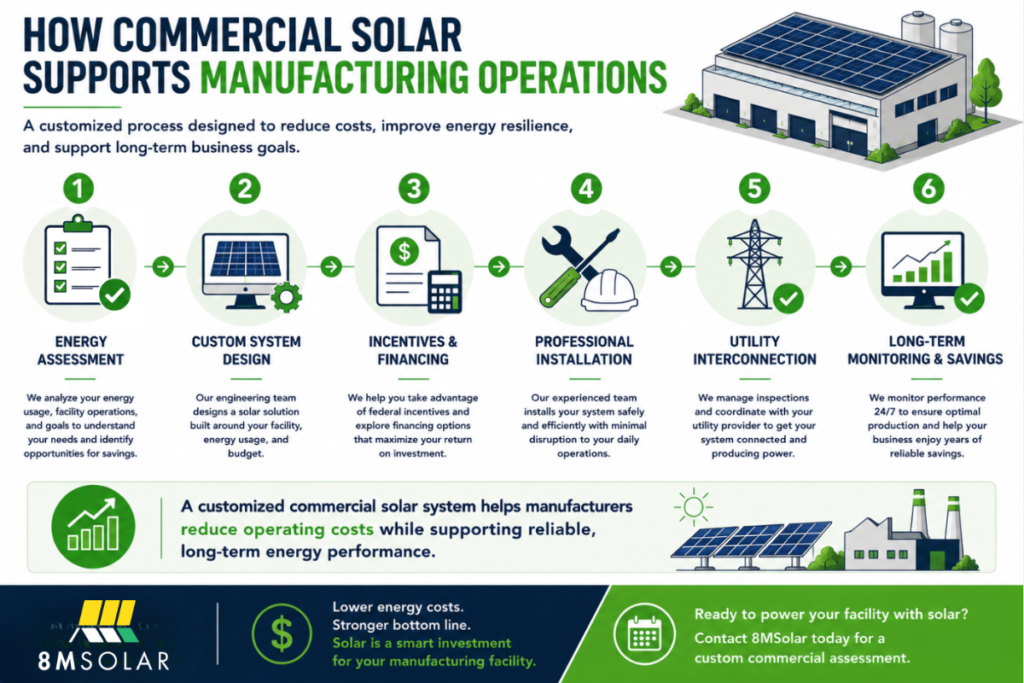
8MSolar has been designing and installing commercial and industrial solar across North Carolina and Virginia for over 20 years. For manufacturing projects, that experience translates into several specific advantages.
- Commercial and industrial expertise: We understand the distinct engineering, electrical, and operational considerations of manufacturing facilities, which differ substantially from residential or small commercial work. Our commercial solar cost guide covers the financial side in more detail.
- Custom engineering: Our in-house engineering team produces fully engineered, code-compliant system designs stamped by licensed engineers and tailored to your facility’s specific electrical and structural characteristics.
- Incentive guidance: We help you identify and document the ITC, MACRS, bonus depreciation, and any applicable utility or REAP incentives, coordinating with your CPA so you capture every available benefit.
- Project management: We manage the full project, including permitting, utility interconnection, and installation, coordinating around your production schedule to minimize disruption.
- Local North Carolina experience: We know NC permitting, Duke Energy interconnection, and the requirements specific to commercial and industrial projects across the state.
- Long-term support: Our relationship continues after installation with monitoring, maintenance, and support for the life of your system.
For businesses also evaluating warehouse space, many of the same principles apply. Our guide to solar for warehouses in NC covers the closely related considerations for distribution and storage facilities, and we handle the full range of solar installations throughout North Carolina.
Common Questions About Manufacturing Solar
Is solar worth it for manufacturing facilities?
For most manufacturers with high energy usage and consistent daytime operations, yes. The combination of large energy bills to offset, ample roof or ground space, and strong tax incentives makes manufacturing one of the most favorable segments for commercial solar. The higher your electricity usage, the stronger the economics tend to be.
How much does commercial solar cost?
Rooftop commercial systems in North Carolina run approximately $1.75 to $2.25 per watt installed before incentives, with ground mounts at $2.25 to $2.75 and carports at $3.75 to $4.75. A 250 kW rooftop system typically falls between $437,500 and $562,500 before the 30% ITC. Actual cost depends on system size, roof condition, and electrical infrastructure.
Will installation interrupt production?
In most cases, no. Solar installation is performed primarily on the roof or on adjacent land, above or outside active production areas. Any work requiring coordination is scheduled around your production schedule during planned downtime or off-hours to avoid disrupting operations.
How much can manufacturers save with solar?
Savings scale with energy usage. A manufacturer offsetting 50% to 90% of a large electricity bill can save substantial amounts monthly, with savings growing as utility rates rise. Over a 25 to 30-year system life, total savings for a high-usage facility can reach into the millions of dollars, though actual figures depend entirely on your usage and system size.
Are tax credits available for commercial solar?
Yes. Commercial solar qualifies for the 30% federal Investment Tax Credit, MACRS five-year accelerated depreciation, and bonus depreciation. Together these can offset a large share of the system cost, often recovering a significant portion of the investment within the first year or two through tax savings. Consult your CPA to model the exact impact.
How long do commercial solar panels last?
Modern commercial solar panels are designed to last 25 to 30 years or more, with manufacturer warranties typically covering 25 years of performance. Panels continue producing energy well beyond the payback period, generating essentially free electricity for the remainder of their life.
Can manufacturers add battery storage?
Yes. Battery storage can be included in the initial installation or added later. It is particularly valuable for manufacturers facing demand charges or those needing backup power for critical operations. Whether it makes financial sense depends on your rate structure and operational needs.
How long does installation take?
The physical installation of a commercial system is typically completed within a matter of days to a few weeks depending on system size. The full timeline from contract to activation, including engineering, permitting, and utility interconnection, generally runs several months, though most of that time does not involve on-site work or any operational impact.
Take the Next Step for Your Facility
Manufacturing facilities often have the energy usage, roof space, and long-term planning horizon needed to maximize the value of commercial solar. A customized assessment can help determine the right system size, available incentives, and expected return on investment for your specific operation. Rather than relying on generic estimates, an actual evaluation of your facility and energy usage provides the accurate numbers you need to justify the investment internally and make an informed decision.
Contact 8MSolar today to learn how solar can support your business goals. Our team will assess your facility, analyze your energy usage, identify the incentives you qualify for, and provide a customized proposal with realistic ROI projections tailored to your manufacturing operation.