Artificial intelligence is changing more than how businesses operate. It is also changing how much electricity the country will need.
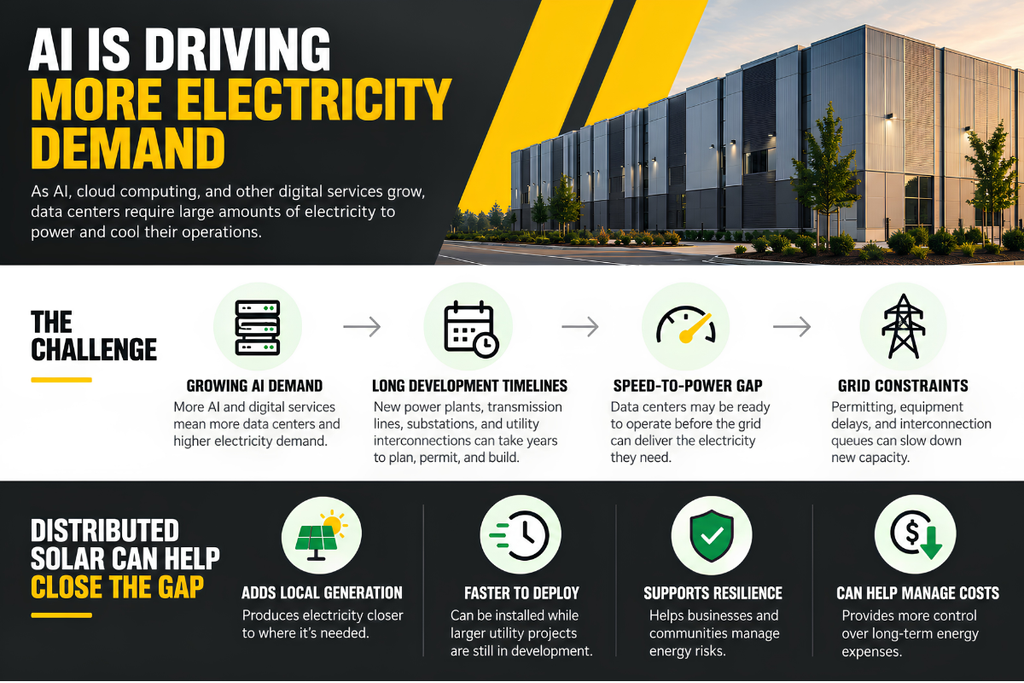
As companies build and expand data centers to support AI systems, cloud computing, and other digital services, electricity demand is increasing. New power plants, transmission lines, substations, and utility interconnections can take years to plan, permit, finance, and build.
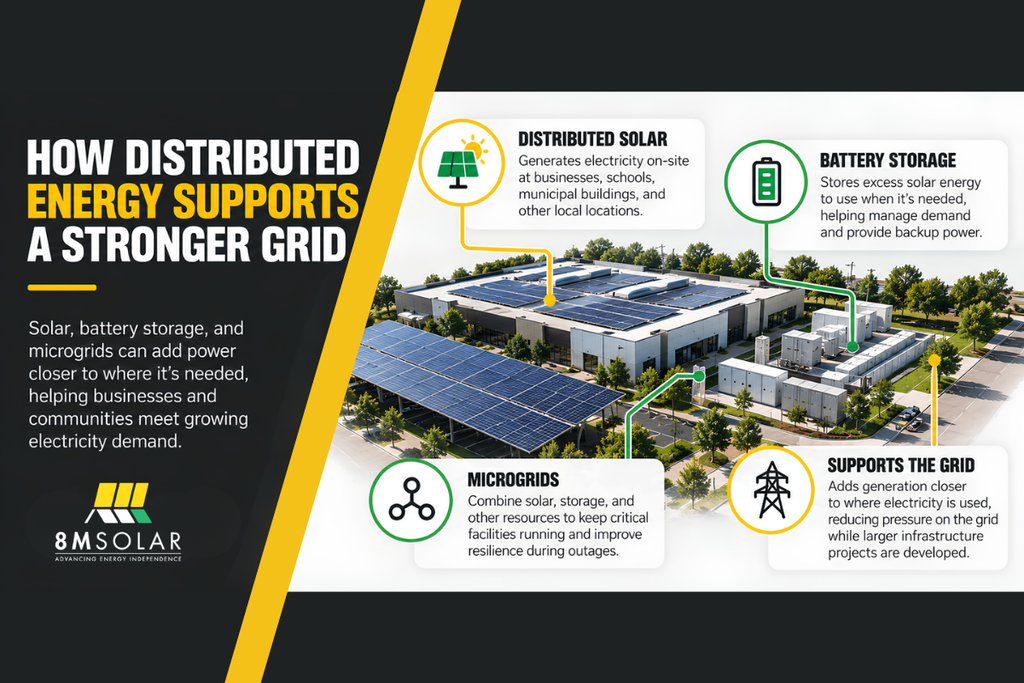
That creates an important opportunity for distributed energy resources, including commercial and industrial solar, community solar, battery storage, and microgrids.
Distributed energy will not replace utility-scale generation or major grid infrastructure. However, it can help provide additional power, improve resilience, manage energy costs, and support growing electricity demand while larger projects move forward.
AI Is Creating a New Electricity Challenge
Data centers require large amounts of electricity to operate servers, cooling systems, networking equipment, and other critical infrastructure. As AI applications become more widespread, the demand for computing capacity is expected to grow.
The challenge is that data-center development and energy infrastructure do not always move at the same speed.
A data center may be ready to operate before the surrounding grid can provide the necessary electricity. Large generation projects can face lengthy permitting processes, equipment delays, transmission constraints, and interconnection queues. In some regions, a proposed project may wait years before it can connect to the grid.
This gap between the need for power and the ability to deliver it is often described as a “speed-to-power” problem.
The issue is not simply whether the country can generate enough electricity over the long term. It is also whether power can be delivered to the right location quickly enough to support new demand.
Distributed Solar Can Help Close the Gap
Distributed solar offers one way to address this challenge.
Unlike a single large generation project, distributed solar can be installed across many locations, including:
- Commercial and industrial rooftops
- Manufacturing facilities
- Warehouses and distribution centers
- Schools and municipal buildings
- Residential properties
- Community solar projects
- Smaller-scale solar farms
These projects can add generation closer to where electricity is being used. They may also be developed while larger utility-scale projects, transmission upgrades, and substations are still moving through planning and construction.
For businesses with available rooftop or site space, solar provides an opportunity to generate some of their own electricity rather than relying entirely on power purchased from the grid.
This does not eliminate the need for utility infrastructure. It adds another layer of generation that can support the larger system.
Solar Plus Storage Adds Flexibility
Solar production changes throughout the day. It is strongest when sunlight is available, while electricity demand may continue into the evening and overnight.
Battery storage can help address that timing difference.
A battery can store electricity when solar production is high and release it when energy is needed. Depending on the system and its design, batteries may also help businesses manage demand charges, provide backup power, and reduce exposure to changing electricity prices.
For data centers and other energy-intensive facilities, storage can provide additional flexibility. It may help manage short-term power needs, support critical operations, or work alongside other generation resources.
The right approach will depend on the facility, its load profile, local utility rules, available incentives, and the technical design of the project. Solar and batteries should not be viewed as completely separate technologies. Together, they can provide both generation and flexibility.
Microgrids Could Become More Important
Microgrids take the concept of distributed energy a step further.
A microgrid combines local energy resources, controls, and loads so that a facility or group of facilities can operate together. Depending on its design, a microgrid may include solar, batteries, generators, energy-management systems, and other technologies.
Microgrids can be particularly valuable for facilities where power interruptions create serious consequences, such as:
- Hospitals
- Schools
- Emergency-response facilities
- Community centers
- Manufacturing operations
- Municipal buildings
- Critical business infrastructure
As electricity demand grows and extreme weather continues to place pressure on the grid, the ability to maintain essential operations during an outage becomes increasingly important.
Microgrids are not a universal solution, but they offer another way to improve resilience and flexibility by producing and managing energy closer to where it is needed.
Speed Matters, but Responsible Development Matters Too
The need for faster power delivery should not mean that communities ignore environmental or public-health concerns. Data centers can affect the communities where they are built through land use, water consumption, noise, traffic, and energy infrastructure. The source of their electricity also matters.
Using temporary or backup generation may help a project receive power quickly, but that approach can create additional emissions and local environmental impacts. Speed should therefore be considered alongside responsible siting, cleaner generation, regulatory compliance, and community needs.
Distributed solar and storage can support a cleaner approach by providing electricity without relying entirely on combustion-based generation. However, every project still needs to be evaluated based on its location, design, construction requirements, and actual operating conditions.
The Opportunity for Commercial and Industrial Solar
Commercial and industrial facilities represent an important part of the distributed-energy opportunity.
Many businesses operate on large properties with substantial roof space, parking areas, or available land. These sites may be able to support solar generation while continuing to serve their primary business purpose.
For businesses, the potential benefits can include:
- Greater control over long-term energy costs
- Reduced reliance on purchased electricity
- Protection against some energy-price volatility
- Improved resilience when paired with storage
- Progress toward sustainability and energy goals
The financial case will vary by project. Electricity rates, system size, financing, utility policies, roof conditions, available incentives, and operating schedules all influence the outcome.
That is why commercial solar projects require more than a comparison of panel costs. They require a clear understanding of how a facility uses energy and how the proposed system will interact with the grid.
A “Both-And” Approach to the Future Grid
The growing demand from AI and data centers presents a major infrastructure challenge, but it also creates an opportunity to rethink how electricity is generated and delivered.
Large power plants and transmission projects will remain necessary. At the same time, distributed solar, batteries, and microgrids can help meet demand closer to the point of use, improve resilience, and provide additional flexibility.
For 8MSolar, this connects directly to the long-standing goal of advancing energy independence. Solar is not only about producing clean electricity. It is also about giving homes, businesses, and communities more options in how they generate, manage, and use energy.
The intersection of AI and solar energy is ultimately a conversation about building an electricity system capable of meeting rising demand while maintaining affordability, reliability, resilience, and responsible development.
Distributed energy will not solve every challenge created by AI. But it can be an important part of the solution.
Thinking About Distributed Solar for Your Business?
As electricity demand grows, businesses have more reason to consider how they generate, manage, and use energy. Commercial solar, battery storage, and other distributed energy resources can give businesses more control over their energy strategy while supporting a more flexible grid.
At 8MSolar, we can help businesses evaluate whether solar makes sense for their facility, energy use, and long-term goals.
Explore Commercial Solar With 8MSolar / Get Your Free Solar Quote