
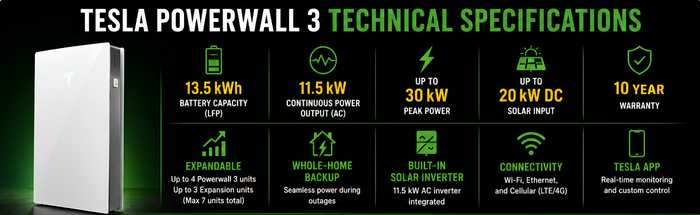
The Tesla Powerwall 3 is a fully integrated home battery system that stores solar energy, provides automatic whole-home backup during outages, and helps homeowners reduce electricity costs under time-of-use rate structures. It supports up to 20 kW DC of solar input, delivers up to 11.5 kW of continuous AC power, and uses Lithium Iron Phosphate (LFP) battery chemistry for improved durability and safety compared to older battery technologies. A single unit can start heavy loads rated up to 185 LRA, which means it can handle the startup surge of central air conditioning, well pumps, and EV chargers without tripping – something most competing home batteries cannot do.
This guide covers how the system works, what the three primary components do, what the official specifications mean in plain terms, and how the system scales for homes with larger energy needs. All specifications are sourced from the official Tesla Powerwall 3 datasheet (2026).
The Three Components of a Complete Powerwall 3 System
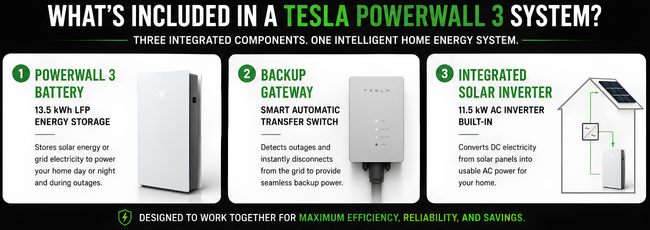
A complete Powerwall 3 system is not just the battery. It consists of three primary components, and understanding what each one does is as important as knowing the specifications. Homeowners who understand the system architecture make better decisions about sizing, placement, and whether a retrofit or new installation is the right path.
The Powerwall 3 Battery Unit
The Powerwall 3 battery stores 13.5 kWh of energy using Lithium Iron Phosphate (LFP) chemistry. If you are familiar with older Powerwall models, which used Nickel Manganese Cobalt (NMC) chemistry, LFP is a meaningful upgrade. LFP batteries have a higher cycle life, meaning they can be charged and discharged many more times before degrading, which is important when you are running a daily charge-discharge cycle for 10 or more years. LFP is also thermally more stable than NMC, which improves safety in both indoor and outdoor installations and matters in particular for NC homeowners who may be mounting the unit in a garage or on an exterior wall exposed to summer heat.
The unit delivers up to 11.5 kW of continuous AC output, which is substantially more than older Powerwall models and most competing home batteries. Its 185 LRA load start capability is the specification that determines whether a battery can actually start a motor-driven appliance. Central air conditioning, well pumps, and pool equipment all require a significant surge of current at startup that lower-rated batteries will trip on. The Powerwall 3’s 185 LRA rating means it handles those starts without issue, which is what makes it a genuine whole-home backup solution rather than just a partial one.
Round-trip efficiency is 89% for the solar-to-battery-to-home use case, meaning roughly 89 cents of every dollar of solar energy that goes into the battery comes back out as usable electricity. Direct solar-to-home efficiency is 97.5%, which is the best-case scenario when panels are producing and the home is consuming simultaneously without going through storage.
The Tesla Backup Gateway
The Backup Gateway is the component that most homeowners think least about but that matters most when the grid goes down. It is a smart automatic transfer switch that controls how your home’s electrical system interacts with the grid, your solar panels, and your battery. It monitors your utility connection continuously, and the moment it detects an outage, it mechanically disconnects your home from the grid and switches to battery power automatically, with no action required from you.
The mechanical disconnection is not just a convenience feature. It is a safety requirement. Without it, your battery could backfeed electricity into grid lines that utility crews believe are de-energized and safe to work on. The Gateway prevents this by physically isolating your home’s electrical system from the utility the instant an outage is detected. The transition happens fast enough that most homeowners experience no perceptible interruption in power at all.
The Gateway 3 also provides revenue-grade energy metering accurate to plus or minus 0.5%, which is used by the Powerwall to optimize solar self-consumption, time-based control, and backup operation. It includes an internal 200 A panelboard with 8-space/16-circuit capacity, is rated for 200 A continuous current, and carries NEMA 3R and indoor/outdoor ratings. Dimensions are 660 x 411 x 149 mm and it weighs 16.3 kg.
One clarification worth understanding: the Powerwall 3 is compatible with three islanding devices. The Gateway 3, the Backup Switch, and the older Backup Gateway 2. The Gateway 3 is the standard choice for new whole-home backup installations. The Backup Gateway 2 is typically used for partial-home backup configurations where non-essential loads remain connected to the grid. Your installer will specify which configuration is appropriate for your home based on your electrical setup and backup goals.
The Integrated Solar Inverter
This is the Powerwall 3’s most significant engineering advance over previous models. For new DC-coupled solar installations, the Powerwall 3 includes a fully integrated 11.5 kW AC solar inverter that handles up to 20 kW DC of solar input. This eliminates the need for a separate standalone inverter, which all previous Powerwall models required.
The integrated inverter includes six independent MPPTs (Maximum Power Point Trackers) which allow panels on different roof orientations, pitches, or in partial shade to be managed independently rather than dragging each other down. This is particularly useful for NC homes with complex roof geometries or panels facing multiple directions.
One important distinction: if you are adding a Powerwall 3 as a retrofit to an existing solar system that already has a separate inverter, the integrated inverter in the Powerwall 3 is typically not used for the existing solar connection. The existing inverter continues to handle solar conversion, and the Powerwall 3 adds battery storage and backup capability to the system. This is a common and fully supported configuration, but it means the cost and complexity of a retrofit differs from a new installation. Your installer should walk you through the implications for your specific setup before you commit.
What Happens When There Is a Grid Outage?
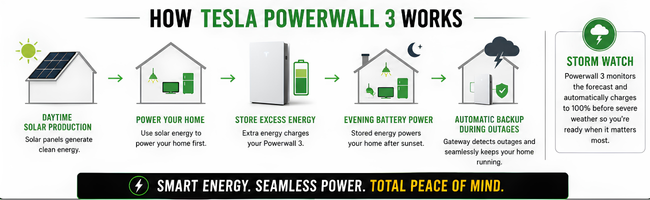
The Powerwall 3 battery doesn’t actually handle the physical disconnection from the electrical grid. That is the function of the previously mentioned “smart transfer switch,” the Tesla Gateway 3 (or in approved markets / areas, the Tesla Backup Switch).
Here is the process that occurs grid isolation – allowing the system to power the home during a power outage: :
1. Immediate Detection of the Power Outage
The Gateway 3 continuously monitors the incoming voltage and frequency from the utility grid.
- When the grid is online (normal conditions), electricity flows directly from the grid through the Gateway to power your home.
- If the grid drops voltage, a storm knocks out power, or someone drives into a power pole – the Gateway detects this in a fraction of a second.
2. Disconnection (<.5 second)
As soon as an outage is detected, the Gateway triggers an internal automatic transfer switch (a heavy-duty internal relay).Then physical contactors slam open, cutting the link between your home and the utility grid completely – i.e. isolation.
This functionality is a strict legal and safety requirement of the utility company, called anti-islanding. Without this disconnection and isolation of the system, the solar panels could feed power back to the grid through downed power lines and seriously harm utility workers.
3. Forming the “Microgrid”
Once your home is 100% isolated, this is noted by the Gateway which instantly sends a signal to the Powerwall 3.
- The Powerwall 3 system activates and changes from “grid-tied” mode to “island” (off-grid) mode. It beings generating its own local AC power signal
- The transition is so fast that most electronics, clocks, and Wi-Fi routers may not even reboot or notice the blip.
4. Reconnecting to the Grid
When the grid is back online, the Gateway monitors the restored grid power for a few minutes to ensure the voltage is stable. When stabilized, it matches the Powerwall’s phase to the grid and closes the internal switch. Your home is then back on the grid and being powered per normal, typically without even an interruption in your home’s electrical system.
Feature: Time-Based Control – Getting More Value From the Battery
Time-Based Control is the feature that turns the Powerwall 3 from a backup device into an active financial tool. It allows the system to make intelligent decisions about when to charge and when to discharge based on your utility’s rate schedule.
Under the standard configuration, the Powerwall charges from solar during the day and discharges in the evening. With Time-Based Control enabled and configured to your utility’s specific TOU schedule, the system becomes more strategic: it can draw from the grid to top off the battery during cheap overnight off-peak hours, hold that charge through the midday period, and deploy it during the expensive on-peak window in the afternoon and evening.
For North Carolina homeowners going solar after the December 31, 2026 Bridge Rate (Net-Metering) deadline, this feature is not optional. It is the primary tool for managing costs under Duke Energy’s mandatory Residential Solar Choice plan, which includes Time-of-Use billing and Critical Peak Pricing that can push electricity costs above 40 cents per kilowatt-hour on designated high-demand days. A Powerwall 3 with Time-Based Control configured to your specific rate schedule can substantially reduce exposure to those peak-rate periods.
Feature: Storm Watch and Outage Behavior
Storm Watch connects the Powerwall 3 to National Weather Service data and automatically charges the battery to 100% when severe weather is detected in your area, even if that requires drawing from the grid. For NC homeowners who have experienced extended outages from hurricanes, ice storms, or severe thunderstorm seasons, this feature handles the pre-storm preparation automatically so you do not have to think about it. You receive a notification in the Tesla App when Storm Watch activates and can monitor charging progress before the storm arrives.
When an outage actually occurs, the Gateway detects the loss of grid power within milliseconds, mechanically disconnects your home, and switches to battery power. The transition is fast enough that most electronics do not reset and most homeowners do not notice the switch. If the sun is shining during the outage, solar panels continue generating electricity and charging the Powerwall, which means a daytime outage is significantly less stressful than a nighttime one. Your battery is actively being replenished even while powering your home.
How long a Powerwall 3 lasts during an outage depends entirely on how much your home consumes during that period. A home running only essential loads (refrigerator, lights, phone charging, a few outlets) might run for 7 to 13 hours on a single 13.5 kWh unit. A home running central air conditioning through a hot NC summer afternoon will deplete the battery faster. This is why system sizing and reserve configuration both matter, and why homes with larger backup needs should consider Expansion units. Read more about how to approach these decisions in our guide to home backup power basics.
Full Technical Specifications
System Specifications
| Specification | Value | What It Means |
| Nominal Battery Energy | 13.5 kWh | Usable storage per unit at 25°C, beginning of life |
| Battery Chemistry | LFP (Lithium Iron Phosphate) | Higher cycle life and thermal stability vs. NMC |
| Continuous AC Output Power | Up to 11.5 kW | Supports most whole-home loads simultaneously |
| Load Start Capability | 185 LRA | Can start central HVAC, well pumps, and EV chargers |
| Solar to Home Efficiency | 97.5% | Direct production to consumption efficiency |
| Solar to Battery to Home Efficiency | 89% | Round-trip efficiency for the storage use case |
| Maximum Solar DC Input | 20 kW | Handles large solar arrays without a separate inverter |
| Number of MPPTs | 6 | Independent optimization for panels on different orientations |
| PV DC Input Voltage Range | 60 to 550 V DC | Compatible with a wide range of panel and string configurations |
| Power Scalability | Up to 4 Powerwall 3 units | Stack units for higher continuous output |
| Energy Scalability | Up to 3 Expansion units per Powerwall 3 | Maximum 7 total units, up to 94.5 kWh storage |
| Connectivity | Wi-Fi (2.4 and 5 GHz), Ethernet, Cellular | Cellular is backup, not primary connectivity |
| AC Metering | Revenue grade, +/- 0.5% | Accurate enough for utility billing reconciliation |
| Warranty | 10 years | Standard Tesla product warranty |
Environmental and Physical Specifications
| Specification | Value |
| Dimensions (with glass cover) | 1105 x 609 x 193 mm (43.5 x 24 x 7.6 in) |
| Total Installed Weight | 132 kg (291.2 lb) |
| Mounting Options | Floor or wall mount |
| Operating Temperature | -20°C to 50°C (-4°F to 122°F) |
| Operating Humidity | Up to 100%, condensing |
| Enclosure Rating | NEMA 3R (indoor and outdoor rated) |
| Ingress Protection | IP67 (Battery and Power Electronics), IP55 (Wiring Compartment) |
| Operating Noise at 1 meter | Less than 50 dB(A) typical, less than 62 dB(A) maximum |
| Maximum Elevation | 3000 m (9,843 ft) |
The IP67 rating on the battery and power electronics means the Powerwall 3 is protected against dust and temporary water immersion, making it suitable for garage or exterior installation in NC’s climate. The NEMA 3R enclosure provides additional protection against rain and sleet. Performance may be de-rated at operating temperatures above 40°C (104°F), which is worth noting for installations in enclosed spaces without ventilation during summer.
Expanding the System
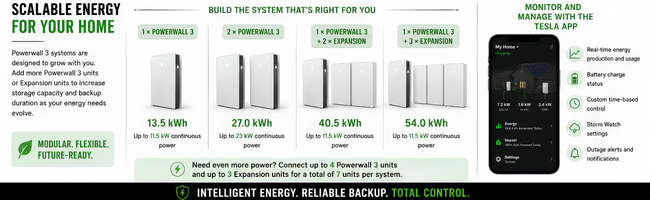
The Powerwall 3 Expansion units are purpose-built battery modules that add 13.5 kWh of LFP storage each, connected to the Powerwall 3 via the Powerwall 3 Expansion harness. Each Expansion unit shares the same battery chemistry, environmental ratings, and 10-year warranty as the Powerwall 3 itself. They are only compatible with the Powerwall 3, they cannot be used with older Powerwall models.
Up to three Expansion units can connect to a single Powerwall 3, and they can be stacked in a floor-mount configuration directly behind the main unit. Adding Expansion units also increases the maximum continuous charge current from 20.8 A (5 kW) on a standalone Powerwall 3 to 33.3 A (8 kW) with up to three Expansions connected.
| Configuration | Total Storage | Best Fit For |
| 1 Powerwall 3 | 13.5 kWh | Most NC homes, short to moderate outage coverage |
| 1 Powerwall 3 + 1 Expansion | 27 kWh | Larger homes or extended outage coverage |
| 1 Powerwall 3 + 2 Expansions | 40.5 kWh | High-usage homes, multi-day backup capability |
| 1 Powerwall 3 + 3 Expansions | 54 kWh | Maximum storage on a single Powerwall 3 |
| 4 Powerwall 3 + 3 Expansions (max system) | 94.5 kWh | Very large homes or near-complete energy independence |
The maximum system configuration, four Powerwall 3 units plus three Expansion units, requires a Backup Switch rather than a Gateway 3 and is designed for properties with very high energy demands or those pursuing near-complete grid independence. If you are weighing whether adding storage makes sense for your existing solar system, our guide on solar panel and battery storage compatibility covers the key factors to evaluate first.
Managing the System With the Tesla App
The Tesla App is the customer interface for the Powerwall 3 system and it is more capable than most homeowners initially realize. Beyond monitoring, it gives you active control over how the system behaves.
In real time, the App shows solar production, battery charge level, grid interaction, and home consumption. You can see exactly how much electricity your panels are generating, how fast the battery is charging or discharging, and whether you are currently buying from or selling to the grid. Over time, the historical reports let you understand your energy patterns and evaluate how the system is performing against your expectations.
The settings available through the App include your backup reserve level (how much battery to hold in reserve for outages), Time-Based Control configuration (the rate schedule the system uses to decide when to charge and discharge), and Storm Watch (which you can monitor and receive notifications for when it activates). For homeowners on Duke Energy’s TOU plan, properly configuring the App’s Time-Based Control settings for your specific rate tiers is one of the most important steps after installation, and something 8MSolar configures during the installation itself.
Is the Powerwall 3 the Right Battery for Your Home?
The Powerwall 3 is the strongest fit for homes that are adding solar for the first time and want a fully integrated system from day one, or for homes that have high enough peak power demands that lower-rated batteries would not handle whole-home backup. If your home runs central HVAC, a well pump, or other heavy motor loads, the 185 LRA load start rating and 11.5 kW continuous output of the Powerwall 3 are not just nice-to-haves, they are requirements for the system to actually work as advertised during an outage.
For homeowners adding storage to an existing solar system with a separate inverter, the Powerwall 3 is still a strong choice for the backup performance and LFP chemistry, but the integrated inverter advantage does not apply in the same way. The financial case for adding storage to an existing system is also influenced by your utility’s rate structure, which is becoming more relevant as Duke Energy transitions new solar customers to TOU billing after the 2026 Bridge Rate deadline.
For homes where the primary concern is maximum storage capacity rather than maximum power output. For example, a vacation property that needs multi-day coverage with modest loads. The combination of a Powerwall 3 and multiple Expansion units may be more cost-effective than multiple full Powerwall 3 units. Your installer should model the specific configuration that fits your priorities rather than defaulting to a single-size recommendation. You can compare the Powerwall 3 to other top-rated home battery options in our best solar batteries guide.
Installing a Powerwall 3 with 8MSolar
8MSolar is a Tesla Powerwall Certified Premier Installer, and that designation carries specific meaning for homeowners. It means our team has completed Tesla’s training and certification process for Powerwall design and installation, that we have direct access to Tesla’s technical support resources, and that we are accountable to Tesla’s quality standards in addition to our own.
For every Powerwall installation, we design the system around your home’s specific electrical layout, energy usage, and backup goals. We handle all utility interconnection paperwork and local permitting, configure the Tesla App including Time-Based Control settings for your specific rate plan, and walk you through the system before we leave. If your needs change, whether that means adding Expansion units later or expanding your solar array, we remain your point of contact throughout the system’s life.
The Powerwall 3 is one of the most capable home battery systems available, and when it is properly designed and installed, it delivers on that capability. Schedule your free consultation and our team will walk you through whether it is the right fit for your home, what size configuration makes sense, and how it fits into your residential solar installation alongside solar financing options that can make the upfront cost more manageable.