
Before you can understand what solar could do for your business, it helps to understand what you’re paying for today.
A commercial electric bill can look complicated, with different charges for energy use, demand, and other costs. But you don’t need to understand every line to get a useful picture of your solar opportunity.
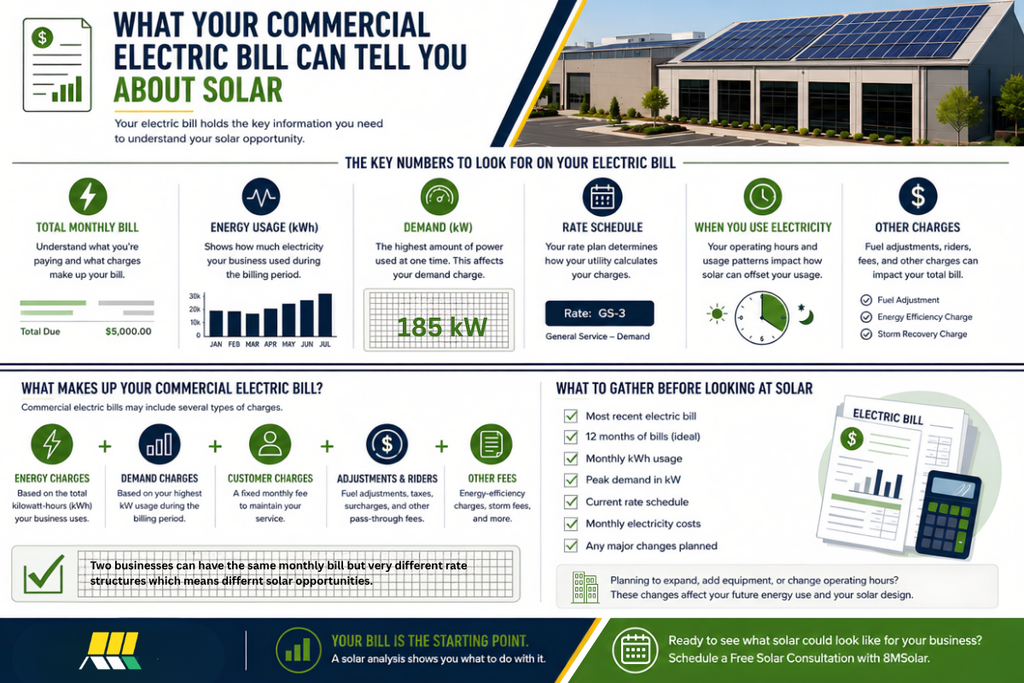
A few numbers can tell you a lot: how much electricity you use, when you use it, how much power your business demands at once, and what rate you’re paying.
Start With Your Total Monthly Bill
Your total monthly bill is the easiest place to start, but it doesn’t tell the whole story. A commercial electricity bill can include several different charges depending on your utility and rate schedule. You may see energy charges, demand charges, customer charges, fuel adjustments, and other fees.
When you’re looking at solar, don’t just ask, “How much is my bill?”
Look at what is making up that bill.
A business paying $5,000 a month for electricity could have a very different solar opportunity from another business with the same monthly bill.
Find Your Energy Usage in kWh
One of the first numbers to look for is your electricity usage, measured in kilowatt-hours (kWh).
This tells you how much energy your business used during the billing period.
For example, your bills might show:
- 20,000 kWh in January
- 24,000 kWh in February
- 30,000 kWh in July
That gives you a much better picture of your energy needs than looking at one month’s bill.
If possible, gather 12 months of electricity bills before talking with a solar provider. Your usage can change throughout the year, and that history helps show how much electricity your business actually needs.
Look for Your Demand Charge
For many commercial customers, this is one of the most important numbers on the bill.
Energy usage and demand are not the same thing.
Your energy usage is measured in kWh. Demand is measured in kilowatts (kW) and reflects how much power your business is using at a given time.
For example, a manufacturing facility may have several large pieces of equipment running at once. Even if that happens for only a short period, it can create a high peak demand. That peak can affect the business’s electricity bill through a demand charge.
Why Demand Matters for Solar
This is one reason commercial solar isn’t as simple as looking at your annual kWh and putting enough panels on the roof to match it. Solar can reduce the amount of electricity your business purchases from the grid, but the impact on your total bill depends on your rate structure and how your electricity use lines up with solar production.
If demand charges make up a significant portion of your bill, system design becomes especially important.
Find Your Electricity Rate or Rate Schedule
Your electric bill should identify the rate or rate schedule you’re currently using. This tells you how your utility calculates your charges. Commercial customers can have different rate structures depending on factors such as electricity use, demand, and the type of service provided.
Your rate schedule can affect:
- Energy charges
- Demand charges
- Time-of-use pricing
- Fixed charges
- Minimum charges
- How solar generation is credited
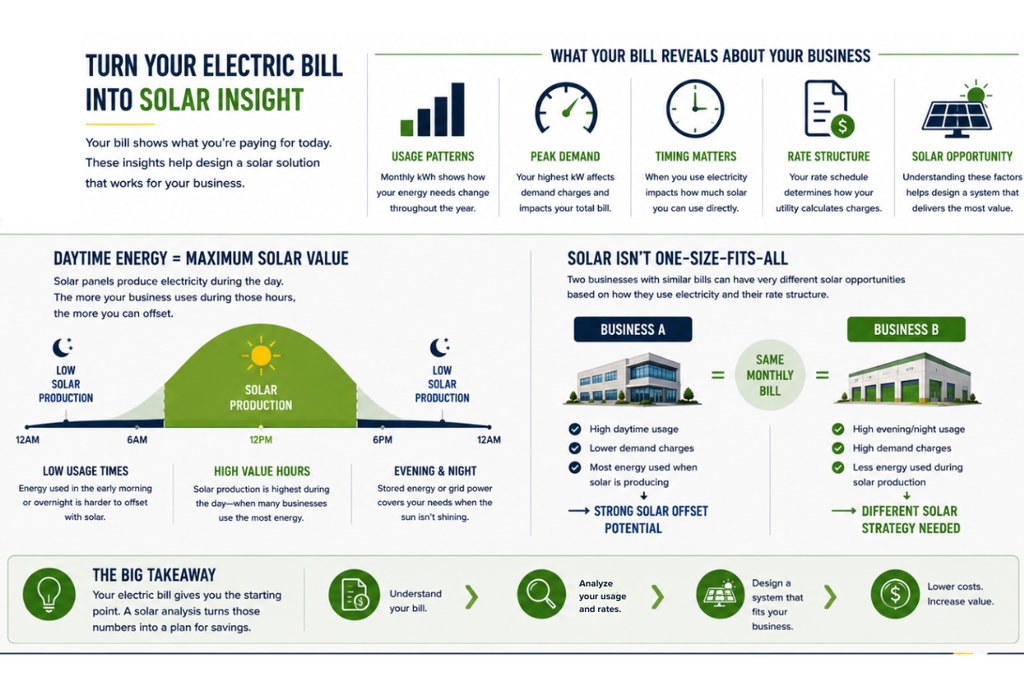
Two businesses can have similar electricity bills but very different rate structures, which means they may also have different solar opportunities.
Look at When Your Business Uses Electricity
The amount of electricity you use matters, but when you use it matters too. Take a look at your business’s operating schedule.
Does most of your electricity use happen:
- During normal business hours?
- Early in the morning?
- Overnight?
- During the summer?
- During specific production periods?
Solar panels produce electricity during the day, so a business that uses a lot of electricity while the sun is producing energy may have a different solar profile than a business that uses most of its electricity overnight.
This is especially important when you’re evaluating how much of your solar production your business may be able to use directly.
Don’t Ignore the Other Charges
Your commercial electric bill may include more than energy and demand charges. Depending on your utility and rate, you may also see fuel adjustments, riders, energy-efficiency charges, storm-related charges, or other fees.
You don’t need to become an expert in every line item.
The important thing is to provide a complete bill when you’re getting a solar analysis. That gives your solar provider the information needed to understand the rate structure you’re actually paying under.
What Should You Gather Before Looking at Solar?
Before getting a commercial solar proposal, gather:
- Your most recent electric bill
- Ideally, 12 months of bills
- Monthly kWh usage
- Peak demand in kW
- Your current rate schedule
- Monthly electricity costs
- Any major changes planned for your business
It’s also worth mentioning anything that could change your future electricity use.
Are you expanding the building? Adding equipment? Increasing production? Changing operating hours? Those changes can affect the amount of electricity your business will need, so they should be considered when designing a solar system.
What Your Electric Bill Can Tell You About Solar
Your electric bill is a good starting point, but it can’t tell you exactly how much solar your business needs. That requires looking at your energy usage, demand, rate structure, property, available installation space, and expected solar production.
The goal isn’t simply to offset a certain number of kWh.
It’s to understand how a solar system could work with the way your business actually uses electricity. For one business, that might mean focusing on daytime energy use. For another, demand charges or operating schedules may play a larger role.
The bill gives you the starting point. A solar analysis shows you what to do with it.
Ready to See What Solar Could Look Like for Your Business?
If you’re considering commercial solar, 8MSolar can help you make sense of the numbers.
Bring your recent electricity bills to a consultation, and our team can look at your usage, demand, rate structure, and property to help determine whether solar makes sense for your business.