In many cases, yes. Roof-mounted solar panels are often covered by standard homeowners insurance because they are considered part of the home’s permanent structure. However, coverage varies by insurer and policy type, and there are important differences between what insurance covers and what your solar warranties cover. Homeowners should verify their specific coverage after installation.
Most homeowners are pleasantly surprised to learn that their existing policy likely extends to their solar system without requiring a separate policy. But “likely covered” is not the same as “automatically covered,” and the details matter. This guide explains how solar panel insurance typically works, what is and is not covered, and what NC homeowners should do to make sure their investment is protected.
The Short Answer: Does Homeowners Insurance Cover Solar Panels?
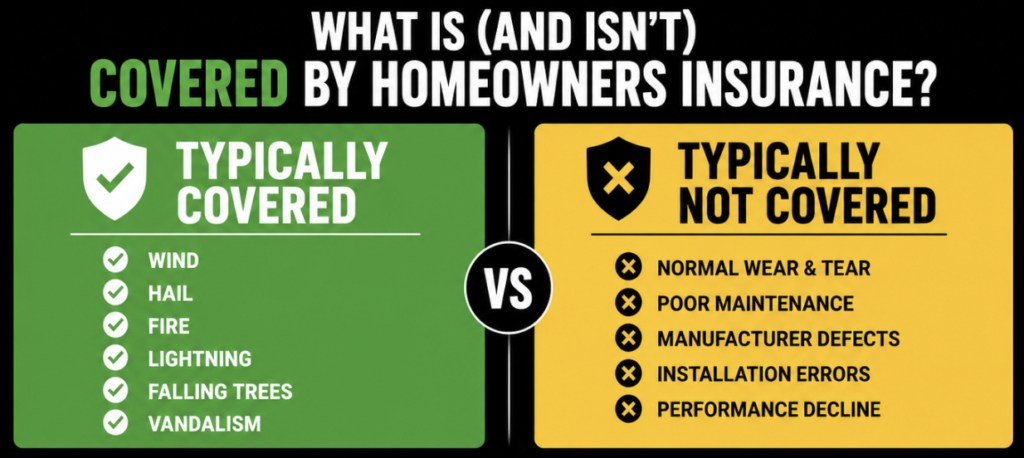
For roof-mounted systems, most standard homeowners insurance policies extend dwelling coverage to solar panels because they are attached to the home and considered a permanent improvement. This means covered perils such as wind, hail, fire, and lightning typically apply to your solar system the same way they apply to your roof and siding.
That said, coverage is not universal. Different insurers handle solar panels differently, some policies require a coverage update when you add significant value to your home, and ground-mounted systems are treated differently than roof-mounted ones. The only way to know for certain what your policy covers is to contact your insurance company after installation and confirm in writing.
Why Are Solar Panels Often Covered by Homeowners Insurance?
Standard homeowners insurance policies include dwelling coverage, which covers the physical structure of your home and anything permanently attached to it. When solar panels are mounted on your roof and connected to your home’s electrical system, most insurers classify them as part of the dwelling rather than separate personal property.
This is the same logic that applies to other permanent home improvements like a new roof, an addition, or an HVAC system. Because the panels are fixed to the structure, they are generally treated as part of the insured property rather than as detachable equipment.
That classification is good news for homeowners. It means you typically do not need to purchase a separate solar panel insurance policy. What you do need to do is make sure your coverage limit reflects the increased value of your home after installation, and confirm with your insurer that your specific policy extends to solar equipment.
What Types of Solar Panel Damage Are Typically Covered?
Coverage varies by policy, but the following perils are commonly covered under standard homeowners insurance for roof-mounted solar systems:
Wind Damage
North Carolina homeowners are no strangers to high winds from thunderstorms and tropical systems. Most policies cover wind damage to structures, and that coverage typically extends to solar panels mounted on the roof. Severe wind events that lift, crack, or dislodge panels would generally fall under a standard wind damage claim.
Hail Damage
Hail is one of the most common causes of solar panel damage. Modern solar panels are engineered and tested to withstand significant hail impact, but severe hailstorms can still cause cracks or delamination. Hail damage is a standard covered peril under most homeowners policies and typically applies to solar panels as part of the roof structure.
Fire Damage
Fire damage to solar panels, whether caused by an external fire, a lightning strike, or an electrical issue, is generally covered under the dwelling portion of a standard homeowners policy. This is one of the more straightforward coverage scenarios because fire damage to the home and fire damage to attached panels are usually treated as a single claim.
Lightning Strikes
A direct lightning strike can damage panels, inverters, and associated electrical components. Lightning damage is a covered peril under most standard homeowners policies, and that coverage extends to permanently installed solar equipment.
Falling Trees and Debris
If a tree or large branch falls on your solar array during a storm, the resulting damage is typically covered under the same provision that covers a tree falling on your roof. This is a common scenario in wooded areas of North Carolina during hurricane season.
Vandalism
Intentional damage to your solar system caused by vandalism is generally covered under the same vandalism provisions that apply to the rest of your home. This is less common than weather-related claims but is included in most standard policies.
What Is Not Usually Covered?
Understanding the limits of your insurance coverage is as important as understanding what is included. The following types of damage or loss are typically not covered by homeowners insurance:
Normal Wear and Tear
Homeowners insurance covers sudden, accidental damage, not the gradual degradation that occurs naturally over time. Solar panels degrade slowly over their lifespan, typically losing about 0.5% to 0.7% of output per year. That gradual decline is not an insurable event.
Poor Maintenance
If damage results from neglected maintenance, such as allowing debris to accumulate and cause structural stress, insurance companies can deny the claim. Keeping your system in good working order and following the manufacturer’s solar panel maintenance recommendations protects both your system’s performance and your coverage.
Manufacturer Defects
If a panel fails due to a manufacturing defect, that is not a covered insurance event. It is a warranty event. Equipment defects are handled through the manufacturer’s product warranty, not your homeowners policy. This is one of the key reasons solar panel warranties matter and why working with an installer who carries quality equipment is important.
Installation Errors
Damage that results from improper installation is also typically excluded from insurance coverage. This reinforces the importance of working with a licensed, experienced installer. At 8MSolar, every installation is completed by our in-house engineering team, not subcontractors, which means installation quality is consistent and documented.
Gradual Performance Loss
A system that is producing less energy than expected due to panel degradation, shading changes, or inverter aging is not an insurance claim. Performance issues are addressed through performance warranties from the manufacturer or installer, not homeowners insurance.
Are Ground-Mounted Solar Panels Covered?
Ground-mounted solar systems are treated differently than roof-mounted systems by most insurers. Because they are not attached to the home, they may not be covered under the dwelling portion of your policy.
Instead, a ground-mounted system may fall under the “other structures” portion of your homeowners policy, which typically covers detached garages, fences, and similar structures not attached to the main dwelling. Other structures coverage is usually a smaller sub-limit of your total policy, often 10% of your dwelling coverage, which may or may not be sufficient to cover the full value of a ground-mounted solar array.
If you are installing a ground-mounted solar system, it is especially important to discuss coverage specifics with your insurer before installation to confirm the system is adequately covered and to increase your other structures limit if necessary.
Will Solar Panels Increase Homeowners Insurance Costs?
Possibly, but not dramatically for most homeowners. Here is why: homeowners insurance premiums are partially based on the replacement cost of your home. Adding a solar system increases the value of your home and therefore the amount it would cost to replace it after a total loss. That increased replacement value can result in a modest premium adjustment.
The increase varies by insurer and by system size, but most homeowners report relatively small premium changes after adding solar. The exact impact depends on your current coverage limits, your system’s value, and how your insurer calculates replacement cost.
Some insurers also have specific underwriting considerations for solar, particularly in high-wind or high-hail areas. If you are in a coastal or storm-prone area of North Carolina, it is worth asking your insurer specifically how they treat solar panels in their risk assessment.
Solar Panel Warranty vs. Homeowners Insurance
Insurance and warranties are complementary but distinct protections. Understanding what each covers helps you know where to turn when something goes wrong.
| Situation | Homeowners Insurance | Manufacturer Warranty | Installation Warranty |
| Storm damage (wind, hail, fire) | Typically covered | Not covered | Not covered |
| Equipment defect | Not covered | Typically covered | May be covered |
| Panel underperformance | Not covered | Performance warranty applies | May be covered |
| Improper installation damage | Not covered | Not covered | Typically covered |
| Vandalism | Typically covered | Not covered | Not covered |
| Normal degradation over time | Not covered | Not covered | Not covered |
| Lightning strike | Typically covered | Not covered | Not covered |
| Falling tree or debris | Typically covered | Not covered | Not covered |
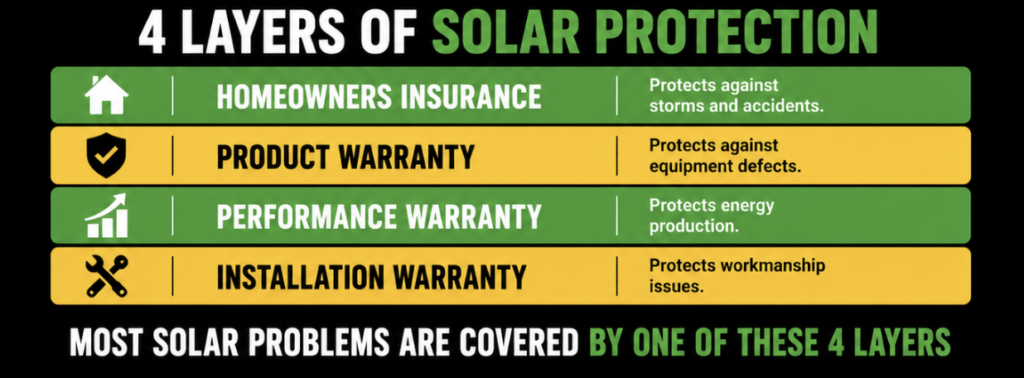
Most quality solar systems come with three layers of warranty protection: a product warranty covering equipment defects, a performance warranty guaranteeing minimum output over 25 years, and an installation workmanship warranty from your installer. Together with homeowners insurance, these four layers of protection cover the vast majority of scenarios a homeowner might face over the life of their system.
What Should Homeowners Do After Installing Solar?
Contact Your Insurance Company
The most important step is notifying your insurer that you have installed solar panels. Provide the system’s value, the installation documentation, and the equipment specifications. Confirm in writing that your system is covered under your existing policy and ask whether any coverage updates are needed.
Update Home Value Information
Your insurer may need to update your dwelling replacement cost estimate to reflect the added value of your solar system. Failing to do this could leave you underinsured in the event of a total loss claim.
Keep Installation Documentation
Store your installation contract, permit approvals, engineering drawings, and inspection certificates somewhere accessible. These documents may be required when filing a claim and help establish the value and condition of your system at the time of installation.
Store Warranty Information
Keep copies of all manufacturer warranties and your installer’s workmanship warranty. Know what each covers, for how long, and how to file a claim under each. 8MSolar provides all warranty documentation at installation and remains your point of contact for warranty-related questions throughout the life of your system.
How 8MSolar Helps Protect Your Investment
At 8MSolar, protecting your solar investment starts before the first panel goes on your roof. Here is how we approach it:
- Quality equipment. We install panels and inverters from manufacturers with strong product and performance warranties. Equipment quality is the foundation of long-term system reliability.
- Professional installation. Every 8MSolar installation is completed by our in-house engineering team. That means consistent quality, proper documentation, and full accountability for the work we perform.
- Manufacturer warranties. The equipment we install carries industry-standard product and performance warranties. We review those terms with you before installation so you know exactly what is covered.
- Ongoing support. We remain your point of contact for system performance, warranty questions, and maintenance needs for the life of your system. You will not be left searching for support after the installation is complete.
- Documentation assistance. We provide complete installation documentation that you can share with your insurance company, including permit approvals, engineering drawings, and equipment specifications.
Solar panels are built to withstand decades of weather exposure, and in most cases they are protected by both homeowners insurance and manufacturer warranties. If you are considering residential solar installation in North Carolina, 8MSolar can help you understand every aspect of system ownership, from installation and warranties to long-term protection. Schedule your free solar consultation today.
Frequently Asked Questions
Are solar panels automatically covered by homeowners insurance?
Not automatically. Roof-mounted panels are often covered under existing dwelling coverage, but you should notify your insurer after installation and confirm coverage in writing. Some policies require an update to reflect the added home value.
Does insurance cover hail damage to solar panels?
Hail is a standard covered peril under most homeowners insurance policies and typically extends to roof-mounted solar panels. Modern panels are tested to withstand significant hail impact, but severe storms can still cause damage that would be covered under a standard claim.
Are ground-mounted solar panels covered?
Ground-mounted systems may fall under the “other structures” portion of your policy rather than dwelling coverage, which typically carries a lower coverage limit. Verify coverage specifics with your insurer before installing a ground-mounted system.
Will solar panels increase my homeowners insurance premium?
Possibly. Adding solar increases your home’s replacement value, which can modestly affect your premium. The exact impact varies by insurer, system size, and your current coverage limits. Most homeowners report relatively small premium adjustments.
Do I need additional insurance for solar panels?
In most cases, no. Roof-mounted systems are typically covered under existing homeowners insurance. However, if your system’s value would push your home’s replacement cost above your current coverage limit, you may need to increase your dwelling coverage. Ask your insurer to confirm.
What is the difference between a solar warranty and insurance?
Insurance covers sudden damage from covered events like storms, fire, and vandalism. Warranties cover equipment defects, performance shortfalls, and installation workmanship issues. The two work together to provide comprehensive protection over the life of your system.
Does homeowners insurance cover battery storage systems?
In most cases, yes. Battery storage systems installed as part of a solar installation are generally treated similarly to other permanently installed home equipment. Confirm with your insurer that your battery system is included in your dwelling coverage.
What should I tell my insurance company after installing solar?
Notify your insurer that you have installed solar panels, provide the system’s total value and equipment specifications, share your installation documentation, and ask them to confirm in writing that your system is covered under your existing policy. Ask whether any coverage limit adjustments are needed to reflect the added home value.