Table of Contents
- Introduction to Solar Panels and Wildlife
- The Impact of Solar Energy on Wildlife Habitats
- How to Reduce Solar Panels’ Impact on Wildlife
- Innovations in Wildlife-Friendly Solar Design
- Case Studies: Successful Wildlife Conservation Efforts in Solar Projects
- Collaboration and Stakeholder Engagement
- Looking Ahead: The Future of Wildlife-Friendly Solar Energy
- Frequently Asked Questions About Solar Panels and Wildlife
- Making Solar Energy More Wildlife-Friendly
Introduction to Solar Panels and Wildlife
Solar energy helps reduce reliance on fossil fuels, but solar panel installations can also affect wildlife and natural habitats. The extent of those impacts depends on where solar panels are installed, the size of the project, and how the surrounding land is managed.
Do solar panels harm wildlife? Solar installations can disrupt habitats, affect animal movement, and create potential risks for birds and other species, particularly when large solar farms are built on previously undeveloped land. However, careful site selection, wildlife-friendly designs, and responsible vegetation management can help reduce these impacts.
Understanding the relationship between solar panels and wildlife is important for developing renewable energy projects that protect biodiversity while generating clean electricity.
However, it’s important to recognize that not all solar installations have the same impact on wildlife. Factors such as the location, size, and design of solar projects can influence their effects on local ecosystems. For example, rooftop solar installations and solar arrays installed on already degraded lands have minimal impact on wildlife compared to large-scale ground-mounted solar farms built in pristine natural areas. To address these challenges, researchers, conservationists, and renewable energy developers are increasingly working together to develop wildlife-friendly solar solutions. These efforts involve implementing best practices in site selection, design, and land management to minimize negative impacts on wildlife while maximizing renewable energy generation.
For homeowners, rooftop solar generally has a smaller direct impact on natural habitats because panels are installed on an existing structure rather than requiring additional land. Ground-mounted residential systems may also have relatively limited impacts, depending on their size, location, and the vegetation or habitat affected during installation.

Innovations in solar panel technology and design also offer promising opportunities for integrating renewable energy and wildlife conservation goals. For instance, incorporating bird-friendly designs that reduce collision risks or creating pollinator-friendly habitats within solar arrays can enhance biodiversity and ecosystem services while supporting clean energy production. Community engagement and stakeholder collaboration are essential components of sustainable solar development. By involving local communities, indigenous peoples, and other stakeholders in the planning and decision-making processes, we can ensure that solar projects respect cultural values, protect sensitive habitats, and benefit both people and wildlife.
As we transition towards a more sustainable energy future, it’s critical to approach solar energy development with an understanding of its environmental impacts, including its effects on wildlife and ecosystems. By integrating wildlife conservation principles into solar planning and implementation, we can lessen potential conflicts and create synergies that benefit both renewable energy production and biodiversity conservation.
The Impact of Solar Energy on Wildlife Habitats
Solar energy represents a promising avenue for combating climate change and reducing our reliance on fossil fuels. As we embrace this energy source, it’s essential to understand the implications for wildlife habitats and ecosystems. Solar panel installations, while offering clean energy benefits, can also exert significant pressure on local ecosystems, altering habitats and affecting various species in nuanced ways. The construction and operation of solar installations can disrupt wildlife behaviors and ecological processes. Noise, vibrations, and human activity associated with construction can disturb wildlife, leading to increased stress levels, changes in movement patterns, and even displacement from critical habitats. The presence of solar infrastructure, such as panels and support structures, can create barriers to animal movement and migration, fragmenting habitats and inhibiting species’ ability to access food, water, and shelter.
Another concern is the potential for solar installations to create new hazards for wildlife. Large-scale solar farms can create collision risks for birds and other flying wildlife. Researchers are also studying whether reflected and polarized light from solar panels attracts certain species or influences their flight behavior, potentially contributing to these risks. The use of pesticides, herbicides, or other chemicals in solar farm maintenance can have unintended impacts on local wildlife populations and ecosystems as well. While the impact of solar energy on wildlife habitats is significant, it’s not uniform across all projects. Factors such as the location, size, and design of solar installations play a crucial role in determining their footprint.
To address these challenges and minimize negative impacts on wildlife habitats, stakeholders are exploring various strategies and approaches. This includes conducting environmental assessments and site evaluations to identify and avoid critical habitats and sensitive species, implementing wildlife-friendly design features such as wildlife corridors and habitat buffers, and adopting responsible land management practices to enhance biodiversity within solar project areas. Achieving a balance between renewable energy development and wildlife conservation requires thoughtful planning, collaboration, and innovation. By integrating wildlife considerations into the planning, design, and management of solar projects, we can ease negative impacts on habitats and species while advancing our transition to a cleaner, more sustainable energy future.
How to Reduce Solar Panels’ Impact on Wildlife
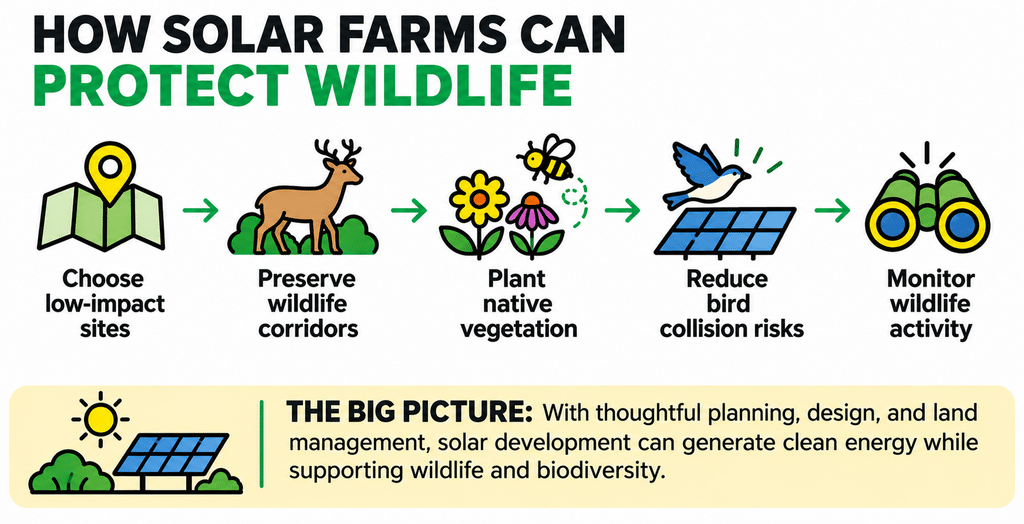
As we expand our use of solar energy to combat climate change, we must adopt strategies that minimize disruption to wildlife habitats. Thoughtful placement of solar infrastructure plays a role in lowering risks and preserving ecological integrity. By considering key factors such as habitat suitability, biodiversity conservation, and land-use planning, we can minimize the impact of solar panel placement on wildlife.

Site Selection and Land Use Planning:
- Conduct site assessments to identify areas with minimal ecological value and low wildlife sensitivity.
- Prioritize the use of brownfield sites, abandoned agricultural lands, or degraded areas for solar development to minimize habitat fragmentation.
- Avoid siting solar projects in critical habitats, such as wetlands, riparian zones, or important wildlife corridors, to prevent disturbance to sensitive species and ecosystems.
Wildlife Corridors and Habitat Connectivity:
- Design solar projects to include wildlife corridors and connectivity pathways that allow for the movement of species between fragmented habitats.
- Maintain or restore natural vegetation buffers around solar installations to provide habitat connectivity and nesting areas for wildlife, reducing isolation and promoting species resilience.
Sensitive Species Protection:
- Implement setback distances and exclusion zones to protect sensitive habitats and breeding sites of priority species, minimizing direct impacts on their populations.
Minimizing Disturbance during Construction:
- Implement measures to reduce noise, vibrations, and human disturbance during the construction phase to minimize stress on wildlife populations.
- Schedule construction activities outside of sensitive breeding or nesting seasons to avoid disrupting critical life stages for wildlife species.
Reducing Collision Risks:
- Utilize non-reflective or bird-friendly solar panel designs to reduce the risk of collisions with birds and other flying wildlife.
- Implement deterrent measures such as visual markers, ultrasonic devices, or acoustic deterrents to mitigate collision risks and minimize wildlife mortality.
Vegetation Management and Habitat Enhancement:
- Adopt low-impact vegetation management practices, such as mowing regimes or targeted grazing, to maintain vegetation cover within solar project areas.
- Incorporate native plantings and pollinator-friendly habitats within solar arrays to enhance biodiversity, support wildlife populations, and promote ecosystem services.
Monitoring and Adaptive Management:
- Establish long-term monitoring programs to assess the effectiveness of mitigation measures and track changes in wildlife populations and habitat conditions over time.
- Implement adaptive management strategies to adjust solar project operations and management practices based on monitoring data and stakeholder feedback, ensuring compatibility with wildlife conservation objectives.
By integrating these best practices into the planning and management of solar projects, we can minimize disruption to wildlife and their habitats while maximizing the benefits of clean energy. Through collaboration between renewable energy developers and conservation organizations we can achieve a balance between renewable energy development and wildlife conservation goals, contributing to a more sustainable and ecologically resilient future.
Innovations in Wildlife-Friendly Solar Design
As the demand for renewable energy grows, there is a need to develop innovative solutions that not only harness solar power efficiently but also minimize harm to wildlife and their habitats. Here are some notable innovations in wildlife-friendly solar design:
Solar Panel Orientation and Placement:
Optimal panel orientation and tilt angles can maximize energy capture while minimizing visual disturbance to wildlife and reducing the potential for solar glare. By orienting solar panels to reduce reflective surfaces and light pollution, wildlife-friendly designs can temper disruption to nocturnal species such as bats and night-flying insects.
Bird-Friendly Design Features
Researchers are exploring bird-friendly design features, including changes to panel reflectivity, surface patterns, and visibility, to determine whether these approaches can reduce collision risks around solar installations. Research into avian behavior and flight patterns assists in the development of design elements that increase visibility for birds and minimize the risk of collision with solar panels.
Habitat Enhancement within Solar Arrays
Integrating habitat enhancement features within solar arrays, such as native plantings, pollinator gardens, and wildlife corridors, can provide foraging and nesting opportunities for wildlife while promoting biodiversity. These enhancements not only support local wildlife populations but also contribute to ecosystem services such as pollination, pest control, and soil conservation.
Pollinator-Friendly Solar Farms
Pollinator-friendly solar projects incorporate native grasses, wildflowers, and other vegetation to provide habitat for bees, butterflies, and other beneficial insects.
These practices can support biodiversity while helping manage soil erosion and vegetation around solar equipment.
For example, Minnesota’s Habitat Friendly Solar Program promotes vegetation management practices that benefit pollinators and other wildlife. Monitoring at participating solar sites has documented a variety of native insects, birds, amphibians, and other animals.
However, the ecological benefits depend on the site’s original condition, plant selection, maintenance practices, and long-term habitat management.
Elevated or Dual-Use Solar Installations
Elevated solar installations, such as solar canopies or raised platforms, minimize ground disturbance and provide habitat continuity for ground-dwelling species. Dual-use solar installations that combine energy production with agricultural or grazing activities can optimize land use efficiency while maintaining habitat functionality for wildlife.
Remote Sensing and Monitoring Technologies
Remote sensing technologies like drones, satellite imagery, and LiDAR (Light Detection and Ranging), enable accurate site assessments and wildlife surveys to identify sensitive habitats and inform design decisions. Real-time monitoring systems equipped with motion sensors, cameras, and acoustic detectors allow for the continuous monitoring of wildlife activity around solar installations, facilitating adaptive management and mitigation efforts.
Collaborative Research and Knowledge Sharing
Collaborative research initiatives bring together cross-functional teams of scientists, engineers and ecologists to develop and evaluate wildlife-friendly solar design solutions. Knowledge sharing platforms circulate lessons learned and encourage the adoption of wildlife-friendly principles across the solar industry, driving innovation and improvement.
Policy Incentives and Certification Programs
Policy incentives, such as tax credits, grants, and renewable energy mandates, can incentivize the adoption of wildlife-friendly practices and support the development of wildlife-friendly solar projects. Certification programs, such as the Wildlife-Friendly Solar Certification by the National Wildlife Federation, provide validation for solar projects that adhere to wildlife conservation standards.
These innovations in wildlife-friendly solar design can minimize the ecological footprint of solar energy development and create harmonious landscapes where clean energy coexists with thriving wildlife populations. As we continue to refine these technologies, we move closer to a sustainable energy future that prioritizes both environmental stewardship and renewable energy innovation.
Case Studies: Successful Wildlife Conservation Efforts in Solar Projects
Examining real-world examples where solar developers have shown a commitment to protecting local wildlife populations offers insights into the synergies between renewable energy development and wildlife conservation. These case studies showcase innovative approaches and best practices that have been instrumental in creating solar projects while promoting biodiversity and ecosystem health.
Desert Tortoise Conservation, Solar Energy Generating Systems (SEGS), California
The SEGS project in California’s Mojave Desert exemplifies a proactive approach to wildlife conservation in solar energy. Developers collaborated with wildlife biologists to conduct surveys and implement measures to protect the threatened desert tortoise population.
Protective fencing, wildlife crossings, and habitat restoration efforts were employed to minimize disturbance to tortoises and maintain connectivity. Real-time monitoring systems were also installed to track tortoise movements and inform management strategies.
Avian Protection, Topaz Solar Farm, California
The Topaz Solar Farm, one of the largest photovoltaic solar installations in the world, prioritized avian protection during project planning and construction phases. Developers worked closely with ornithologists and conservation organizations to identify potential collision risks for birds.
Bird-friendly design features were incorporated into the solar panels to reduce collision risks. Monitoring programs were established to assess avian behavior and mortality rates, enabling adjustments to minimize impacts on bird populations.
Pollinator Habitat Restoration, Butter Solar Project, Minnesota
The Butter Solar Project in Minnesota integrated pollinator-friendly habitat restoration into its solar design, demonstrating a novel approach to amplify biodiversity while generating energy. Native plants were seeded between solar panels to create pollinator habitats.
By providing resources for bees, butterflies, and other pollinators, the project not only supported local wildlife populations but also contributed to agricultural productivity and resilience. The success of the pollinator habitat restoration has inspired similar initiatives in other solar projects across the region.
Collaboration and Stakeholder Engagement
Wildlife-friendly solar development depends on cooperation between project developers, environmental specialists, landowners, local communities, and regulatory agencies. Early communication can help identify sensitive habitats, address environmental concerns, and incorporate conservation measures before construction begins.
In the realm of sustainable energy, legislative frameworks that mandate collaboration between renewable energy developers, conservationists, and local communities are vital. Such legislation would serve as a catalyst for bridging gaps and finding solutions that benefit all involved parties. Let’s delve into why this legislative approach is essential and how it could lead to tangible outcomes:
Ensuring Transparency and Communication
Legislation would enforce transparent communication from the beginning of renewable energy projects. It would require early engagement of stakeholders, allowing them to voice concerns, share insights, and propose solutions. Transparent communication builds trust and fosters a sense of ownership among all parties involved.
Empowering Local Communities through Legal Frameworks
Legislation would empower local communities to actively participate in decision-making processes regarding renewable energy projects. It would mandate community involvement, ensuring that projects align with local values, address community needs, and foster economic opportunities. Legislation would provide policy support and incentives for renewable energy projects. It would create an environment for sustainable energy development by encouraging collaboration and stakeholder engagement. Incentives would spur innovation and investment in projects that benefit both the environment and communities.
Looking Ahead: The Future of Wildlife-Friendly Solar Energy
The future of wildlife-friendly solar energy is bright, with ample opportunities for innovation and policy development to minimize environmental impact while maximizing clean energy production. By harnessing technological advancements, implementing adaptive management strategies, and fostering collaboration among stakeholders, we can pave the way for a sustainable energy future that prioritizes both wildlife conservation and renewable energy generation. Together, we can ensure that solar energy projects not only meet our energy needs but also safeguard the biodiversity and ecosystems that sustain life on our planet.
Frequently Asked Questions About Solar Panels and Wildlife
Do Solar Panels Harm Wildlife?
Solar panels can affect wildlife, particularly when large ground-mounted solar installations disturb natural habitats or create barriers to animal movement. However, the level of impact depends on the project’s location, size, design, and land management practices.
Are Solar Panels Dangerous to Birds?
Birds can collide with solar panels and other infrastructure at solar facilities, including fences and power lines. Researchers are also investigating how reflected light may influence bird behavior. Careful site selection and wildlife-conscious project design can help reduce potential risks.
Do Rooftop Solar Panels Affect Wildlife?
Rooftop solar panels generally have less direct impact on natural habitats than large ground-mounted installations because they use existing structures. However, installers should still consider wildlife that may nest or shelter around the roof and follow applicable wildlife protection requirements.
Can Solar Farms Benefit Wildlife?
Yes, some solar farms can support wildlife when they incorporate native vegetation, pollinator habitats, and suitable wildlife corridors. These benefits depend on the site’s original conditions and how the land is managed.
How Can Solar Farms Reduce Their Environmental Impact?
Solar developers can reduce impacts by avoiding sensitive habitats, preserving wildlife corridors, limiting construction disturbance, using responsible vegetation management, and monitoring wildlife activity.
Are Solar Panels Better for the Environment Than Fossil Fuels?
Solar panels generate electricity without burning fossil fuels during operation, helping reduce electricity-related greenhouse gas emissions. However, manufacturing, land use, installation, and disposal still have environmental impacts that should be managed responsibly.
Making Solar Energy More Wildlife-Friendly
Solar energy offers important environmental benefits, but responsible development requires considering its effects on wildlife and natural habitats. From careful site selection to native vegetation and wildlife corridors, thoughtful planning can help reduce the environmental impacts of solar installations.
For homeowners, rooftop solar can offer a way to generate renewable electricity without requiring the extensive land development associated with large solar farms. Choosing the right installation location and working with an experienced solar provider can help minimize unnecessary disruption to the surrounding property.
At 8MSolar, we help homeowners and businesses explore solar energy solutions suited to their properties, electricity needs, and long-term goals.
Contact 8MSolar to learn more about solar installation options for your home or business.