
A full charge for a Tesla vehicle model typically ranges from $10 to $25, depending on the model. Most Tesla owners find that charging their vehicle’s battery is more economical than fueling a conventional gasoline-powered car, potentially reducing fuel costs by up to 50%. The exact charging expense varies based on several factors, including your specific Tesla model, where you charge it, and how often you drive.
The Tesla Model 3, Model Y, Model S, Model X, and Cybertruck have different energy requirements, meaning their charging costs can vary considerably.
Below, we’ll compare estimated Tesla charging costs, explain what affects your electricity expenses, and explore how home solar panels can help offset the cost of charging an electric vehicle.
Table of Contents
- How much does it cost to charge a Tesla?
- How Much Does It Cost to Drive a Tesla 100 Miles?
- How much does it cost to charge a Tesla Model S?
- How much does it cost to charge a Tesla Model X?
- How much does it cost to charge a Tesla Model Y?
- What is the cost to charge a Tesla Model 3?
- How Much Does It Cost to Charge a Tesla Cybertruck?
- Charging a Tesla with Solar
- What are the pros and cons of electric vehicles?
- What Factors Affect the Cost of Charging a Tesla?
- Frequently Asked Questions About Tesla Charging Costs
- Reduce Your Tesla Charging Costs With Home Solar
How much does it cost to charge a Tesla?
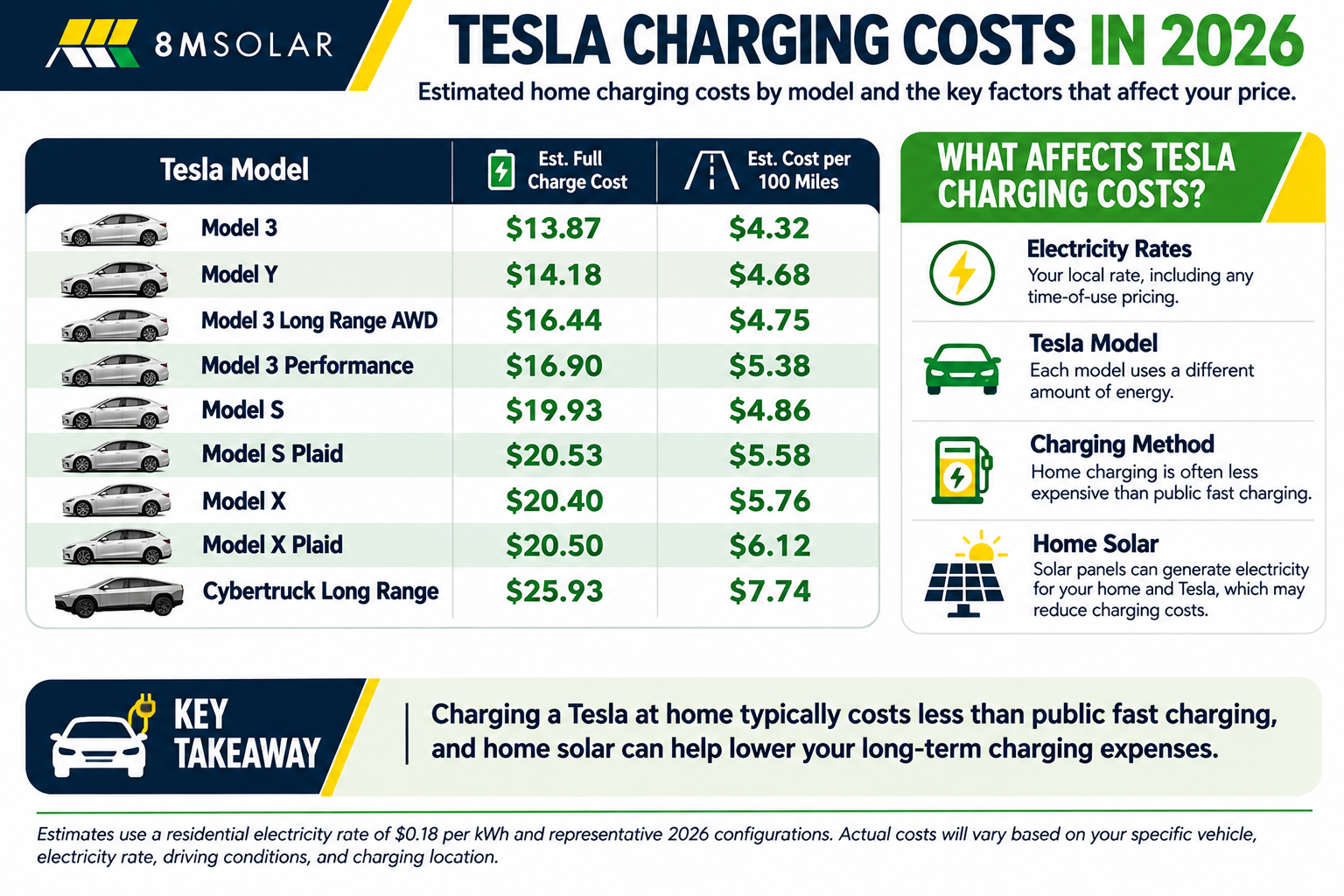
The amount you’ll spend to charge a Tesla varies based on your vehicle usage, the specific Tesla model you plan to purchase, and your charging location. The table below provides an average estimate of the costs associated with fully charging each Tesla model at home:
| Model | Est. charging cost | Cost per 100 miles |
| Model 3 | $13.87 | $4.32 |
| Model Y | $14.18 | $4.68 |
| Model 3 Performance | $16.90 | $5.38 |
| Model 3 Long Range | $16.44 | $4.75 |
| Model X Plaid | $20.50 | $6.12 |
| Model X | $20.40 | $5.76 |
| Model S | $19.93 | $4.86 |
| Model S Plaid | $20.53 | $5.58 |
| Tesla Cybertruck | $25.93 | $7.74 |
Note: These figures are estimates for residential electricity charging, not fixed prices. Your actual charging cost depends on your Tesla’s model year and configuration, local electricity rate, battery level, and charging losses. Public Supercharger pricing may differ substantially from home electricity rates.
How Much Does It Cost to Drive a Tesla 100 Miles?
Another way to compare Tesla charging costs is to calculate the electricity expense for every 100 miles driven.
This is especially helpful when comparing Tesla models with different battery capacities and driving ranges.
The basic formula is:
Cost per 100 miles = Electricity used per 100 miles (kWh) × Electricity rate ($/kWh)
For example, if an electric vehicle uses 25 kWh to travel 100 miles and your electricity rate is $0.18 per kWh, the estimated electricity cost would be $4.50 per 100 miles, before accounting for any additional charging losses.
Your actual cost will depend on your vehicle’s efficiency, driving conditions, local electricity rate, and charging equipment.
When comparing Tesla models, looking at cost per 100 miles can be more helpful than comparing full-charge costs alone.
How much does it cost to charge a Tesla Model S?
As of November 2026, the estimated cost of charging a Tesla Model S depends on the vehicle’s configuration and local electricity rates. Using an illustrative residential electricity rate of $0.18 per kWh, a Model S costs approximately $19.93 for a full charge, or $4.86 per 100 miles. The Model S Plaid has a slightly higher estimated charging cost of $20.53 for a full charge, or $5.58 per 100 miles.
These estimates are based on representative 2026 vehicle efficiency ratings. Actual costs may vary depending on driving conditions, charging location, and electricity prices.
How much does it cost to charge a Tesla Model X?
As of November 2026, the Tesla Model X remains one of Tesla’s larger electric SUVs, with charging costs that vary depending on the configuration and electricity rate.
At an illustrative residential electricity rate of $0.18 per kWh, the Model X has an estimated full-charge cost of $20.40, or approximately $5.76 per 100 miles. The Model X Plaid has an estimated full-charge cost of $20.50, or approximately $6.12 per 100 miles.
Because the Model X is a larger vehicle, its electricity consumption is generally higher than that of smaller Tesla models. Actual charging expenses depend on driving habits, weather conditions, and local electricity prices.
How much does it cost to charge a Tesla Model Y?
As of November 2026, the Tesla Model Y continues to offer an all-electric SUV option with charging costs that depend on its configuration, energy efficiency, and local electricity rates.
Using an illustrative residential electricity rate of $0.18 per kWh, the Model Y has an estimated full-charge cost of $14.18, or approximately $4.68 per 100 miles.
These figures represent estimated home charging costs for a representative 2026 configuration. Actual costs may vary depending on the specific Model Y version, driving conditions, charging efficiency, and electricity rates.
While these fuel savings are significant, many Tesla owners have found an even more economical charging solution: utilizing home solar panels. This approach further reduces operating costs for their electric vehicles.
What is the cost to charge a Tesla Model 3?
As of November 2026, the Tesla Model 3 is available in multiple configurations, with differences in driving range, energy efficiency, and charging costs.
Using an illustrative residential electricity rate of $0.18 per kWh, estimated charging costs for representative 2026 Model 3 configurations include:
- Tesla Model 3: Approximately $13.87 for a full charge, or $4.32 per 100 miles.
- Tesla Model 3 Long Range AWD: Approximately $16.44 for a full charge, or $4.75 per 100 miles.
- Tesla Model 3 Performance: Approximately $16.90 for a full charge, or $5.38 per 100 miles.
The Model 3 is generally more energy-efficient than Tesla’s larger SUVs and trucks, which can help keep charging expenses lower.
Actual costs depend on the specific configuration, electricity rates, driving habits, and charging conditions.
How Much Does It Cost to Charge a Tesla Cybertruck?
As of November 2026, the Tesla Cybertruck generally requires more electricity per mile than smaller Tesla models because of its size and energy consumption.
Using an illustrative residential electricity rate of $0.18 per kWh, the 2026 Cybertruck Long Range has an estimated full-charge cost of $25.93, or approximately $7.74 per 100 miles.
The actual cost of charging a Cybertruck depends on its configuration, driving conditions, electricity prices, and whether it is charged at home or through Tesla’s Supercharger network.
For Cybertruck owners who regularly charge at home, installing solar panels may help offset some of the additional electricity consumption associated with EV ownership.
Charging a Tesla with Solar

Can You Charge a Tesla With Solar Panels?
Yes. A home solar panel system can generate electricity that helps power your home and charge your Tesla.
When your solar panels produce electricity, that energy can be used by household appliances and an EV charger. Depending on your system configuration and charging schedule, solar energy may reduce the amount of electricity you need to purchase from your utility.
How Much Does It Cost to Charge a Tesla With Solar Power?
The cost depends on several factors, including:
- The cost and size of your solar installation.
- How much electricity your panels generate.
- Your Tesla’s charging requirements.
- Whether you charge during the day or at night.
- Your utility’s electricity rates and solar export compensation policies.
- Whether your home has battery storage.
Solar energy is not automatically free after installation. However, generating electricity at home may help reduce long-term charging expenses, particularly for households with significant electricity usage.
Do You Need a Solar Battery to Charge a Tesla?
No. A solar battery is not required to charge a Tesla using electricity generated by home solar panels.
A grid-connected solar system can supply electricity to your home and EV charger without battery storage. However, if you typically charge your Tesla after sunset, your vehicle may draw electricity from the grid unless your system includes compatible energy storage.
A home battery can provide additional flexibility, although it also increases the upfront system cost.
How Many Solar Panels Do You Need to Charge a Tesla?
The number of solar panels needed depends on how far you drive, your Tesla’s electricity consumption, local sunlight conditions, and the output of your solar panels.
Homeowners considering solar-powered EV charging should include their vehicle’s expected electricity usage when sizing a solar energy system.
The actual cost of solar panel installation and the electricity output can vary based on your home’s location and the amount of sunlight it receives. To get a tailored estimate, you can use an online solar calculator, entering your zip code and power bill details.
What are the pros and cons of electric vehicles?

Electric vehicles offer considerable savings on annual operating costs and the convenience of home recharging, contributing positively to environmental conservation. They have also demonstrated their ability to match traditional vehicles in terms of power and performance. However, adapting to charging networks may present initial challenges, requiring additional planning for potentially slower charging stops.
What Factors Affect the Cost of Charging a Tesla?
Several factors determine how much you’ll pay to charge a Tesla, whether at home or at a public charging station.
1. Local Electricity Rates
Your electricity rate is one of the biggest factors affecting charging costs. Some utilities also offer time-of-use plans with different electricity prices depending on when you charge.
2. Tesla Model and Energy Efficiency
Different Tesla models consume different amounts of electricity. Larger vehicles and performance-oriented configurations may require more energy to travel the same distance.
3. Home Charging vs. Public Charging
Charging at home typically allows you to use your residential electricity rate, while public charging stations may have different pricing structures.
4. Charging Efficiency
Some energy is lost during the charging process. As a result, the amount of electricity purchased from the grid may be greater than the energy ultimately stored in the vehicle’s battery.
5. Driving Habits and Weather
Highway speeds, extreme temperatures, elevation changes, and climate control usage can affect how much electricity your Tesla consumes.
6. Home Solar Energy
Homeowners with solar panels may be able to offset some of their EV charging electricity consumption. The financial benefit depends on solar production, charging schedules, and local utility policies.
Frequently Asked Questions About Tesla Charging Costs
Is It Cheaper to Charge a Tesla at Home or at a Supercharger?
Home charging is often less expensive because it uses your residential electricity rate. Tesla Supercharger pricing varies by location and charging conditions, so comparing local prices is the best way to determine the difference.
How Much Does It Cost to Charge a Tesla Overnight?
Overnight charging costs depend on your Tesla model, how much electricity the battery needs, and your utility’s rate. Households with time-of-use electricity plans may have access to lower off-peak rates.
How Much Does It Cost to Charge a Tesla for 100 Miles?
The cost depends on your Tesla’s electricity consumption and your electricity rate. For example, a vehicle using 25 kWh per 100 miles would require approximately $4.50 in electricity at $0.18 per kWh, before additional charging losses.
Can Solar Panels Reduce Tesla Charging Costs?
Yes. Solar panels can generate electricity that helps power your EV charger, potentially reducing electricity purchases from your utility. The savings depend on solar production, household energy usage, and local electricity rates.
Do You Need a Tesla Powerwall to Charge a Tesla With Solar?
No. A Tesla Powerwall is not required for solar-powered EV charging. However, compatible battery storage can help homeowners use stored solar electricity outside daylight hours.
Reduce Your Tesla Charging Costs With Home Solar
Charging a Tesla at home can be a convenient way to manage your vehicle’s energy needs. Pairing home charging with solar panels may also help reduce the amount of electricity you purchase from your utility.
At 8MSolar, we help homeowners explore solar energy systems that fit their household electricity usage, including the additional demand from electric vehicles.
Whether you’re considering home solar, battery storage, or EV charging equipment, our team can help you evaluate your options.
Contact 8MSolar to learn how residential solar energy could support your Tesla charging needs.