
North Carolina homeowners will see higher electricity rates beginning in 2027.
On November 16, 2026, the North Carolina Utilities Commission approved new rates for Duke Energy Carolinas and Duke Energy Progress. The changes will take effect January 1, 2027, with additional increases scheduled for January 2028.
According to Duke Energy’s announcement, residential customers will see average annual rate increases of approximately 4.8% for Duke Energy Carolinas and 4.7% for Duke Energy Progress over the two-year rate plan.
While the approved increases are lower than Duke Energy originally requested, they will still add to electricity costs for many North Carolina households.
For homeowners, understanding what these changes mean and how to manage long-term electricity expenses is becoming increasingly important.
What Are Duke Energy’s Approved Rate Increases?
The approved rate changes affect customers of both Duke Energy utilities operating in North Carolina.
Duke Energy Carolinas serves approximately 2.3 million homes and businesses across central and western North Carolina, including Charlotte, Durham, and the Triad.
Duke Energy Progress serves approximately 1.6 million customers across central and eastern North Carolina, including the Asheville region.
The approved residential rate increases are:
| Utility | Average Annual Residential Rate Increase | Effective Dates |
| Duke Energy Carolinas | 4.8% | January 2027 and January 2028 |
| Duke Energy Progress | 4.7% | January 2027 and January 2028 |
Although the two utilities are scheduled to combine into a single utility on January 1, 2027, their rates will initially remain separate. The North Carolina Utilities Commission will determine how those rates gradually blend over time.
These percentages represent average annual residential rate increases under the approved plans. Individual bill changes will depend on electricity usage and applicable rates.
How Much More Will North Carolina Homeowners Pay?
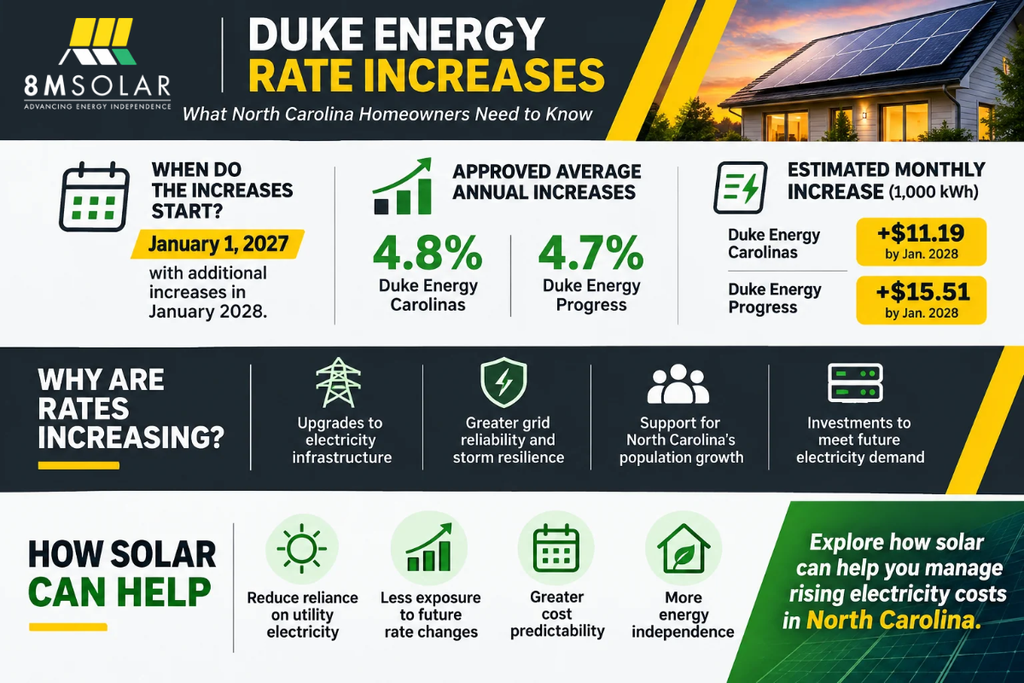
Percentages can be difficult to translate into household expenses. Duke Energy also provided projected monthly bill increases for residential customers using 1,000 kilowatt-hours (kWh) of electricity per month.
| Utility | January 2027 Increase | Additional January 2028 Increase | Total Monthly Increase by 2028 |
| Duke Energy Carolinas | $6.53 | $4.66 | $11.19 |
| Duke Energy Progress | $9.62 | $5.89 | $15.51 |
Source: Duke Energy, November 17, 2026. Estimates are based on monthly electricity usage of 1,000 kWh.
By January 2028, these projections represent approximately $11 to $16 in additional monthly electricity costs for a typical household, compared with bills before the increases.
Actual bill changes will vary. Homes that use more electricity may see larger increases, while households with lower consumption may see smaller changes.
Why Are Duke Energy Rates Increasing?
Duke Energy initially filed its rate increase requests with the North Carolina Utilities Commission in November 2025.
The original proposals sought overall retail revenue increases of 15% for Duke Energy Carolinas and 15.1% for Duke Energy Progress over the rate plan period.
Following regulatory review and negotiations with the North Carolina Public Staff and other participating parties, Duke Energy reached settlement agreements that reduced its original requests.
On November 16, 2026, the commission approved the revised agreements, establishing the new rates beginning in January 2027.
The approved plans include investments in electricity infrastructure and reliability. Duke Energy has cited North Carolina’s population growth and the need to strengthen the power grid against storms as factors behind its planned investments.
The agreements also include additional protections related to large data centers, infrastructure project timelines, and financial assistance for customers experiencing hardship.
The final approved increases are lower than Duke Energy originally proposed, but electricity costs will still rise for residential customers.
How Can Solar Help With Rising Electricity Costs?
Homeowners cannot control the rates their utility charges, but they can explore ways to reduce how much electricity they purchase from the grid.
Residential solar panels allow homeowners to generate electricity on their property and use that power to meet a portion of their household’s energy needs.
Depending on the system and the home’s electricity consumption, solar can offer several benefits:
- Reduced reliance on utility electricity: Generating electricity at home can offset some of the power that would otherwise come from the grid.
- Less exposure to utility rate changes: Using more of your own solar electricity can reduce the amount of electricity you need to purchase at utility rates.
- Greater cost predictability: Depending on the system’s cost and financing arrangement, solar can make a portion of long-term electricity expenses more predictable.
- More energy independence: Homeowners gain another source of electricity rather than relying entirely on their utility.
Solar does not automatically eliminate an electric bill. Homeowners may still have fixed utility charges, purchase electricity when their panels aren’t generating enough, or have financing and maintenance expenses.
Battery storage is another option for homeowners who want to store excess solar generation for use later. Whether a battery makes financial sense depends on household needs, utility policies, and system costs.
The goal is to understand how solar could work for your home and how much of your electricity usage it could realistically offset.
Common Questions About Rising Electricity Rates
When will Duke Energy’s rate increases take effect?
The approved rate increases for Duke Energy Carolinas and Duke Energy Progress will begin January 1, 2027. Additional increases are scheduled for January 2028.
How much are Duke Energy rates increasing in 2027?
For a residential customer using 1,000 kWh per month, Duke Energy Carolinas projects a $6.53 monthly increase beginning in January 2027. Duke Energy Progress projects a $9.62 monthly increase for the same level of electricity use.
How much more will Duke Energy customers pay by 2028?
By January 2028, a residential customer using 1,000 kWh per month could pay approximately $11.19 more per month with Duke Energy Carolinas or $15.51 more per month with Duke Energy Progress, compared with bills before the approved increases.
Can solar panels lower my Duke Energy bill?
Yes. Solar panels can generate electricity for your home, reducing the amount you need to purchase from Duke Energy. Actual savings depend on electricity usage, system size, utility rates, and other factors. Homeowners may still have utility charges or need to purchase electricity from the grid.
Will solar panels protect me from future electricity rate increases?
Solar can reduce your exposure to utility rate increases by allowing you to generate and use some of your own electricity. However, it does not eliminate every utility cost or guarantee protection from all future rate changes.
Take a Closer Look at Solar for Your North Carolina Home
With electricity rates scheduled to increase in 2027 and 2028, now is a good time to evaluate your home’s long-term energy needs.
At 8MSolar, our team can help you understand how a solar system could work for your property, how much electricity it may generate, and what that could mean for your future utility bills.