What if your solar panels could earn you money even after they’ve already zeroed out your electric bill? For homeowners in certain states, that’s exactly what happens — thanks to Solar Renewable Energy Credits, or SRECs. These certificates are one of the most powerful but least understood solar financial incentives available, and for Virginia homeowners in particular, they can add hundreds of dollars per year in passive income on top of everything else solar already provides.
This guide breaks down exactly what SRECs are, how much they’re worth today, and the step-by-step process to sell them — with a special focus on the Virginia SREC market and what North Carolina residents need to know instead.
What Exactly Is an SREC?
The Simple Analogy: A “Green Energy Receipt”
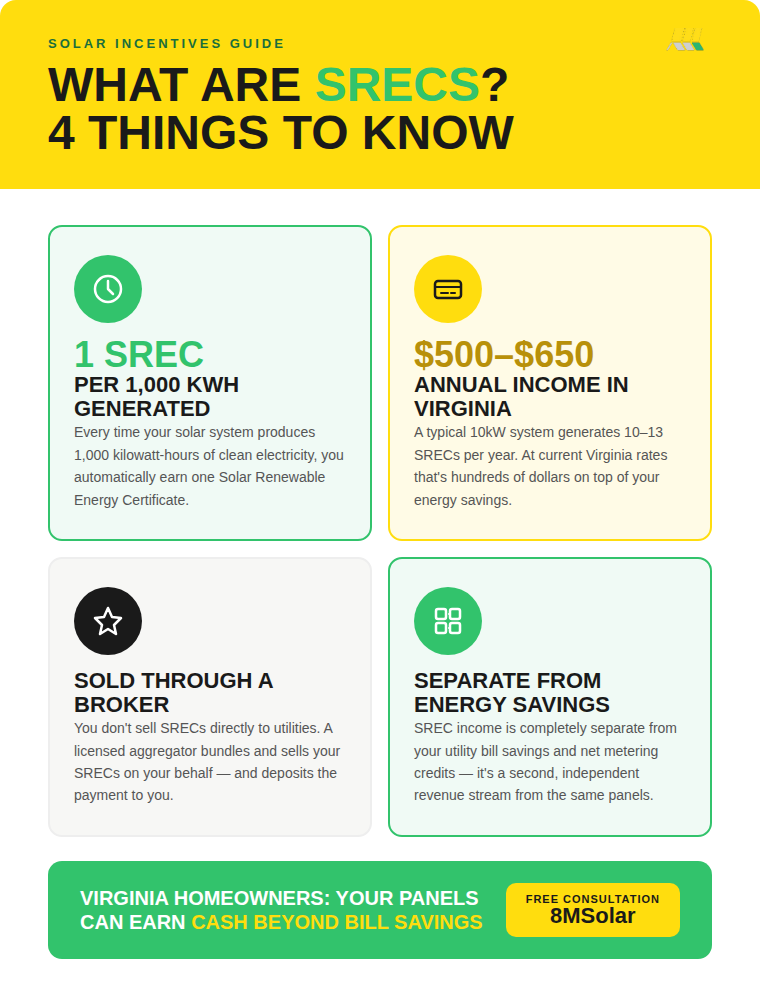
Think of an SREC as a tradeable receipt your solar system earns for every 1,000 kilowatt-hours (kWh) of clean electricity it produces. State laws require utility companies to collect a certain number of these “green receipts” each year to prove they’re supporting renewable energy. If they don’t generate or purchase enough clean energy themselves, they must buy these receipts from solar system owners like you — and that’s where your income comes from.
The key insight: you earn SRECs for the electricity your panels generate, not just what you use. Even if you consume every kilowatt-hour your system produces, you still earn one SREC per 1,000 kWh generated. The certificate and the electricity are two separate, independently tradeable things.
How SRECs Help States Meet Clean Energy Goals
SRECs exist because of state policies called Renewable Portfolio Standards (RPS) — state-mandated goals that require a certain percentage of a utility’s electricity to come from renewable sources. Some states go further by including a solar carve-out: a specific portion of that renewable requirement that must come specifically from solar power.
That solar carve-out is what creates a dedicated SREC market. Utilities that can’t meet their solar requirement through their own generation must buy SRECs from homeowners and businesses that have solar systems — creating real demand and real market value for your certificates.
The SREC Market: How Prices Are Determined
Supply and Demand: The Core Driver
Like any market, SREC prices rise and fall based on supply and demand. When many new solar systems come online and flood the market with SRECs, prices tend to fall. When utilities are behind on their solar goals and need to buy more certificates, prices rise. This is why SREC values vary significantly from state to state and can change year to year — even within the same state.
The ACP: The Market’s Price Ceiling
Every SREC market has a built-in price ceiling called the Alternative Compliance Payment (ACP). This is the fine a utility must pay for every SREC they fall short of their annual solar requirement. A utility will never pay more for an SREC than the cost of this fine — so the ACP effectively sets the maximum possible SREC price in a given state. States with high ACPs tend to have higher SREC values; states with low ACPs have lower ones.
A Deep Dive: The Virginia SREC Market
Current Virginia SREC Prices
Virginia’s SREC market has been active since 2020 under the Virginia Clean Economy Act. Virginia homeowners with solar systems can currently earn between $500 and $650 per year from SREC sales for a standard 10kW system. For the most current market pricing, check reputable SREC trading platforms like SRECTrade or Flett Exchange before making any decisions — prices fluctuate with market conditions.
How Much Can a Typical Virginia Homeowner Earn?
A standard 10kW solar system in Virginia typically produces around 12,000 kWh per year — generating approximately 12 SRECs annually. At current 2025 market rates, that translates to roughly $500–$650 per year in SREC income, on top of your electricity bill savings and net metering credits. Over a 25-year system lifespan, that adds up to $12,500–$16,250 in cumulative SREC income from the same panels already saving you money every month.
The Step-by-Step Process to Sell SRECs in Virginia
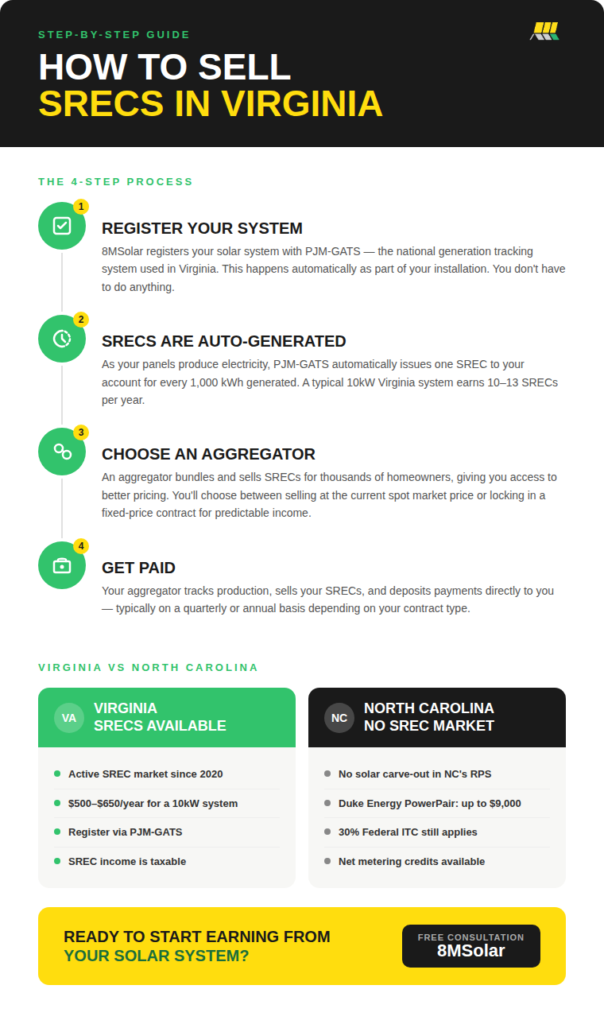
- System registration: Your solar installer (8MSolar) registers your system with the PJM-GATS (Generation Attribute Tracking System), the national tracking platform used in Virginia. This happens during or shortly after your installation — you don’t have to manage it yourself.
- SRECs are automatically generated: As your system produces electricity, PJM-GATS automatically issues one SREC for every 1,000 kWh generated. Your production meter reports generation data continuously.
- Choose an aggregator: An aggregator is a company that bundles and sells SRECs for thousands of homeowners, giving you access to better pricing and handling all the market transactions on your behalf. You’ll choose between a spot market arrangement or a fixed-price contract (more on this below).
- Get paid: Your aggregator tracks your production, sells your SRECs, and deposits payments to you — typically on a quarterly or annual basis depending on your contract.
Why Doesn’t North Carolina Have an SREC Market?
Different Policies, Different Incentives
North Carolina has renewable energy goals under its own RPS policy, but its laws don’t include a solar-specific carve-out — meaning there’s no compliance requirement for utilities to specifically buy solar energy certificates. Without that carve-out, there’s no SREC market. NC utilities can meet their renewable obligations through any source, so they have no particular need to purchase solar certificates from homeowners.
North Carolina’s Alternative: The Duke Energy PowerPair Program
Instead of production-based credits, North Carolina focuses on a powerful upfront incentive: the Duke Energy PowerPair program. Rather than earning ongoing certificates, eligible NC homeowners can receive up to $9,000 in upfront rebates for installing solar paired with battery storage — plus the 30% Federal ITC on top of that. It’s a different structure than SRECs, but the financial impact is significant. 8MSolar actively advocates for expanding solar incentive programs in NC and will keep customers informed as the policy landscape evolves.
Selling Your SRECs: Choosing the Right Strategy
Option 1: Selling on the Spot Market
Selling on the open spot market means your SRECs are sold at whatever the current market price is at the time of the sale.
- Pros: You can capture the highest possible price if the market spikes. Full flexibility — no long-term commitment.
- Cons: Income is unpredictable. If the market is oversupplied and prices drop, your annual earnings can be significantly lower than expected.
Option 2: Long-Term Fixed-Price Contracts
A forward contract locks in a guaranteed price for your SRECs for a set number of years — typically 3 to 5 years.
- Pros: Predictable, stable income. Makes it easy to budget and plan loan repayments. Protects you if market prices fall.
- Cons: If market prices rise above your contract rate, you’ll miss out on higher earnings. You’re locked in for the contract period.
The right choice depends on Virginia’s current market conditions and your financial goals. 8MSolar can walk you through both options and help you decide what makes the most sense for your situation.
Frequently Asked Questions About SRECs
Which states have active SREC markets?
As of 2025, states with active SREC markets include New Jersey, Massachusetts, Maryland, Pennsylvania, Illinois, Virginia, Ohio, Delaware, and Washington DC. Markets vary significantly in value — New Jersey and Massachusetts have historically offered some of the highest SREC prices in the country.
Are SREC earnings taxable?
Yes — the IRS generally considers income from SRECs to be taxable income. How it’s classified (ordinary income vs. other) can depend on your specific situation. We always recommend consulting with a qualified tax professional to understand your obligations and any potential deductions.
How is my solar production tracked to create SRECs?
Your system’s inverter or a dedicated production meter automatically reports generation data to PJM-GATS, the national tracking system used in Virginia. PJM-GATS then issues the corresponding SRECs to your account. Your aggregator manages this process for you — it’s fully automated once your system is registered.
Do I still save money on my electric bill if I sell SRECs?
Absolutely. Selling SRECs is completely independent of your utility bill savings and net metering credits. They’re separate systems — selling a certificate doesn’t affect your ability to use the electricity your panels produce or the credits you earn through net metering. SRECs are simply an additional, second revenue stream from the same solar investment.
Can I sell SRECs if I financed my solar system?
Yes — as long as you own the system (purchased outright or financed with a loan), you own the SRECs it generates. If you leased your solar panels, the SRECs typically belong to the leasing company, not you. This is one of the key financial advantages of ownership over leasing.
Let 8MSolar Help You Maximize Your Solar ROI
SRECs are a game-changing incentive for Virginia homeowners — turning solar panels into a true revenue-generating asset that pays you in multiple ways simultaneously: lower utility bills, net metering credits, and annual SREC income. For North Carolina homeowners, the PowerPair program and Federal ITC offer equally compelling financial returns through a different structure.
The key is understanding which incentives apply to you and working with an installer who knows how to maximize every one of them. Contact 8MSolar today for a free consultation — we’ll give you a clear breakdown of your potential savings, SREC income, and total return on investment so you can make the most informed decision possible.