Buying solar is a big decision. Once you start looking into it, you quickly realize there isn’t just one way to pay for a system. You can pay for it upfront, finance it with a solar loan, lease the system, or use another third-party ownership arrangement. The Prepaid Lease is another option that works differently from a traditional solar lease.
So which one makes the most sense?
It depends on what you want from your solar system, how much you want to pay upfront, whether you want to own the equipment, and whether you’d rather make monthly payments or handle the cost another way.
Why How You Pay for Solar Matters
The price of a solar system is only part of the decision. Two homeowners could install nearly identical systems and end up with very different financial arrangements depending on how they pay for them.
A cash purchase means paying upfront and owning the system. A solar loan spreads that cost over time while keeping ownership with the homeowner. A lease shifts ownership and certain responsibilities to a third party. The Prepaid lease takes a different approach by using one upfront payment instead of traditional monthly lease payments.
The best option comes down to more than the lowest monthly payment. It’s worth looking at the total cost, ownership, contract terms, maintenance responsibilities, and what happens if you sell your home.
The 4 Main Ways to Pay for Solar
For most homeowners, the options worth comparing are:
- Cash purchase: Pay for the system upfront and own it outright.
- Solar loan: Finance the system over time while keeping ownership.
- Solar lease: A third party owns the system while you make payments under the lease agreement.
- Prepaid Lease: Make one upfront payment while a financing provider covers the remaining system cost and owns the system.
Third-party ownership is the structure behind some of these options, including traditional leases and prepaid arrangements. It isn’t necessarily a separate payment method, but it’s important to understand because it determines who owns the system.
Solar Financing At a Glance
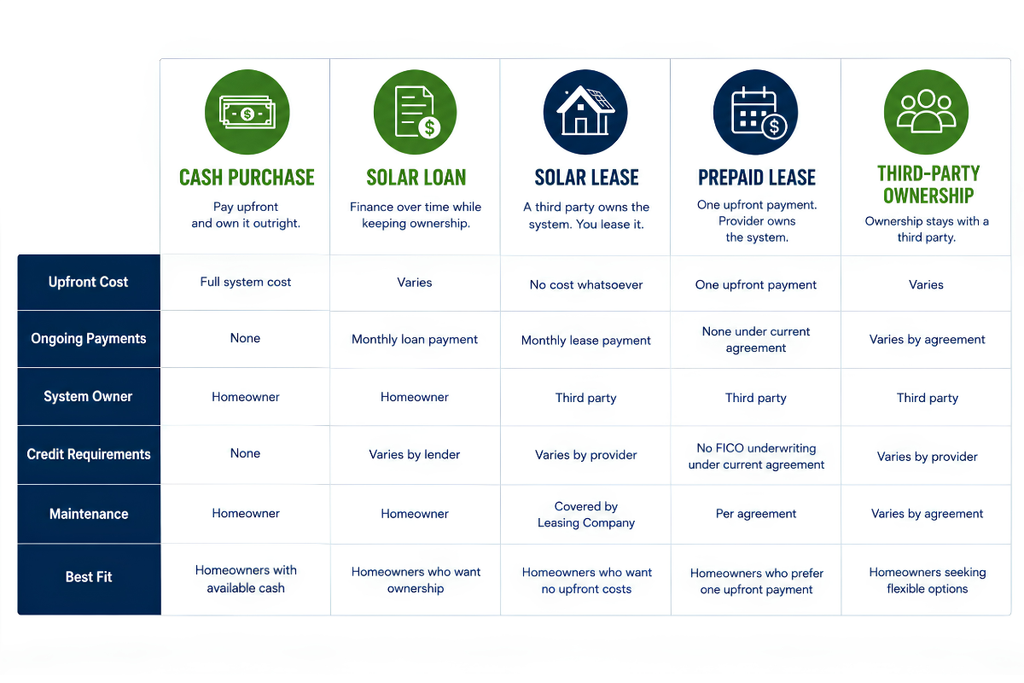
Tax treatment can vary by ownership structure and current tax rules, so that should be reviewed separately before choosing a financing option.
Option 1: Buying Solar With Cash
How It Works
A cash purchase is the most straightforward way to buy solar.
You pay for the system and installation upfront, and you own the system from the start. There are no loan payments or lease payments after the purchase. The total cost depends on the size of the system, equipment, installation requirements, your home’s energy use, and other project-specific factors.
Pros
- You own the system outright.
- There are no monthly solar payments.
- You don’t pay interest on the system.
- You have control over the equipment.
- Ownership may make you eligible for incentives available under current rules.
Cons
- You need the money available upfront.
- A large amount of cash goes toward the project at once.
- You’re responsible for the system as the owner.
- Your long-term savings depend on the system’s cost, energy production, electricity rates, and applicable incentives.
Best Fit
A cash purchase can make sense if you have the money available and want to avoid financing altogether.
If you want a closer look at what goes into a residential solar installation, see 8MSolar’s residential solar installation guide.
Option 2: Using a Solar Loan
How It Works
A solar loan lets you spread the cost of your system over time rather than paying for everything upfront. A lender finances the project, and you make monthly payments according to the loan terms. Interest rates, loan lengths, down payments, and qualification requirements vary by lender.
The important part is that you own the solar system.
Pros
- You own the system.
- You can spread the cost over several years.
- Some loans offer little or no money down.
- You don’t have to use a large amount of cash upfront.
- You may be eligible for incentives available to system owners under current rules.
Cons
- Interest increases the total cost of the system.
- You’ll need to qualify for the loan.
- You’ll have a monthly payment for the length of the loan.
- As the owner, you’re responsible for understanding maintenance and warranty coverage.
A lower monthly payment isn’t necessarily a lower total cost. Longer loan terms can reduce the monthly payment while increasing the amount you pay over time.
For a deeper look at this option, see 8MSolar’s solar lease vs. solar loan comparison.
Best Fit
A solar loan can be a good fit if you want to own your system but don’t want to pay the entire project cost upfront.
Option 3: Solar Leasing
How It Works
With a traditional solar lease, a third party owns the solar system installed on your home.
Instead of buying the equipment, you make payments under the lease agreement for the use of the system and the energy it produces. The details can vary between providers. Payment amounts, contract length, escalators, maintenance responsibilities, and purchase options all depend on the specific agreement.
Pros
- Little or no upfront cost may be available.
- You don’t have to purchase the system.
- The system owner typically handles certain maintenance and service responsibilities.
- Payments can make your solar costs more predictable.
- You can use the energy your system produces without owning the equipment.
Cons
- You don’t own the system.
- Monthly payments continue according to the agreement.
- Some leases include annual payment increases.
- Contract terms can affect what happens when you sell your home.
- You don’t have the same ownership benefits as someone who purchases the system.
Best Fit
A lease may make sense if keeping your upfront costs low and avoiding system ownership are more important to you than owning the equipment outright.
If you’re specifically interested in low-upfront-cost solar, 8MSolar’s guide to getting solar panels with no money down goes into more detail about the different ways that can work.
Option 4: Prepaid Lease
The Prepaid Lease takes a different approach from a traditional monthly solar lease.
Instead of making ongoing lease payments, the homeowner makes one upfront payment. Under the current Prepaid Lease described by 8MSolar, a financing provider covers the remaining system cost and owns the system. Participate Energy is the current provider referenced by 8MSolar, but the more important thing to understand is how the financing structure itself works.
How It Works
The homeowner makes a single upfront prepayment and receives an immediate reduction in the cost of the arrangement. The financing provider covers the remaining system cost and remains the system owner.
Under the current agreement described by 8MSolar, the homeowner has no additional fees, ongoing payments, or financial obligations for the stated 25-year period. The current agreement also does not require a FICO score or credit underwriting and does not require a UCC lien on the property. The upfront payment may also be financed separately through an approved lender or the homeowner’s financial institution, subject to that lender’s requirements.
Pros
- One upfront payment instead of traditional monthly lease payments.
- Immediate upfront discount.
- No FICO score or credit underwriting for the described Customer Participation Agreement.
- No property lien through the Customer Participation Agreement.
- No ongoing payments under the current described agreement.
- The upfront payment may be financed separately.
Cons
- You still need to cover the upfront payment or arrange separate financing.
- You don’t initially own the solar system.
- Separate financing for the upfront payment has its own terms.
- Any future purchase option depends on the specific agreement.
- Selling the home is subject to the agreement’s transfer provisions.
Best Fit
The Prepaid lease may be worth considering if you prefer one upfront payment instead of traditional monthly solar payments, but don’t necessarily want to own the equipment yourself.
8MSolar has a prepaid solar lease guide with more information about how the current structure works.
How Third-Party Ownership Fits In
Third-party ownership, or TPO, simply means that someone other than the homeowner owns the solar system. A traditional solar lease is one example. Prepaid leases can also use a third-party ownership structure.
That distinction matters because ownership affects who is responsible for the equipment, how payments work, what happens if you sell your home, and how incentives are handled. When you’re comparing TPO options, don’t stop at the fact that someone else owns the system. Look at the actual agreement and compare the payment structure, contract length, escalators, maintenance responsibilities, transfer requirements, and any purchase options.
What About Tax Credits and Incentives?
This is one area where you want to be careful. Tax treatment can depend on who owns the system and the rules in effect when you install it. Cash purchases and solar loans put ownership with the homeowner, while leases and other third-party arrangements put ownership with the provider.
That doesn’t mean you should assume a specific tax credit applies to one option without checking the current rules.
Federal solar incentives have changed, and some existing solar financing information online reflects older rules. Before choosing a financing structure based on a tax benefit, confirm the current requirements and speak with a qualified tax professional about your situation.
Which Solar Payment Option Is Right for You?
There isn’t one option that’s best for everyone. Think about what matters most to you.
Want to Own the System?
A cash purchase or solar loan keeps ownership with you.
Want to Avoid a Large Upfront Cost?
A solar loan or traditional lease may let you get started without paying the full system cost upfront.
Want to Avoid Monthly Solar Payments?
Cash purchase and Prepaid lease are two options to look at, although they work very differently.
Don’t Want to Own or Maintain the Equipment?
A traditional lease or another third-party ownership arrangement may be worth comparing.
Want the Simplest Long-Term Arrangement?
Ownership through a cash purchase means there is no financing agreement or lease payment to manage after the system is purchased. The important thing is to compare the full picture, not just the first number you see.
Look at:
- Upfront cost
- Monthly payments
- Total cost over time
- System ownership
- Maintenance responsibilities
- Contract length
- Escalators
- Incentives and tax treatment
- What happens if you sell your home
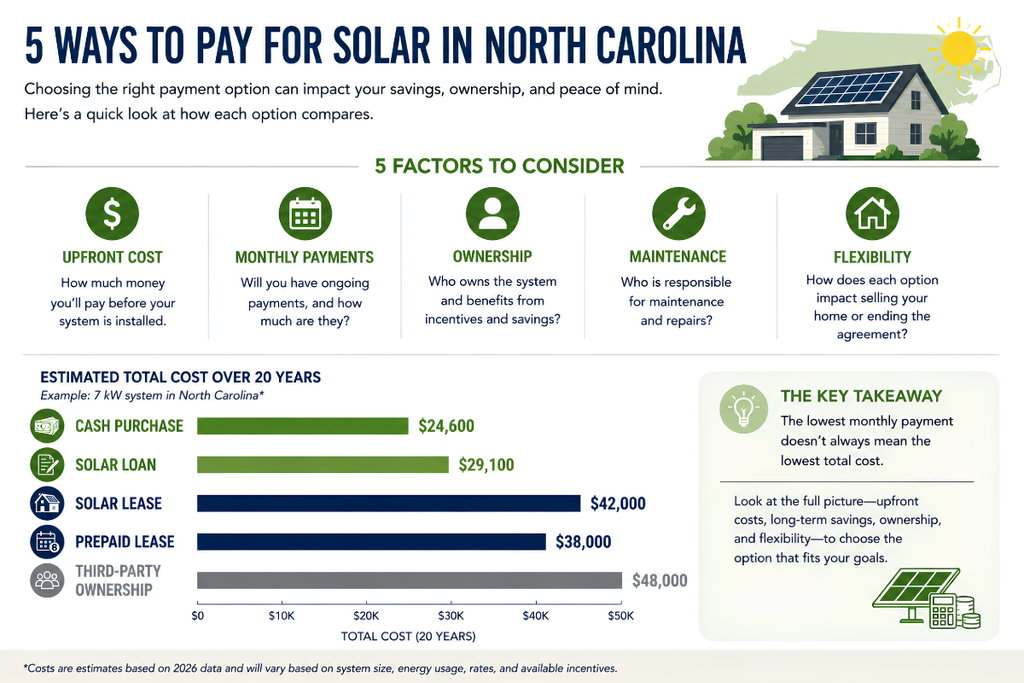
The lowest monthly payment isn’t automatically the lowest-cost option. And the highest upfront cost isn’t automatically the best investment. Your energy use, budget, plans for the home, and priorities all matter.
Get Help Comparing Your Solar Options
You don’t have to figure out the financing side before you even talk about solar. 8MSolar can walk you through the different ways to pay for a system, explain how they compare, and help you understand what each option would look like for your home.
The goal isn’t to push you toward one financing option. It’s to give you enough information to make a decision you’re comfortable with.
If you’re ready to compare your options, schedule a free solar consultation with 8MSolar.