When you’re investing in a solar system for your home, the panels themselves often get all the attention. But there’s another component that’s just as critical to your system’s performance and longevity: the inverter. More specifically, the type of inverter technology you choose can affect how much energy you produce, how your system handles shading, and whether you’ll have backup power during outages.
At 8MSolar, we’ve installed thousands of solar systems across North Carolina, and we’ve seen firsthand how microinverter technology transforms the solar experience for homeowners. Unlike traditional string inverters that create a single point of failure for your entire system, microinverters provide panel-level power conversion that maximizes production and reliability.
This guide will walk you through the microinverter options we trust and install, explaining how each one works, what makes them different from string inverters, and which might be the best fit for your home’s specific needs.
Table of Contents
- What Are Microinverters and Why Do They Matter?
- Microinverters vs String Inverters
- The Microinverters 8MSolar Trusts
- Enphase IQ8: The Standard in Microinverter Technology
- APsystems Microinverters: Proven Performance and Value
- SolarEdge Power Optimizers: A Hybrid Approach
- Choosing the Right Microinverter for Your Home
- The Benefits of Microinverters: A Summary
- Expert Installation Makes the Difference
- Future-Proof Your Home with Microinverter Technology
What Are Microinverters and Why Do They Matter?
Before diving into specific models, it helps to understand what microinverters do and why they represent an advancement over older inverter technology.
When solar panels generate electricity, they produce direct current (DC) power. Your home runs on alternating current (AC) power. An inverter’s job is to convert DC to AC so you can use the electricity your panels produce.
Traditional solar systems use a single large string inverter, usually mounted on the side of your house or in your garage. This central inverter handles the conversion for all your panels at once. While this approach has been the industry standard for years, it comes with some limitations.
Microinverters take a different approach. Each solar panel gets its own dedicated inverter mounted directly beneath it on your roof. This panel-level conversion offers several advantages that translate to better performance, enhanced safety, and more detailed monitoring.
Microinverters vs String Inverters
The choice between microinverters and string inverters affects virtually every aspect of your solar system’s operation. Understanding these differences helps you make an informed decision.
Performance: Eliminating the Christmas Light Effect
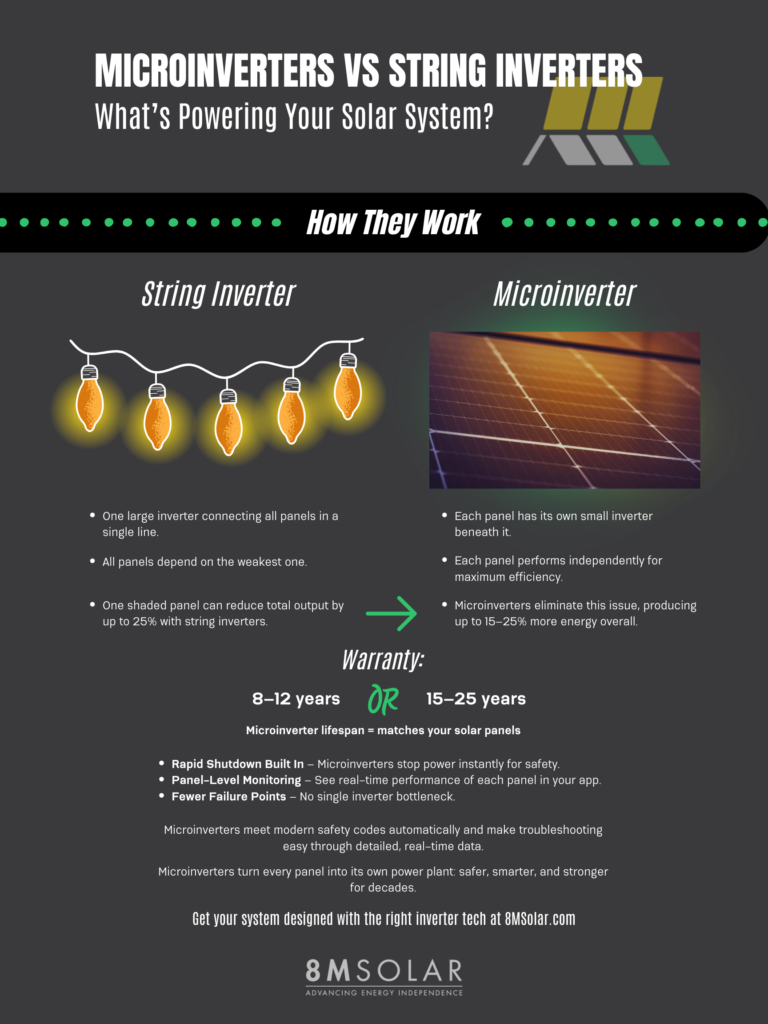
String inverters create what solar professionals call “the Christmas light effect.” Remember those old holiday light strands where one burnt-out bulb would darken the entire string? String inverters work the same way with your solar panels.
Because string inverters connect all your panels in series, the whole system can only produce power at the level of the weakest-performing panel. If one panel is shaded by a tree branch, covered with leaves, or simply dirtier than the others, every panel in that string operates at that reduced capacity.
Microinverters eliminate this problem. Each panel operates independently with its own dedicated inverter. One shaded or dirty panel affects only its own output—the other panels continue producing at their maximum potential.
This independent operation translates to 5-15% more energy production over the system’s lifetime compared to a string inverter setup. Homes with chimneys, vent pipes, trees, or other shading challenges can see even greater improvements, sometimes 20-25% more production.
Safety: Built-in Rapid Shutdown
Modern electrical codes require rapid shutdown capability for residential solar systems. This safety feature allows firefighters and other first responders to quickly de-energize rooftop solar panels in an emergency.
With string inverters, rapid shutdown requires additional equipment, wiring, and potential points of failure. Microinverters have this safety feature built directly into each unit. When the grid connection is lost or a shutdown signal is sent, each microinverter immediately stops producing power. The DC voltage at the panel level drops to safe levels within seconds.
This integrated approach provides protection for your family and emergency personnel while maintaining a more reliable installation.
Monitoring: Seeing What’s Actually Happening
String inverters can only tell you your system’s total output. If production drops, you won’t know which panel is causing the problem without getting on your roof to investigate.
Microinverters enable panel-level monitoring. You can view real-time production data for each individual solar panel through a smartphone app. This visibility makes system maintenance simpler. If you notice one panel underperforming, you can quickly identify whether it needs cleaning or if a growing tree branch is casting shade.
Lifespan: A Warranty That Matches Your Panels
Solar panels typically come with 25-year performance warranties. Traditional string inverters usually carry warranties of only 8-12 years. Many homeowners end up replacing their string inverter at least once during their solar system’s lifetime, adding several thousand dollars in unexpected costs.
The microinverters we install come with warranties ranging from 15 to 25 years, providing peace of mind and protecting your investment for decades.
The Microinverters 8MSolar Trusts
As a design and engineering-based firm, we can install any make and model of microinverters. We’ve found that certain brands consistently deliver the reliability, performance, and support our customers deserve. Here are the microinverter options we recommend most frequently.
Enphase IQ8: The Standard in Microinverter Technology
The Enphase IQ8 represents the latest generation of microinverters from Enphase, the market leader in microinverter technology. This shows a shift in what solar systems can do for homeowners.
Revolutionary Grid-Forming Technology
What sets the IQ8 apart from all previous microinverter generations is its “grid-forming” capability. This technical term describes something remarkably practical: the ability to create a stable, independent power grid for your home when the utility grid fails.
Most solar systems—even those with older microinverters—shut down automatically during a power outage. This safety feature protects utility workers from unexpected voltage on power lines they’re trying to repair. The IQ8 changes this dynamic.
The IQ8 can detect a grid outage and instantly switch modes to form a microgrid, using sunlight as the power source to deliver electricity to designated circuits in your home. This addresses one of the biggest frustrations solar homeowners have faced: watching the sun shine on their panels during an outage while they sit in the dark.
Sunlight Backup Without a Battery
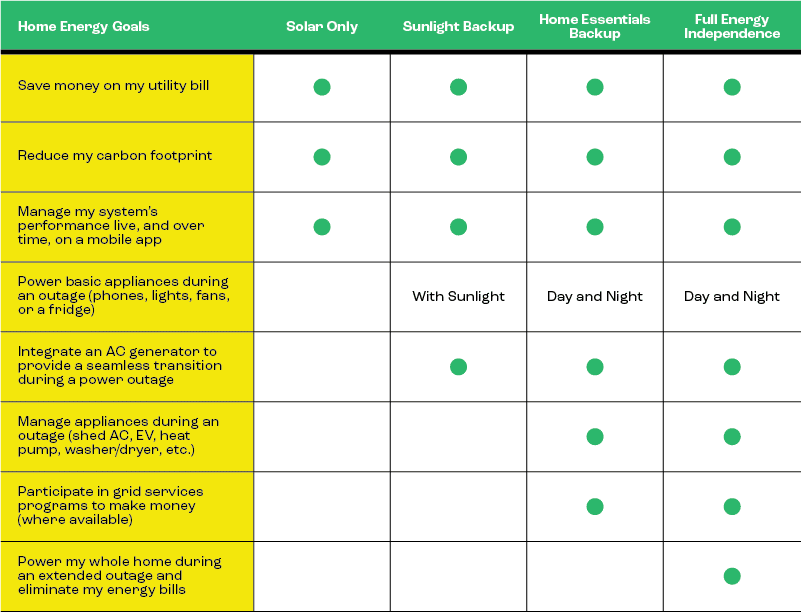
The IQ8’s Sunlight Backup feature provides power during grid outages without requiring a battery—a first for the solar industry. When the sun is shining and the grid is down, your IQ8 system can power essential loads through a dedicated sub-panel.
During sunny periods, essential loads include your refrigerator and freezer, several lights throughout the house, your internet router and modem, small electronics, and a television for monitoring news updates. The exact capacity depends on your solar array size and available sunlight.
It’s important to understand that without a battery, power is only available when the sun is shining. Once the sun sets or heavy clouds roll in, the power will stop flowing until the sun returns or the grid comes back online. For 24/7 backup power, pairing the IQ8 with an Enphase IQ Battery provides complete energy independence.
Seamless System Integration
The IQ8 integrates perfectly with the complete Enphase Energy System, including batteries and monitoring. The Enphase App provides panel-level visibility, showing you how much energy each panel is producing in real-time. This makes troubleshooting simple and gives you transparency into your system’s performance.
The IQ8 comes with an industry-leading 25-year limited warranty, matching the lifespan of your solar panels and providing long-term protection for your investment.
APsystems Microinverters: Proven Performance and Value
APsystems has established itself as a reliable alternative in the microinverter market, offering proven technology with excellent performance characteristics and competitive pricing. We’ve installed many APsystems setups for homeowners who want the benefits of microinverter technology with a more budget-conscious approach.
Dual-Module Design
One feature of many APsystems microinverters is their dual-module design. Rather than one microinverter per panel, these units can handle two panels each. This approach can reduce installation costs while providing many of the benefits of true panel-level conversion.
The dual-module design works well for installations where panels are installed in matching pairs with similar orientation and shading conditions. The system still outperforms string inverters, especially in scenarios with partial shading or panel mismatch.
Strong Warranty Coverage
APsystems backs their microinverters with strong warranty coverage, offering 15-year warranties that can be extended to 20 years. While not quite matching the 25-year coverage of Enphase, this still provides protection and exceeds the 8-12 year warranties common with string inverters.
Reliable Monitoring Platform
The APsystems monitoring platform provides detailed performance data through their Energy Communication Unit (ECU) and smartphone app. You can track production at the microinverter level, view historical performance, and quickly identify any issues that might arise.
SolarEdge Power Optimizers: A Hybrid Approach
While not technically microinverters, SolarEdge power optimizers deserve mention as they provide some similar benefits through a different technological approach. We install SolarEdge systems when they’re the right fit for a home’s needs.
How Power Optimizers Work
SolarEdge uses panel-level power optimizers connected to a central inverter. Each solar panel gets an optimizer that performs maximum power point tracking (MPPT) at the panel level. This allows each panel to operate at its optimal voltage independently, similar to microinverters.
The optimized DC power then flows to a central SolarEdge inverter for the final conversion to AC. This hybrid approach provides many of the performance benefits of microinverters while maintaining some of the cost advantages of a central inverter.
When SolarEdge Makes Sense
SolarEdge systems work well for installations where the central inverter location is convenient and accessible. They’re also popular for homes planning to add electric vehicle charging or battery storage in the future, as SolarEdge offers integrated solutions for these features.
The power optimizers come with 25-year warranties, while the central inverter carries a 12-year warranty (extendable to 25 years for an additional cost). The monitoring platform provides excellent panel-level visibility similar to true microinverter systems.
Choosing the Right Microinverter for Your Home
With several excellent options available, how do you choose the right microinverter technology for your situation? Here are the factors we help homeowners consider.
Budget Considerations
Microinverters add a modest premium compared to traditional string inverters, but the increased energy production and longer warranties often make them cost-effective over the system’s lifetime. The federal solar tax credit applies to your entire system including the inverters, reducing your out-of-pocket expense by 30%.
Among microinverter options, Enphase IQ8 systems are the premium choice, offering the most advanced features and longest warranty. APsystems provides excellent value for homeowners seeking microinverter benefits at a more accessible price point.
Backup Power Needs
If having power during grid outages is important to you, the Enphase IQ8’s Sunlight Backup capability is worth serious consideration. This feature provides immediate value without requiring battery storage, though you can always add batteries later for 24/7 backup power.
Other microinverter systems can certainly work with battery backup, but they don’t offer the same grid-forming capability for battery-free backup power.
Roof Complexity and Shading
Homes with complex roof layouts, multiple orientations, or shading challenges benefit most from microinverter technology. The independent panel operation guarantees you maximize production even when some panels receive more sunlight than others.
For simple, unshaded roof installations with all panels facing the same direction, the performance gap between microinverters and string inverters narrows somewhat. The enhanced monitoring, safety features, and longer warranties still make microinverters an attractive choice.
Future Expansion Plans
If you might want to add more panels in the future, microinverter systems make expansion simpler. You can add panels and their associated microinverters without replacing or upgrading a central inverter.
The modular nature of microinverter systems also makes them ideal if you’re planning to add battery storage down the road. The Enphase ecosystem in particular offers seamless integration between IQ8 microinverters and IQ Batteries.
The Benefits of Microinverters: A Summary
Across all the brands we install, microinverters share several advantages that make them our preferred choice for most residential installations:
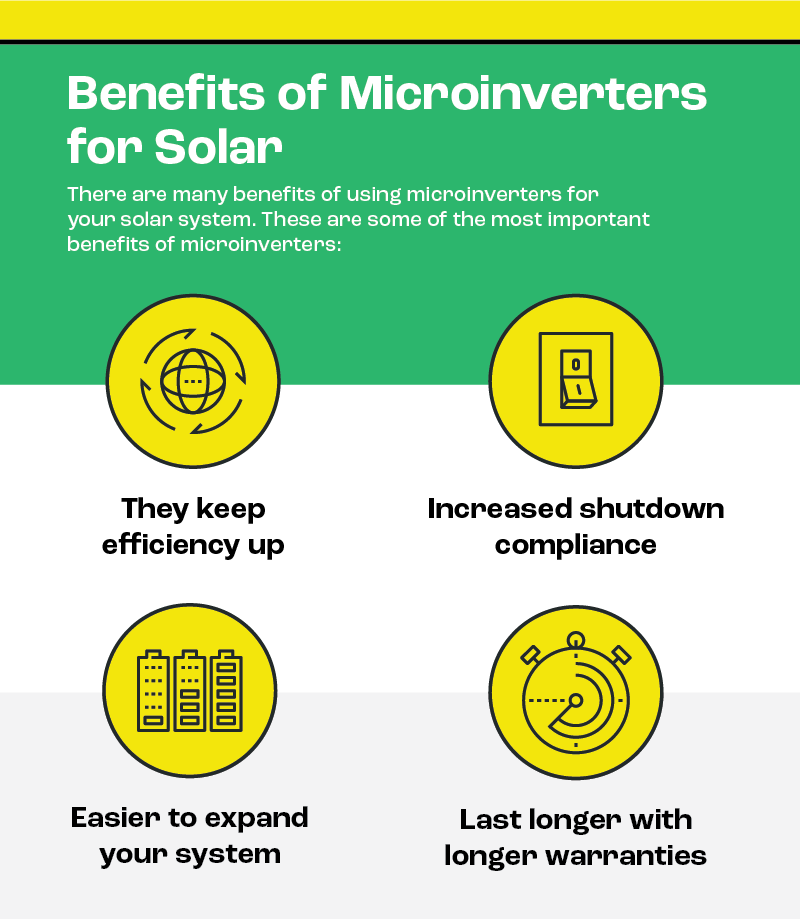
Superior energy production through independent panel operation means you generate more electricity over your system’s lifetime. Each panel produces at its maximum potential regardless of what’s happening with other panels.
Enhanced safety through integrated rapid shutdown protects your family and first responders. There are fewer points of potential failure and cleaner installations compared to string inverters with add-on safety equipment.
Detailed monitoring at the panel level makes troubleshooting simple and gives you complete visibility into your system’s performance. You’ll know immediately if a panel needs attention.
Longer warranties ranging from 15-25 years protect your investment and eliminate the risk of expensive inverter replacements mid-life through your system’s operation.
Greater flexibility for future expansion or adding battery storage means your system can grow with your changing needs.
Expert Installation Makes the Difference
The quality of your microinverter installation matters just as much as the equipment itself. Our team of professional engineers and installers has extensive experience with all the microinverter systems we recommend. We take care to design systems that maximize your property’s solar potential while ensuring reliable installations that will perform flawlessly for decades.
From expertise to energy savings, working with 8MSolar offers many advantages. We assign a local project manager to each customer, ensuring effective communication and quality installation throughout the entire process. We offer the highest-quality products on the market. Our business model eliminates unnecessary costs, making microinverter technology more affordable for our customers.
Future-Proof Your Home with Microinverter Technology
Choosing microinverters for your solar installation highlights an investment in reliability and peace of mind. Whether you opt for the revolutionary Enphase IQ8 with its grid-forming capability, the proven value of APsystems, or another quality option, you’re choosing technology designed to deliver performance for 25 years or more.
As electricity rates rise and grid reliability becomes more uncertain, having a solar system that maximizes every ray of sunlight becomes more valuable each year. Microinverters make sure you’re capturing that value while leaving the door open for future enhancements like battery storage.
Ready to power your home with advanced microinverter technology? Get a Solar Quote from our team at 8MSolar and see how the right microinverter system can work for your specific needs. Contact us to start your journey toward energy independence today.