Solar energy is one of the smartest financial decisions a homeowner or business owner can make — but before you commit, you need to understand what solar panel installation costs, what drives those costs, and how quickly your system will pay for itself. In this guide, we break down everything you need to know about solar panel installation cost in North Carolina and how solar panels save you money over the long run.
What Does Solar Panel Installation Cost?
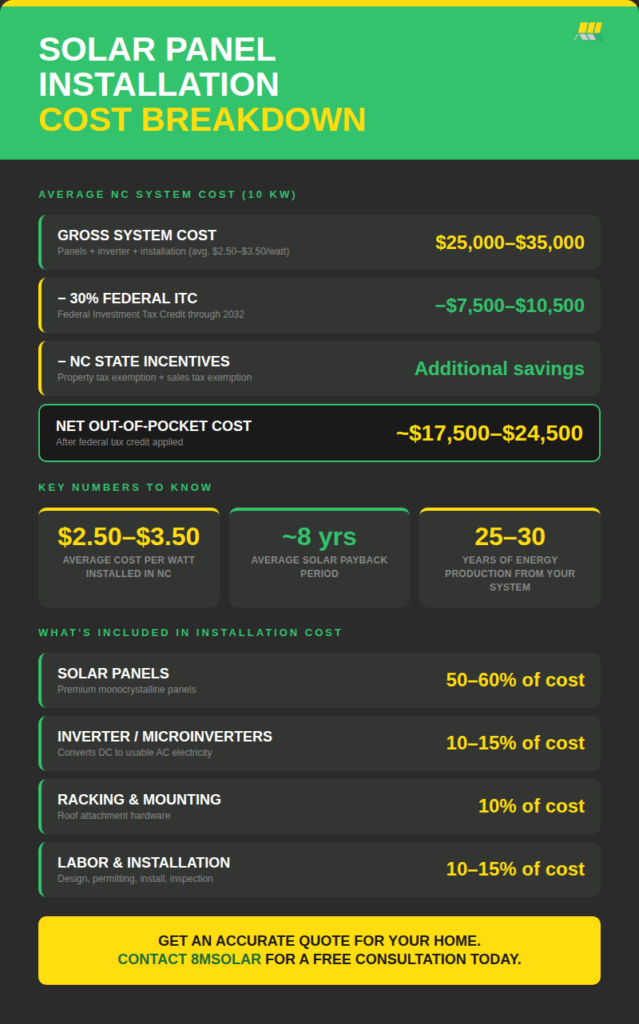
The cost of solar panel installation in North Carolina typically ranges from $2.50 to $3.50 per watt installed. For a standard 10 kW residential system — enough to cover most NC households — that puts the gross cost between $25,000 and $35,000 before incentives.
The good news is that federal and state incentives significantly reduce that number. After applying the 30% Federal Investment Tax Credit (ITC), most homeowners bring their net out-of-pocket cost down to $17,500–$24,500 — and additional NC-specific incentives can reduce it further.
What’s Included in the Installation Cost?
Your solar panel installation quote covers more than just the panels. Here’s how a typical system cost breaks down:
- Solar panels (50–60%): The panels themselves are the largest cost component. Premium monocrystalline panels are the most efficient and longest-lasting option available.
- Inverter or microinverters (10–15%): Inverters convert the DC electricity your panels produce into the AC electricity your home uses. Microinverters are installed on each panel individually for maximum efficiency.
- Racking and mounting (10%): The hardware that attaches your panels to your roof. Quality racking protects your roof from leaks and holds panels securely through severe weather.
- Labor and installation (10–15%): This covers system design, permitting, installation, and final inspection — all handled by 8MSolar’s in-house engineering and installation team.
Factors That Affect Your Installation Cost
Every home is different, and several factors will influence your final solar installation cost:
- System size: The bigger your system, the more panels and equipment you need — but larger systems also tend to have a lower cost per watt.
- Roof type and condition: Complex roof shapes or older roofs may require additional work before installation.
- Panel type and efficiency: Higher-efficiency panels cost more upfront but generate more energy in less space.
- Battery storage: Adding a Tesla Powerwall or Enphase IQ Battery to your system increases upfront cost but provides backup power and additional savings through Time of Use rate management.
- Location and sun exposure: Your roof’s orientation and shading affect how many panels you need to meet your energy goals.
Key Benefits of Solar Panels
Beyond the long-term savings, solar panels offer a range of benefits for homeowners and businesses:
- Reduced or eliminated monthly utility bills
- Increased home value
- Protection against rising electricity rates
- Backup power during outages (with battery storage)
- Reduced carbon footprint and environmental impact
- 25–30 years of energy production from a single investment
How Solar Panels Save You Money
Once your system is installed, you can save thousands of dollars over its lifetime. The more energy your solar panels generate, the less you purchase from your utility company. Here are the main ways solar panels reduce your bills:
Net Metering
Net metering allows your solar system to send unused energy back to the grid in exchange for bill credits. When your panels produce more electricity than your home needs, that surplus goes to the grid — and your utility company credits your account. You can then use those credits when your panels produce less energy, such as at night or on cloudy days.
North Carolina has net metering policies in place, meaning most homeowners can take advantage of this program. Most utility companies use a one-for-one credit system: send 1 kWh to the grid, get 1 kWh in credit back.
Solar Batteries
If your utility company charges Time of Use rates — higher prices during peak demand hours and lower prices during off-peak hours — a solar battery can help you save even more. By storing excess energy during low-demand hours and using it during peak hours, you avoid the most expensive electricity your utility sells.
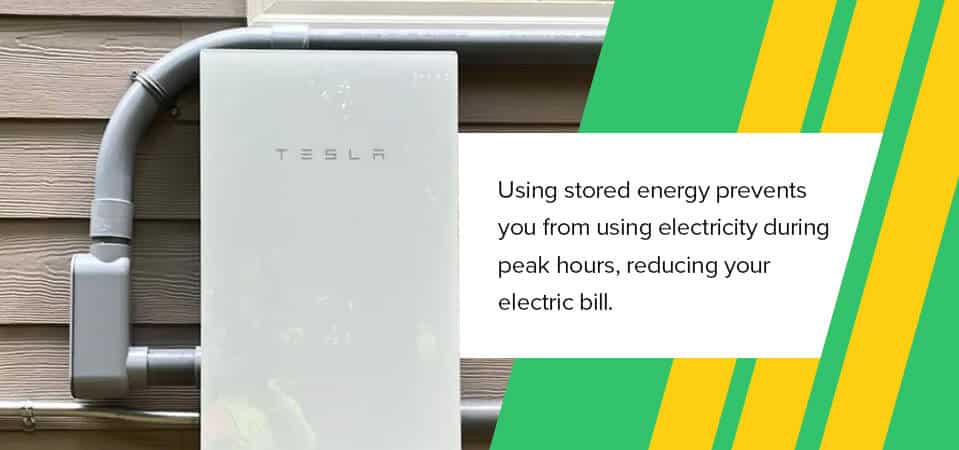
Solar batteries also provide excellent backup power during outages — so when the grid goes down, your home keeps running. 8MSolar installs the Tesla Powerwall 3 and Enphase IQ Battery, two of the most reliable battery storage systems available.
Can You Save More Money With or Without a Solar Battery?
It depends on your utility company’s rate structure. If your energy provider uses net metering with fixed rates, you can save well without a battery — excess energy simply flows to the grid for credit. However, if your utility charges Time of Use rates or you want maximum energy independence and outage protection, a battery is an excellent addition that pays for itself over time.
Can Solar Energy Eliminate Your Electricity Bill?
In many cases, yes. Because net metering grants bill credit for unused solar power, a properly sized system can reduce your electricity bill to zero dollars. Some utility companies charge a small minimum monthly fee ($15–$30) regardless of how much grid electricity you use — but even then, solar dramatically reduces what you owe each month.
How Long Until Solar Pays for Itself?
The average solar payback period in the US is around 8 years — meaning your system’s energy savings will have paid back the full installation cost within roughly 8 years. After that, every year of energy production is pure savings in your pocket.
With a system lifespan of 25–30 years, that means most homeowners enjoy 17–22 years of essentially free electricity after reaching their payback point. Combined with rising utility rates, the savings only grow over time. To calculate your specific payback period, check out our solar payback period guide.
Is the Initial Solar Panel Investment Worth It?
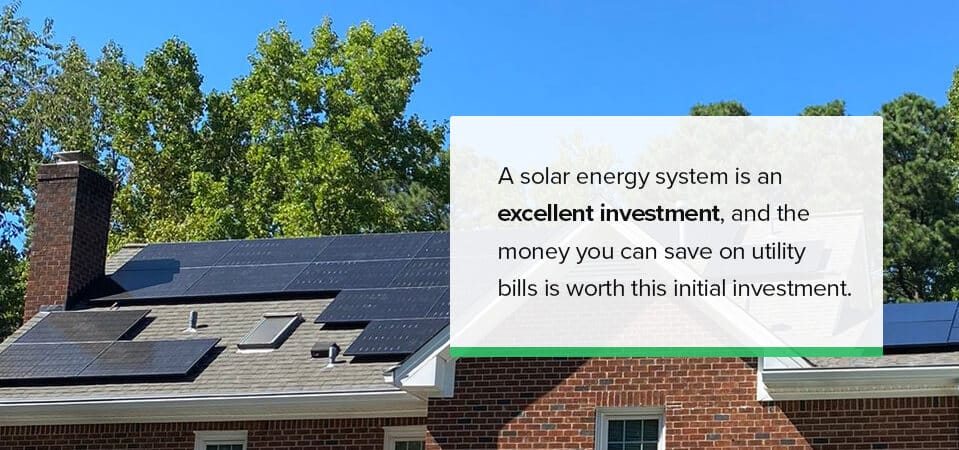
Absolutely. Between the 30% federal tax credit, NC state incentives, net metering credits, and decades of reduced utility bills, solar panel installation consistently delivers one of the strongest returns on investment available to homeowners. And with flexible financing options, you don’t have to pay for it all upfront.
Loan
Finance your solar system with no money down and predictable monthly payments that are typically lower than your current utility bill. You start saving from day one, and the system is yours to own outright once the loan is paid off.
Cash Payment
Paying upfront eliminates interest costs and gives you the fastest payback period. The money you save on monthly utility bills gradually makes up for the initial investment — and everything after your payback point is money back in your pocket.
Tax Credits and Incentives
The federal solar Investment Tax Credit (ITC) gives homeowners a 30% credit on their total solar installation cost through 2032 — one of the most significant financial incentives available. North Carolina also offers additional incentives including a property tax exemption on the added home value from solar, and a sales tax exemption on solar equipment purchases. Together, these incentives can reduce your total installation cost by a third or more.
Get a Solar Panel Installation Quote From 8MSolar
8MSolar offers high-quality solar panels installed by our professional in-house engineering team. With over 20 years of experience, NABCEP certification, and an unlimited electrical license, we’re North Carolina’s most trusted solar installer — and we’ll help you understand exactly what your system will cost and how quickly it will pay for itself.
Contact 8MSolar today to get a free quote on a solar panel system for your home or business.