A roof is generally suitable for solar if it receives adequate sunlight, has enough available space for panels, is structurally sound, and has sufficient remaining lifespan to support a solar system for decades. Factors like roof orientation, shading, roofing material, and current condition all influence solar viability, but fewer roofs are disqualified than most homeowners expect.
Many homeowners assume their roof will not work for solar because of trees, an east-facing orientation, or an aging surface. In many of those cases, they are wrong. Modern solar technology, flexible system design, and alternative installation options mean that a wider range of homes qualify for solar than ever before. This guide walks through exactly what installers look for and what the realistic options are if your roof is not ideal.
Is Your Roof Good Enough For Solar?
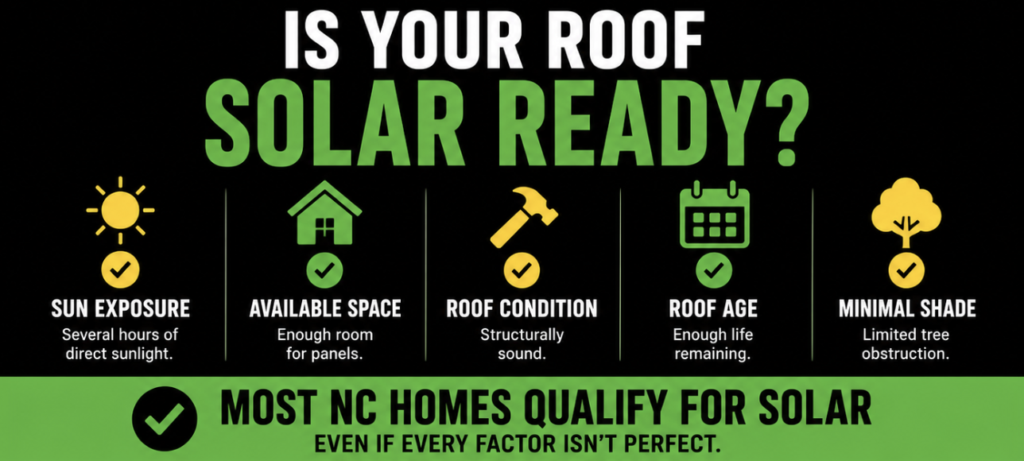
Most roofs in North Carolina are viable solar candidates. Here is a quick checklist of what a good solar roof looks like:
- Receives several hours of direct sunlight daily with minimal shading
- Has enough unobstructed surface area to fit the panels your system requires
- Is structurally sound and can support the weight of solar panels
- Has enough remaining lifespan to avoid a roof replacement shortly after solar installation
- Is made of a material compatible with standard solar mounting systems
Not every roof checks every box perfectly, and that is okay. A professional site assessment can identify which factors apply to your home and what options are available to make solar work even if your roof has limitations.
What Makes a Roof Good for Solar?
Sunlight Exposure
The most important factor is how much direct sunlight your roof receives. Solar panels convert sunlight into electricity, so a roof that spends most of the day in shade will produce significantly less energy than one with full sun exposure. North Carolina receives strong solar irradiance year-round, which is one reason the state is one of the top solar markets in the country. Even roofs with some shading can be productive if panels are placed on the least-shaded surfaces.
The National Renewable Energy Laboratory’s PVWatts tool and similar software allow installers to model your roof’s production potential using real local solar data. This is how a professional estimate accounts for seasonal sun angles, local weather patterns, and your specific roof geometry rather than relying on rough generalizations.
Roof Size
You need enough unobstructed roof space to fit the number of panels your system requires. The average residential solar system uses roughly 300 to 400 square feet of panel area, though this varies with system size and panel efficiency. Obstructions like skylights, vents, chimneys, and HVAC equipment reduce usable space. A roof that looks large may have less usable area than expected once obstructions are mapped out. Your installer will calculate this precisely during the site assessment.
Structural Integrity
Solar panels add approximately 2 to 4 pounds per square foot to a roof. Most standard residential roofs are engineered to support far more than that, but older structures or those with existing damage may need reinforcement before installation. A licensed installer will assess your roof’s structural condition and flag any concerns before design begins. In some cases, a structural engineer review may be recommended for older homes or unusual roof geometries.
Does Roof Direction Matter?
South-Facing Roofs
A south-facing roof receives the most direct sunlight throughout the day in North Carolina and produces the most energy per panel. If you have a large, unshaded south-facing roof surface, you have ideal conditions for solar. That said, south-facing is not the only direction that works.
East-Facing Roofs
East-facing roofs receive strong morning sun and produce well during the first half of the day. Depending on your household’s energy usage patterns, east-facing production can actually align well with morning electricity demand. East-facing systems typically produce about 10 to 20 percent less annually than a comparable south-facing system, but that reduction often does not eliminate the financial case for solar.
West-Facing Roofs
West-facing roofs generate energy in the afternoon and early evening, which aligns well with peak household energy use for many families. Under Duke Energy’s Time-of-Use billing structures, afternoon production can be particularly valuable because it coincides with on-peak rate periods. West-facing systems are often a strong choice for homeowners who are home in the afternoon and evening.
North-Facing Roofs
North-facing roof surfaces receive the least direct sunlight in the Northern Hemisphere and are generally not recommended for primary panel placement. However, many homes have multiple roof planes, and a north-facing primary roof does not disqualify a home from solar if east, west, or south-facing surfaces are available for panel placement. Ground-mounted systems are also an option for homes where no roof surface provides adequate exposure.
How Does Shade Affect Solar Panels?
Shading is one of the most common concerns homeowners raise, and it is worth understanding precisely how it affects production before assuming it disqualifies a roof.
Trees
Trees that shade roof surfaces during peak sunlight hours reduce panel output. The severity depends on how much of the panel area is shaded, for how long, and at what time of day. Shading analysis tools model this precisely using satellite imagery and sun path data. In some cases, selective tree trimming resolves the issue. In others, panel placement on less-shaded portions of the roof reduces the impact. Modern microinverter and power optimizer systems also minimize the effect of partial shading by allowing each panel to operate independently rather than having one shaded panel drag down the whole string.
Nearby Buildings
Neighboring structures can cast shadows on your roof, particularly in the morning or late afternoon when the sun is low. A shading analysis accounts for these obstructions. Urban and suburban areas where homes are close together benefit from a thorough shade assessment to identify the best panel placement zones.
Chimneys and Roof Features
Chimneys, dormers, skylights, and HVAC equipment create both physical obstructions that limit panel placement and potential shadow sources. Experienced system designers account for these features in their layouts and work around them to maximize usable surface area and minimize shading impact.
Does Roof Age Matter?
Yes, and this is one of the most practical questions homeowners should ask before installing solar. A solar system is designed to last 25 to 30 years. If your roof needs to be replaced in 5 years, removing and reinstalling solar panels to replace the roof adds cost and complexity. Timing matters.
New Roofs
A roof that is new or recently replaced is an ideal foundation for solar. You are starting the system’s life on a surface that will match or outlast the panels, and there is no concern about a near-term roof replacement disrupting the installation.
Roofs 5 to 10 Years Old
A roof that is 5 to 10 years old is typically in good condition and has plenty of remaining life for a full solar installation. No special considerations are usually required unless the roof has existing damage or unusual wear.
Roofs 10 to 15 Years Old
A 10 to 15-year-old roof is generally still a good candidate, but it is worth having a professional evaluate its condition during the solar site assessment. Understanding whether the roof will realistically last another 15 to 20 years is an important part of the decision.
Older Roofs
Roofs approaching the end of their expected lifespan, generally 20 or more years for asphalt shingles, may need to be replaced before or alongside a solar installation. Installing solar on a roof that will need replacement in a few years means paying for panel removal and reinstallation, which is an avoidable cost. The better approach is to replace the roof first and then install solar on the fresh surface. Some installers, including 8MSolar, can coordinate roofing referrals and time the installations for efficiency.
What Roofing Materials Work Best for Solar?
| Roofing Material | Solar Compatibility | Notes |
| Asphalt shingles | Excellent | Most common in NC; standard mounting hardware works perfectly |
| Metal roofs (standing seam) | Excellent | Clamp-based mounting requires no penetrations; ideal for solar |
| Metal roofs (corrugated/ribbed) | Good | Compatible with specialized mounting hardware |
| Tile roofs (concrete or clay) | Good | Requires specialized mounting; adds cost but is workable |
| Flat roofs (TPO, EPDM) | Good | Ballasted racking systems avoid penetrations; angle adjustable |
| Wood shake | Fair | Fire and installation concerns; may require additional review |
| Slate | Challenging | Fragile material; requires experienced installer and specialized hardware |
The vast majority of NC homes have asphalt shingle or metal roofs, both of which are well-suited to standard solar installations. Tile, flat, and specialty roofing materials require additional consideration but rarely disqualify a home outright.
What If My Roof Is Not Ideal for Solar?
A less-than-ideal roof does not necessarily mean solar is off the table. Here are the most common alternatives:
Roof Improvements
If the roof needs repairs or replacement, addressing that first and then proceeding with solar is the cleanest path. The upfront cost of a roof replacement is recovered over time through both the improved home value and the long-term solar savings that follow.
Tree Trimming
In cases where trees are the primary shading concern, selective trimming can meaningfully improve production. Your installer can quantify the production difference between a trimmed and untrimmed scenario so you can make an informed decision about whether trimming is worth pursuing.
Partial System Designs
Not every panel on every surface needs to be maximally productive. A well-designed system places panels on the best available surfaces and sizes the system to match your actual energy goals rather than trying to maximize panel count regardless of orientation or shading. A smaller, well-placed system often outperforms a larger, poorly placed one.
Ground-Mounted Solar
If your roof is genuinely not suitable for solar, a ground-mounted solar system installed in your yard may be an excellent alternative. Ground mounts can be oriented and angled for optimal production regardless of roof geometry, and they are increasingly popular for homeowners with shaded roofs, older structures, or unusual roof configurations.
What Happens During a Professional Solar Site Assessment?
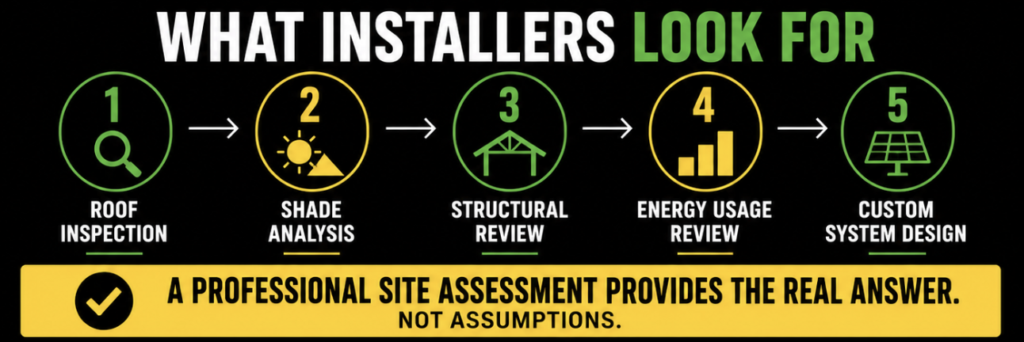
A professional site assessment is the only reliable way to know whether your specific roof is a good solar candidate. Here is what that process involves:
Roof Inspection
Your installer evaluates the roof’s current condition, age, material, and remaining lifespan. Any structural concerns or repair needs are identified at this stage.
Shade Analysis
Using tools like shade analysis software and satellite imagery, your installer maps out shading patterns throughout the year, accounting for trees, neighboring structures, chimneys, and seasonal sun angle changes. This produces a production estimate based on actual shading conditions rather than assumptions. 8MSolar uses professional solar shading analysis tools to model this precisely for every customer.
Structural Review
The roof’s load-bearing capacity is evaluated to confirm it can support the weight of the proposed panel array. For most standard residential roofs this is straightforward, but it is a required step in the design process.
Energy Usage Review
Your 12-month electricity usage is reviewed to determine what size system makes sense for your home. This ensures the system is sized to your actual needs rather than to maximize panel count or revenue for the installer.
System Design Recommendations
Based on all of the above, your installer produces a custom system design that accounts for your roof’s specific conditions, your energy goals, and your budget. The design includes panel placement maps, production estimates, and financial projections. A good installer will also tell you honestly if solar does not make sense for your property.
How 8MSolar Evaluates Roofs for Solar
At 8MSolar, every project starts with a thorough evaluation of your property, not a generic estimate based on zip code and average bills.
- Satellite and aerial analysis. We begin with detailed aerial imagery and shade modeling to understand your roof’s geometry and sun exposure before we ever visit your property.
- On-site evaluation. Our team visits your home to inspect the roof condition, assess the electrical panel, and confirm that the satellite analysis matches the real-world conditions.
- Professional shade assessment. We use industry-standard tools to model shading impact month by month and provide a production estimate that reflects your actual conditions.
- Custom system design. Every system we design is specific to your roof, your energy usage, and your goals. We do not use cookie-cutter designs.
- Honest recommendations. If your roof is not a good solar candidate, we will tell you that. If a ground mount makes more sense than a roof mount, we will explain why. Our goal is to help you make the right decision, not just close a sale.
Many homeowners are surprised to learn that their roof is a better residential solar installation candidate than they expected. The best way to know for certain is with a professional assessment. Schedule a free solar consultation with 8MSolar and find out whether your roof is ready for solar.
Frequently Asked Questions
How old can my roof be for solar panels?
Most installers recommend that a roof have at least 10 to 15 years of remaining lifespan before installing solar. Roofs approaching the end of their life are better replaced before installation to avoid the cost of removing and reinstalling panels for a roof replacement a few years later.
Can solar panels be installed on a roof that needs repairs?
Not recommended. Repairs should be completed before installation. Installing solar on a damaged roof can void roofing warranties and create liability issues if the roof fails after panels are installed.
Does roof direction affect solar production?
Yes. South-facing roofs produce the most energy in North Carolina. East and west-facing roofs produce approximately 10 to 20 percent less but are still viable and often make strong financial sense. North-facing surfaces are generally avoided for primary panel placement.
How much shade is too much for solar?
There is no universal threshold, but significant shading during peak sunlight hours, generally 9am to 3pm, can meaningfully reduce production. A shading analysis quantifies the exact impact for your property. Modern microinverter systems reduce the effect of partial shading compared to older string inverter designs.
Can solar panels be installed on metal roofs?
Yes, and metal roofs are actually excellent for solar. Standing seam metal roofs in particular allow clamp-based mounting that requires no roof penetrations, making installation cleaner and reducing potential leak points.
What if my roof is too small?
A smaller roof limits the number of panels you can install and therefore the system’s maximum output. In some cases, a smaller system still covers enough of your energy usage to make financial sense. In others, a ground-mounted system on your property may be a better option for achieving your energy goals.
Can I install solar if my roof faces east or west?
Yes. East and west-facing roofs produce less than south-facing roofs but often still generate strong savings. West-facing roofs in particular align well with afternoon energy demand and can be advantageous under Time-of-Use billing structures.
How do installers determine if a roof is suitable for solar?
Installers evaluate roof orientation, pitch, condition, age, available space, structural integrity, and shading using a combination of aerial imagery analysis and an on-site assessment. The result is a site-specific production estimate and system design tailored to your roof’s actual conditions. This is why a professional solar installation process always starts with a site evaluation rather than a generic quote.