
Remember those solar-powered calculators from school? You’d hold them under a light, and they’d instantly spring to life. That simple demonstration showcased one of the most elegant energy conversions in nature—sunlight transformed directly into usable electricity. What seemed like magic was proven science happening inside tiny components called solar cells.
Today, this same reliable process powers millions of homes across North Carolina, delivering energy independence and substantial savings on electricity bills. The technology isn’t complicated or mysterious. It’s a straightforward scientific process that’s been refined over decades to become one of the most dependable ways to generate clean electricity.
This guide will break down how solar panels convert sunlight into electricity for your home in five easy-to-understand steps. By the end, you’ll understand the science that makes solar energy such a smart investment for homeowners seeking environmental benefits and long-term savings.

The 5 Steps: How Photovoltaic Cells Work
The heart of every solar panel lies in its photovoltaic cells—the small, blue or black squares you see when you look closely at a solar panel. These cells are where the magic happens, converting sunlight into electricity through a process that’s elegant and reliable. Here’s how it works:
Step 1: Sunlight (Photons) Hits the Solar Cells
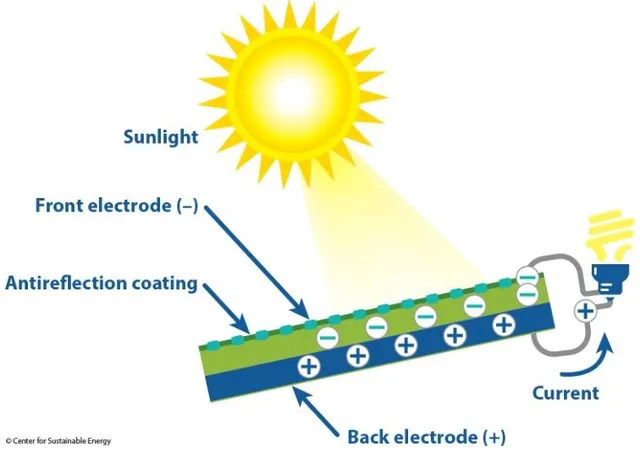
Sunlight is composed of tiny energy packets called photons. These photons travel 93 million miles from the sun at the speed of light, carrying energy that originated from nuclear fusion in the sun’s core. When these photons reach Earth and strike the surface of the photovoltaic cells within your solar panel, they deliver that energy directly to the cell’s materials.
Think of photons as tiny messengers carrying energy packages. Each photon that hits a solar cell has the potential to start the electricity-generation process. The more photons that strike the cells (meaning brighter sunlight), the more electricity the panel can produce.
Step 2: Electrons Are Knocked Loose
This is where the photovoltaic effect begins, the principle that makes solar energy possible. Solar cells are mainly made of silicon, a semiconductor material that’s been specially treated to respond to light energy. When photons from sunlight hit the silicon atoms within the cell, they transfer their energy to electrons orbiting those atoms.
Think of it like a cue ball (the photon) breaking a rack of billiard balls (the electrons) inside the solar cell. The energy from the photon is enough to knock electrons loose from their normal positions around silicon atoms. These free-floating electrons now carry electrical energy and are ready to be harnessed.
The silicon in solar cells has been “doped” with other elements to make this process more efficient. This doping creates a material that’s particularly good at absorbing photons and releasing electrons when light strikes it.
Step 3: An Electric Field Directs the Flow of Electrons
Each photovoltaic cell is constructed with two layers of silicon that have been treated differently. One layer (called n-type) has extra electrons, while the other (called p-type) has fewer electrons, creating “holes” where electrons should be.
When these two layers are joined together, they create an electric field at the junction, like a one-way street for electrons. This electric field acts like a traffic director, forcing all the loose electrons knocked free by photons to move in the same direction. Instead of random movement, you now have organized electron flow, which is the definition of electrical current.
This flow is Direct Current (DC), the same type of electricity produced by batteries. The electric field guarantees that as long as sunlight continues to hit the cell and knock electrons loose, they’ll keep flowing in the same direction, creating a steady stream of electricity.
Step 4: The Current is Captured and Sent to an Inverter
The solar cell has created electricity, but now it needs to be collected and channeled. Thin metal conductors (usually made of silver) are printed in a grid pattern on the surface of each solar cell. These conductors act like tiny highways, collecting the flow of electrons and channeling them into wiring that connects all the cells within a solar panel.
Multiple solar cells are wired together within each panel, and multiple panels are connected to create your complete solar array. All of this DC electricity flows through cables to a crucial piece of equipment: the inverter.
The inverter is often called the “brain” of the solar system because it manages and converts the electricity produced by your panels. At this stage, you have DC electricity flowing from your solar array, but your home needs a different type of power.
Step 5: The Inverter Converts DC to AC Power
Your home, like nearly all buildings connected to the electrical grid, runs on Alternating Current (AC) power. AC electricity changes direction many times per second (60 times per second in the United States), while the DC electricity from your solar panels flows in only one direction.
The inverter’s job is to convert that steady DC flow into the alternating AC power your home can use. Modern inverters are sophisticated pieces of equipment that not only convert DC to AC but also make sure the electricity matches the exact voltage, frequency, and power quality standards required by your home’s electrical system and the utility grid.
Once the inverter completes this conversion, the AC electricity flows into your home’s electrical panel, where it can power your lights, appliances, and devices just like electricity from the utility company. Any excess electricity your solar system produces can flow back into the grid, often earning you credits through net metering programs.
What’s the Difference Between a Solar Cell and a Solar Panel?
Understanding the relationship between solar cells and solar panels helps clarify how the system scales up to power your entire home. A solar cell is the individual component that performs the photovoltaic conversion—usually a square piece about 6 inches on each side.
Multiple solar cells (usually 60 or 72 for residential panels) are wired together and protected under tempered glass to create a solar panel. This glass protects the delicate cells from weather while allowing sunlight to pass through. The cells are also backed with a durable material and framed with aluminum for strength and longevity.
Multiple panels are then connected together to create your complete rooftop solar array. A residential installation might include 15-25 panels, depending on your home’s energy needs and available roof space. This approach allows solar systems to be customized for any size home or energy requirement.
The beauty of this system is its scalability and reliability. Each solar cell operates independently, so if one cell in a panel is shaded or damaged, the other cells continue producing electricity. Similarly, if one panel in your array has an issue, the remaining panels keep generating power for your home.
What About Cloudy Days? Direct vs. Diffuse Sunlight
One of the most common questions homeowners have is whether solar panels work when it’s cloudy. The answer is yes, though with reduced output compared to bright, sunny conditions.
Solar panels are most productive in direct sunlight, when photons can travel straight from the sun to the solar cells without obstruction. However, the panels are also designed to capture diffuse sunlight, the scattered light that reaches Earth even when clouds block direct sunlight.
On overcast days, clouds act like a filter, scattering sunlight in different directions. While this reduces the intensity of light reaching your panels, it doesn’t eliminate it. Depending on cloud thickness and type, your solar panels might produce 10-50% of their peak output on cloudy days.
This is why solar systems in regions with frequent cloud cover can still be highly effective. Countries like Germany, which has a climate similar to Seattle, have successfully deployed solar energy at massive scales. The key is properly sizing your system to account for seasonal and weather variations in your location.
Modern solar panels have become more efficient at capturing different types of light, including diffuse light on cloudy days and even reflected light from snow or other surfaces. This improved efficiency sees that your investment continues producing value even when weather conditions aren’t perfect.
Frequently Asked Questions (FAQ)
What are solar cells made of?
Solar cells are primarily made of silicon, the same material used in computer chips. The silicon is highly purified and then treated with other elements like phosphorus and boron to create the electric field necessary for the photovoltaic effect. The cells are then coated with anti-reflective materials to maximize light absorption and covered with tempered glass for protection.
Do solar panels store electricity?
Solar panels themselves don’t store electricity, they only produce it when sunlight hits them. Solar systems can be paired with battery storage systems like the Tesla Powerwall or LG Chem batteries to store excess energy for use at night or during outages. Without battery storage, excess electricity is sent back to the grid through net metering programs.
How long do solar panels last?
High-quality solar panels are designed to operate efficiently for 25-30 years or more. Most manufacturers offer 20-25 year performance warranties guaranteeing the panels will still produce at least 80-85% of their original output after two decades. The solar cells themselves can last even longer, but other components like inverters may need replacement after 10-15 years.
Putting Proven Science to Work for You
The five-step process happening in every solar cell on your roof represents decades of scientific advancement and engineering refinement. From photons knocking electrons loose to inverters converting DC to AC power, each step is a proven process that millions of homeowners depend on for their electricity needs.
This process within every solar cell is your key to energy independence and significantly lower electric bills. Unlike fossil fuels that require constant extraction, transportation, and burning, solar energy harnesses a free, renewable resource that will continue shining for billions of years.
The technology has matured to the point where solar installations are among the most reliable and low-maintenance home energy systems available. With proper installation and minimal upkeep, your solar system can provide decades of clean, affordable electricity while increasing your property value and reducing your environmental impact.
Ready to put this powerful science to work on your rooftop? The proven technology that converts sunlight into electricity is waiting to transform your energy costs and give you greater control over your household expenses. Contact 8MSolar for a free consultation and discover exactly how much you can save by harnessing the reliable science of solar energy. Our expert team will assess your home’s solar potential and design a system that maximizes your energy independence and long-term savings.