Are your solar panels underperforming without a clear reason? Hidden faults could be quietly draining your energy output—and your revenue.
Thermal imaging inspections provide a data-driven way to detect inefficiencies that traditional methods miss. By identifying heat irregularities across your solar array, this technology uncovers performance issues at the cell level—before they escalate into costly failures.
Unlike standard inspections, thermal diagnostics deliver a complete system health check—fast, precise, and non-invasive.
Why Visual Inspections Alone Fall Short
Traditional solar inspections focus on visible damage, shading, or loose connections. While necessary, they fail to detect internal electrical issues that directly impact performance.
Solar panels can appear fully functional while operating below capacity due to:
- Faulty cells
- Damaged wiring
- Failing bypass diodes
- Internal resistance issues
Thermal imaging bridges this gap by revealing heat inconsistencies—one of the earliest indicators of system failure.
How Thermal Imaging Works for Solar Panels
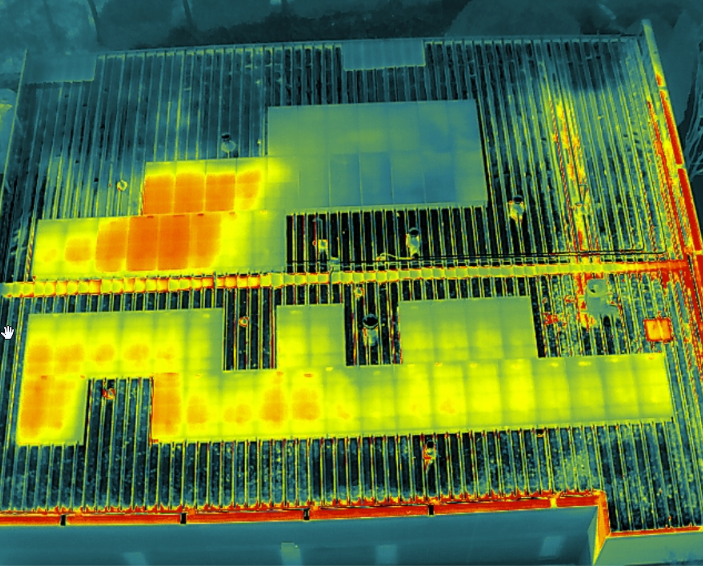
Thermal imaging uses infrared sensors to measure heat distribution across solar panels. Under normal conditions, panels emit heat uniformly. When defects occur, they disrupt this pattern.
These disruptions appear as:
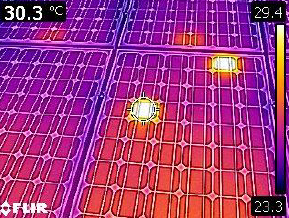
- Hotspots (excess heat) → often caused by electrical resistance or damaged components
- Cold spots (low heat output) → underperforming or inactive cells
Using drone-mounted or handheld thermal cameras, we capture high-resolution thermographic data across your entire system. This allows us to:
- Detect faults without physical contact
- Scan large arrays quickly and safely
- Pinpoint exact failure locations for targeted repairs
This process transforms raw heat data into actionable insights for maintenance and optimization.
Key Benefits of Thermal Imaging Inspections
1. Early Fault Detection
Identify minor issues—like developing hotspots—before they reduce output or cause permanent damage.
2. Maximum Energy Production
Locate underperforming panels and system bottlenecks to restore full efficiency.
3. Predictive Maintenance
Move from reactive repairs to proactive system management, reducing downtime and unexpected costs.
4. Extended System Lifespan
Excess heat accelerates degradation. Detecting and resolving issues early protects your long-term investment.
5. Faster, Scalable Inspections
Drone-assisted inspections dramatically reduce time compared to manual panel-by-panel checks, especially for large arrays.
6. Improved Safety
Eliminate the need for technicians to walk rooftops or navigate tight panel rows—reducing risk and liability.
7. Data-Driven Reporting
Receive detailed thermographic reports that show:
- Fault type
- Exact location
- Severity
- Estimated performance impact
Why One Faulty Panel Matters More Than You Think
In many solar systems, panels are connected in series. This means:
One underperforming panel can reduce the output of the entire string.
Thermal imaging quickly identifies these weak points, allowing you to prioritize repairs that have the greatest impact on total system performance.
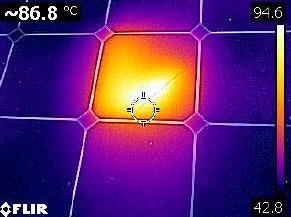
Real-World Example: Hotspot Detection
A panel may look completely normal during a visual inspection—but thermal imaging tells a different story.
A single hotspot can indicate:
- Cell damage
- Wiring faults
- Diode failure
Left untreated, this leads to:
- Reduced energy production
- Accelerated panel degradation
- Potential fire risk
Thermal imaging surfaces these issues instantly, enabling fast, targeted intervention.
Our Approach: Precision + Scale
We combine multiple inspection methods to deliver complete system visibility:
Drone-Based Thermal Imaging
- Rapid scanning of large commercial or utility-scale systems
- Consistent, high-quality data capture
- Minimal disruption to operations
Ground-Level Diagnostics
- Close-up validation of identified issues
- Component-level analysis for accurate repair planning
This hybrid approach ensures both speed and precision, giving you a full operational picture—not just surface-level insights.
Protect Your Solar Investment
Thermal imaging isn’t just an inspection—it’s a performance optimization tool.
By identifying hidden inefficiencies early, you can:
- Increase energy output
- Reduce maintenance costs
- Prevent system failures
- Maximize ROI over the life of your system
Don’t wait for performance drops to become expensive problems.
Schedule a thermal imaging inspection today and ensure your solar system is operating at peak efficiency.