
If you’ve been researching solar batteries and came across the Panasonic EverVolt, here’s what you need to know upfront: Panasonic exited the residential solar market entirely in 2023. The EverVolt battery has been discontinued, and Panasonic no longer manufactures, sells, or supports solar products of any kind.
That’s a significant development for anyone who already owns an EverVolt system — and a clear signal to anyone still shopping that this isn’t a product worth pursuing. This review covers what the EverVolt was, why Panasonic pulled out, and — more importantly — which solar batteries NC homeowners should actually be looking at in 2025.
What Was the Panasonic EverVolt?
Panasonic launched the EverVolt solar battery in 2019 as a modular home energy storage system. It came in four models — two AC-coupled and two DC-coupled — designed to pair with solar panel systems and provide backup power during outages.
On paper, it was a solid product. The EverVolt Plus model offered 17.1 kWh of usable storage and 5.5 kW of continuous power — competitive specs at the time. The standard model came in at 11.4 kWh and 4.6 kW. Both carried a round-trip efficiency of 86–90% and Panasonic’s brand reputation for quality electronics.
| Model | EverVolt Standard | EverVolt Plus |
| Usable capacity | 11.4 kWh | 17.1 kWh |
| Continuous power | 4.6 kW | 5.5 kW |
| Round-trip efficiency | 86–90% | 86–90% |
| Avg. backup duration | ~6 hours | ~9 hours |
| Status | Discontinued | Discontinued |
But specs don’t matter much when the manufacturer walks away from the market entirely.
Why Did Panasonic Exit Solar?
In late 2023, Panasonic announced it was discontinuing all residential solar products — panels and batteries — in North America. The decision came down to economics. The residential solar market had grown intensely competitive, with Tesla, Enphase, SunPower, and others commanding strong brand loyalty and distribution networks that Panasonic couldn’t match at scale.
Panasonic’s solar division never achieved the market share needed to justify continued investment. Rather than compete in a tightening market, the company chose to focus on other business segments where it holds a stronger position, including automotive batteries and electronics.
The exit was relatively quiet, but the impact on existing customers is real. Warranty claims, replacement parts, and technical support are now significantly harder to come by.
What Happens If You Already Own an EverVolt?
If you purchased an EverVolt before 2023, your warranty may still technically be in effect — but getting it honored is a different story. Panasonic has exited the market, and finding a certified technician or replacement components is increasingly difficult.
If your EverVolt is underperforming or failing, your best path forward is to contact your original installer to understand your options. In some cases, replacement with a current-generation battery may be the most practical solution, especially if your system is several years old.
If you’re in North Carolina, reach out to 8MSolar — we can assess your current setup and help you figure out the best next step.
Best Solar Batteries to Consider Instead
The good news: the solar battery market has improved significantly since 2019. The two strongest options for NC homeowners in 2025 are the Tesla Powerwall 3 and the Generac PWRcell M6. Both are actively supported, widely available, and backed by manufacturers with long-term commitment to the residential solar market.
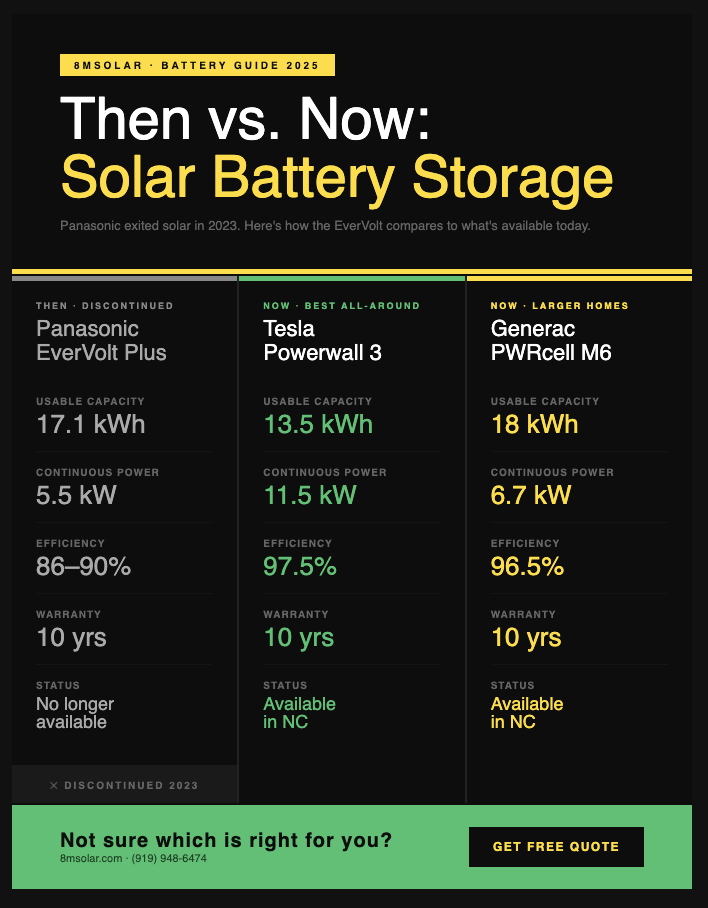
Tesla Powerwall 3 vs. Generac PWRcell M6
Here’s how the two leading alternatives stack up head to head:
| Spec | Tesla Powerwall 3 | Generac PWRcell M6 |
| Usable capacity | 13.5 kWh | 18 kWh |
| Continuous power | 11.5 kW | 6.7 kW |
| Round-trip efficiency | 97.5% | 96.5% |
| Solar integration | DC-coupled (built-in inverter) | DC-coupled |
| Scalable | Yes (stack multiple units) | Yes (modular cabinet) |
| Warranty | 10 years | 10 years |
| Best for | Whole-home backup, EV charging | Larger homes, higher storage needs |
The Powerwall 3 is the stronger all-around performer for most NC homeowners. Its 11.5 kW continuous output is nearly double what the EverVolt Plus ever offered, and the built-in inverter simplifies installation. The Generac M6 edges it out on raw storage capacity, making it a better fit for larger homes with higher energy demands or those who want to maximize backup duration.
Which Battery Is Right for You?
The right battery depends on your home’s size, your energy goals, and how you’re using solar. A few questions worth asking:
- Are you primarily looking for backup power during outages, or do you want to maximize daily self-consumption of solar energy?
- Do you have or plan to get an electric vehicle? The Powerwall 3’s higher output handles EV charging well.
- How large is your home and what’s your average monthly energy usage?
These aren’t questions you need to answer alone. At 8MSolar, we help NC homeowners navigate battery options every day. We’ll look at your actual usage, your existing or planned solar setup, and give you a straightforward recommendation — not a sales pitch.
The 30% federal tax credit (ITC) applies to battery storage when paired with solar through 2032, which can significantly reduce your out-of-pocket cost. Duke Energy’s PowerPair rebate program also offers up to $5,400 for eligible solar and battery installs in NC — another reason not to wait.
Contact 8MSolar today to find out which battery makes the most sense for your home.