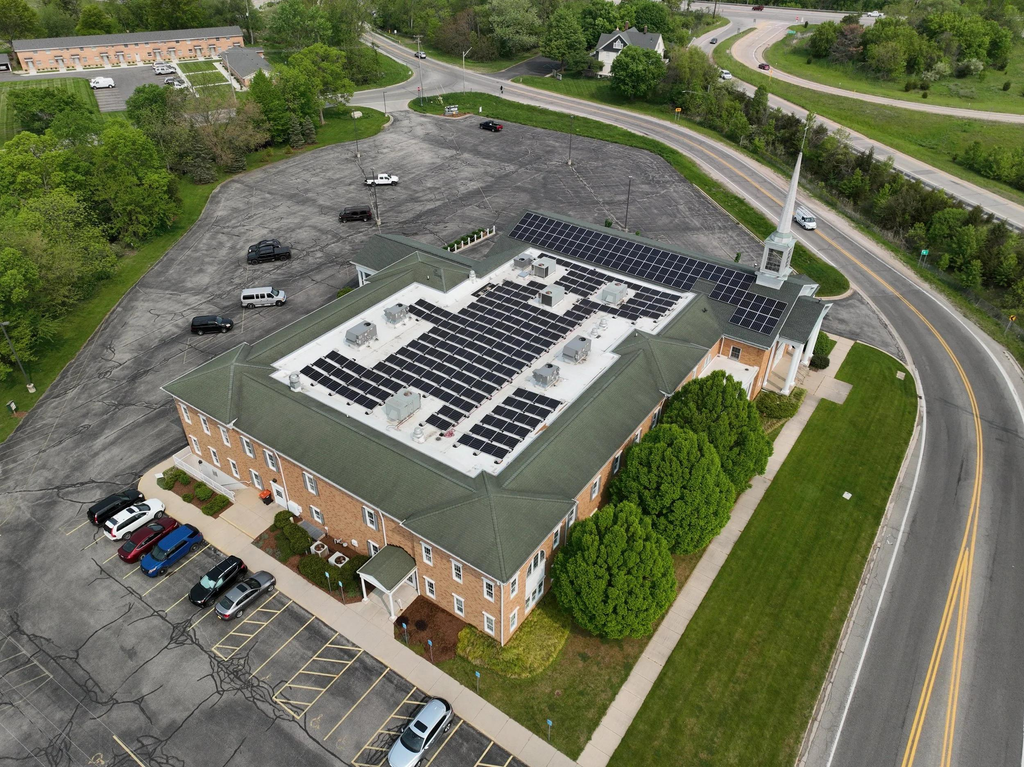
Across America’s landscape of steeples, minarets, and temples, a revolution is taking place on the rooftops. Religious organizations of all faiths are turning their faces not just toward heaven, but toward the sun, installing solar panels that reflect practical economics and spiritual convictions.
Why are churches and other religious organizations installing solar panels? Solar energy can help houses of worship reduce electricity expenses, support environmental stewardship, and redirect more resources toward their communities. Churches, mosques, synagogues, temples, and other faith-based organizations may also have access to nonprofit-specific financing options and certain clean energy incentives, depending on project eligibility and current federal, state, and local policies.
The numbers tell a story of this growing movement. According to Interfaith Power & Light, a faith-based organization promoting renewable energy, 2,545 U.S. congregations had completed solar installations by 2024, representing a combined solar capacity of 170 megawatts. The growing adoption of solar energy among religious organizations reflects a broader movement toward renewable energy, with faith communities increasingly investing in solar installations to reduce energy costs and support environmental sustainability.
This trend shows more than practical decision-making about energy costs, though the economic benefits are certainly significant. For many religious organizations, the choice to go solar embodies the intersection of faith and action, a response to what they see as a divine mandate to serve as stewards of creation. From evangelical churches citing Genesis’s call to “tend the garden” to Muslim communities drawing on Quranic teachings about avoiding waste, religious organizations across various faith traditions are embracing solar energy as a pragmatic financial decision and a spiritual calling to care for our common home.
As utility costs rise and climate concerns grow, these communities are finding that solar power allows them to redirect more resources toward their core missions of service, worship, and community support, all while honoring what many see as one of humanity’s most sacred duties: protecting the planet for future generations.
Table of Contents
- How Faith Communities Are Embracing Solar Energy
- Theological Foundations for Environmental Stewardship
- Economic Benefits for Religious Organizations
- Overcoming Common Challenges: From Obstacles to Opportunities
- How Can a Church or Religious Organization Get Started With Solar?
- The Future of Faith and Sustainability
- Frequently Asked Questions About Solar Power for Religious Organizations
- Can Churches and Other Religious Organizations Install Solar Panels?
- Can Churches Receive Federal Solar Tax Incentives in 2026?
- How Much Can a Church Save With Solar Panels?
- Are Solar Grants Available for Religious Organizations?
- Can Historic Churches Install Solar Panels?
- Can Solar Panels Keep a Church Powered During an Outage?
- Illuminating a Sustainable Path Forward
How Faith Communities Are Embracing Solar Energy
Practical Approaches to Solar Adoption
Faith communities across the United States are embracing solar energy through numerous approaches, ranging from full-scale installations that power entire facilities to smaller community-supported projects. Many congregations begin with energy audits and efficiency improvements before transitioning to renewable energy sources, creating a strong approach to sustainability.
Growing Trend in Houses of Worship
The adoption of solar power in houses of worship has grown over the past decade. Solar installations in religious buildings have increased by 13% year-over-year since 2016, outpacing many other non-residential sectors. This growth has been fueled by declining installation costs, improved financing options designed for non-profits, and increased awareness about environmental responsibility within faith communities.
Interfaith Cooperation on Environmental Initiatives
Another encouraging trend is that of interfaith cooperation on environmental initiatives. Programs like the Faith Climate Action Week bring together religious communities to address climate challenges collectively. In Washington D.C., the Interfaith Power & Light chapter helped coordinate a bulk purchasing program where multiple congregations—including a synagogue, two churches, and a mosque—jointly negotiated solar installations, reducing costs for all participants while fostering interfaith relationships. These collaborations demonstrate how environmental concerns are transcending theological differences, creating common ground for communities that might otherwise have limited interaction.
Through these approaches, faith communities are demonstrating that caring for creation through solar energy adoption is becoming a central expression of their beliefs in action.
Theological Foundations for Environmental Stewardship
Creation Care Principles Across Faith Traditions
Environmental stewardship finds deep roots in the theological foundations of the world’s major religions. While the language and concepts may differ, a common thread runs through faith traditions: humans have a responsibility to care for the natural world. In Christianity, this principle is often referred to as “creation care,” while Judaism speaks of “bal tashchit” (do not destroy or waste). Islamic tradition emphasizes “khalifah” (stewardship), and Buddhism centers on principles of mindfulness and non-harming. Hindu traditions revere nature through concepts like “ahimsa” (non-violence) and the sacred connection between all living beings. These principles provide religious communities with theological frameworks for approaching environmental challenges.
Religious Leaders Speaking on Sustainability
Religious leaders have emphasized environmental care as central to faith. Pope Francis, in his landmark encyclical Laudato Si’, declared: “Living our vocation to be protectors of God’s handiwork is essential to a life of virtue; it is not an optional or a secondary aspect of our Christian experience.” Rabbi Arthur Waskow, founder of The Shalom Center, connects environmental challenges to ancient wisdom: “The Torah teaches us to let the land rest every seven years. Today we need to understand this as teaching us to be more conscious about giving the Earth time to heal.” Islamic scholar Dr. Mustafa Abu Sway notes that “The Prophet Muhammad, peace be upon him, established conservation zones, protected lands, and taught Muslims to be mindful of water usage even when abundant.” The Dalai Lama has stated: “Taking care of our planet is a matter of looking after our own home. We can no longer exploit the earth’s resources without bearing the consequences.” These influential voices help translate ancient teachings into modern environmental action.
Environmental Justice as Faith in Action
For many religious communities, environmental stewardship extends beyond care for creation to concrete concerns about justice and protection of the vulnerable. Environmental degradation disproportionately affects poor and marginalized communities, those whom many religious traditions explicitly call followers to protect. Faith communities recognize that environmental action aligns with core values of justice, compassion, and care for the vulnerable. The concept of “environmental justice” resonates with religious teachings about human dignity and equity.
Through these theological foundations, religious communities find permission and obligation to engage in environmental stewardship, including the adoption of renewable energy sources like solar power.

Economic Benefits for Religious Organizations
| Benefit | How solar can help |
|---|---|
| Lower operating expenses | Reduces the amount of electricity purchased from the utility |
| More funding for community programs | Potential energy savings can support outreach and services |
| Long-term budgeting | Helps reduce exposure to some future electricity price increases |
| Environmental stewardship | Generates electricity without direct operational emissions |
| Community resilience | Solar paired with suitable battery backup can support essential services during outages |
| Educational opportunities | Provides a practical example of sustainability for congregation members |
Slashing Operational Costs Through Solar
Religious organizations across America are discovering what businesses have known for years: solar power reduces operational expenses. Houses of worship have large roof spaces, consistent daytime energy usage patterns, and monthly utility bills, making them ideal candidates for solar conversion. The financial impact can be huge. Congregation Beth Israel in Austin, Texas saw their electricity bills drop by 90% after installing solar panels, saving approximately $18,000 annually. First Parish Church in Brunswick, Maine reduced their utility expenses by over $6,000 per year with their solar installation. For many congregations operating on tight budgets, these savings create financial breathing room.
Incentives, Grants, and Financing
Religious organizations may have several options for financing solar installations, including grants, congregation-supported fundraising, power purchase agreements, and eligible federal clean energy incentives. Certain tax-exempt organizations can use the IRS’s elective-pay process to receive payments associated with qualifying clean energy tax credits. However, changes to federal law in 2025 introduced new eligibility restrictions and deadlines, making project timing and financing structure especially important in 2026.
Federal Solar Incentives for Religious Nonprofits in 2026
Eligible tax-exempt religious organizations may qualify for federal clean energy incentives through the IRS’s elective-pay process, sometimes called direct pay. This allows qualifying organizations to receive a payment based on an applicable tax credit rather than using the credit to offset federal income taxes.
However, federal legislation enacted in July 2025 changed the timeline for solar tax credits. Under the revised rules, qualifying solar projects that began construction after July 4, 2026, generally must be placed in service by December 31, 2027, to remain eligible for the federal clean electricity investment credit. Different rules may apply to projects that began construction before the deadline.
| Funding option | How it works | Main consideration |
|---|---|---|
| Direct purchase | The organization purchases and owns the solar system | Requires upfront funding or financing |
| Elective pay | Eligible nonprofits receive the value of qualifying federal credits | Eligibility, deadlines, and IRS requirements apply |
| Power purchase agreement (PPA) | A third party owns the system and sells electricity to the organization | Contract terms and state rules matter |
| Grants | Public or private funding helps cover eligible project costs | Availability and eligibility vary |
| Congregation fundraising | Members contribute toward the installation | Depends on fundraising capacity |
| Loans | The organization finances the project and repays the lender | Interest rates and repayment terms affect savings |
Eligibility also depends on factors such as project ownership, construction timing, equipment requirements, and compliance with applicable tax rules. Religious organizations considering solar should consult a qualified tax professional and an experienced commercial solar installer before relying on a particular incentive.
There are also other financial pathways that can make solar accessible:
Power Purchase Agreements (PPAs): Many congregations partner with third-party investors who install, own and maintain the solar system while selling the electricity to the congregation at reduced rates. All Souls Church Unitarian in Washington D.C. utilized this approach, achieving savings without upfront costs.
Specialized Grants: Organizations like Interfaith Power & Light offer grants specifically for religious buildings. The Sacred Places program has distributed over $1.2 million in matching grants for congregational energy projects.
Congregation-Supported Financing: Many faith communities have funded solar installations through congregation-led campaigns. Plymouth Congregational Church in Seattle raised $30,000 from members through a dedicated “Solar Fund” that allowed individuals to contribute toward the installation.
Green Revolving Funds: Some denominations have established revolving loan funds for environmental projects. The United Church of Christ’s Cornerstone Fund provides loans for solar installations that congregations repay through their energy savings.
Redirecting Energy Savings
The financial benefits of solar reach further than cost reduction—they amplify mission impact. When congregations spend less on utilities, they can invest more in core religious and community services:
Limestone Presbyterian Church in Delaware redirected approximately $7,000 in annual energy savings to expand their community food pantry, serving 20% more families. Trinity Episcopal Church in Tariffville, Connecticut used their solar savings to establish a scholarship fund for environmental education. The Islamic Center of Southern California applied utility savings toward expanding their youth education programs and community outreach initiatives.
Long-Term Financial Stewardship
Forward-thinking religious organizations recognize that solar investments build financial stewardship over the long term:
Predictable Energy Costs: According to the U.S. Energy Information Administration, average commercial electricity prices increased by approximately 4.9% nationwide from 2024 to 2025. In August 2026, commercial electricity prices were 4.3% higher than a year earlier. Solar can help religious organizations reduce their exposure to future utility rate increases while providing greater stability for long-term budgeting. Congregations can plan for energy production over the 25-year or longer lifespan of their solar systems.
Property Value Enhancement: Solar installations can increase property values by demonstrating modern infrastructure and reducing operating costs—valuable considerations if properties are ever sold or repurposed.
System Longevity: Most solar panels come with 25-year performance warranties but continue producing energy for 30-40 years, providing decades of financial benefits beyond the initial payback period.
Maintenance Planning: Successful congregations budget modest amounts annually ($300-500) for occasional system maintenance, guaranteeing performance and longevity.
For religious organizations facing budget pressures and seeking to maximize mission impact, solar power represents a financially prudent path forward.
How Much Could a Religious Organization Save With Solar?
The financial benefits of solar depend on the building’s electricity consumption, local utility rates, solar production, and installation costs.
For example, consider a religious organization that installs a solar system generating 40,000 kilowatt-hours (kWh) of electricity annually.
If each kilowatt-hour of solar electricity provides an average financial value of $0.12, the system could deliver approximately $4,800 in annual electricity value before accounting for maintenance, financing costs, and other expenses.
This is an illustrative calculation rather than a guaranteed savings estimate. Actual savings depend on how much solar electricity the building uses directly, utility billing policies, and the value of any electricity exported to the grid.
A professional solar assessment can help religious organizations compare projected savings with installation and financing costs.
Overcoming Common Challenges: From Obstacles to Opportunities
Creative Solutions for Historic Structures
Historic preservation concerns don’t need to derail renewable energy goals. Innovative congregations are finding solutions through:
- Ground-mounted systems that preserve historic rooflines
- Solar canopies over parking areas that double as shelter
- “Hidden” installations on flat roofs or behind parapet walls
- Carefully designed solar installations that preserve significant architectural features, including historic rooflines, windows, and stained glass
- Partnerships with preservation authorities to develop compatible solutions
The National Trust for Historic Preservation actively promotes compatible renewable energy integration, publishing guidelines for religious buildings with historical significance.
Building Consensus
Consensus-building may seem daunting in communities with diverse views, but successful congregations frame solar initiatives around shared values.
Effective approaches include:
- Transparent educational forums addressing concerns
- Site visits to nearby congregations with completed installations
- Clear presentation of financial and environmental benefits
- Emphasizing alignment with core faith principles
- Incremental approaches that build support through phased implementation
Streamlining Decision-Making
Religious organizations are reimagining governance processes to facilitate sustainability initiatives. St. Mark’s Lutheran in San Francisco created a dedicated “Creation Care Committee” with limited-scope authority for environmental projects, streamlining their traditionally lengthy approval process.
First United Methodist in Orlando developed a decision framework for sustainability projects, using clear metrics for mission alignment and financial feasibility. Their framework, now shared with other congregations in their network, has reduced approval timelines from years to months.
Innovative Funding Approaches
Financing solar installations extends beyond traditional fundraising:
Congregations have implemented:
- Community solar partnerships allowing member investments
- Green bonds issued by denominational foundations
- Matching grant challenges from environmental organizations
- “Solar Sundays” dedicated to sustainability fundraising
- Crowdfunding campaigns extending to broader communities
- Energy service agreements with guaranteed savings
The Cincinnati Archdiocese pioneered an internal carbon offset program where parishes with larger carbon footprints contribute to a fund supporting solar installations at smaller parishes with limited resources—a model now adopted by several denominations.
Success Through Integration
The most successful religious organizations don’t treat these challenges as separate issues but address them holistically. When Connecticut’s Congregation Beth Israel formed a working group with representation from their historical, financial, and environmental committees, they developed an approach addressing preservation concerns, funding strategies, and community consensus at once. Their solution—a ground-mounted array designed to complement their historic sanctuary while generating energy and educational opportunities—demonstrates how thoughtful integration can transform obstacles into opportunities.
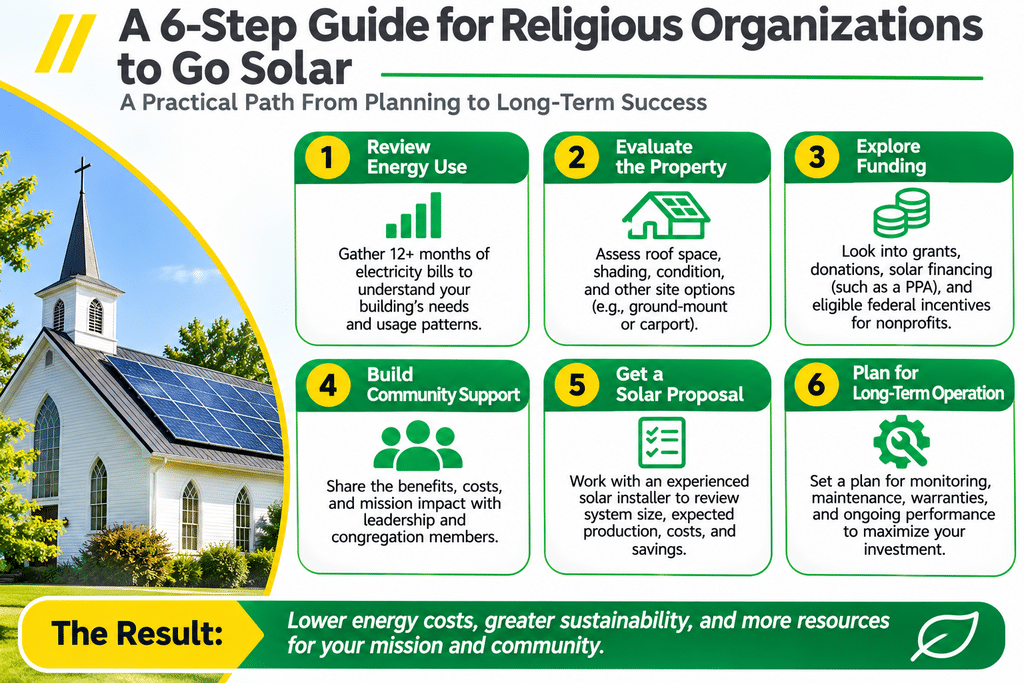
How Can a Church or Religious Organization Get Started With Solar?
Installing solar panels at a house of worship requires more than selecting equipment. Religious organizations should consider their building’s energy needs, financial resources, property conditions, and internal decision-making process before moving forward.
1. Review Electricity Usage
Collect at least 12 months of electricity bills to understand annual consumption, seasonal patterns, and utility costs. Buildings with schools, offices, or community programs may have different electricity needs than facilities used primarily for weekly services.
2. Evaluate the Property
A solar professional can assess available roof space, roof condition, shading, structural requirements, and potential ground-mounted or parking canopy locations. Historic properties may require additional planning.
3. Explore Funding and Incentives
Compare available grants, donations, loans, solar financing arrangements, and eligible clean energy incentives. Tax-exempt organizations should confirm whether their project qualifies for elective pay and whether federal deadlines affect their plans.
4. Build Congregational Support
Share estimated installation costs, electricity savings, maintenance requirements, and environmental benefits with leadership and members. Transparent planning can help align the project with the organization’s financial priorities and mission.
5. Request a Commercial Solar Assessment
Work with an experienced solar installer to evaluate system size, expected production, installation costs, financing options, and potential long-term savings. A detailed proposal can help leadership make an informed decision.
6. Plan for Long-Term Operation
Determine who will monitor solar production, coordinate maintenance, manage warranties, and track electricity savings. Clear responsibilities can help the organization get the most value from its investment over time.
The Future of Faith and Sustainability
Emerging Trends
Religious organizations are pioneering innovative approaches that signal the future direction of sustainability initiatives. Microgrids are emerging as a promising development, with places like Holy Cross Energy Cooperative in Colorado partnering with local churches to create resilient community energy systems. These systems combine solar generation, battery storage, and intelligent energy management to operate independently during grid outages.
Digital engagement is transforming how congregations monitor and celebrate their environmental impact. Real-time energy dashboards displayed in worship spaces and on congregation websites are becoming more common. Ebenezer Baptist Church in Atlanta uses their solar monitoring system as a teaching tool, with digital displays showing carbon emissions avoided and equivalent environmental benefits in terms the community can understand—like trees planted or miles not driven.
Virtual faith communities are also embracing sustainability through “distributed solar networks” where geographically dispersed members install solar on their individual homes while tracking collective impact through shared platforms, demonstrating how environmental stewardship can unite faith communities beyond physical gathering spaces.
Resilience Hubs
The integration of solar + storage systems is positioning houses of worship to serve as community resilience centers during emergencies. When Hurricane Maria devastated Puerto Rico in 2017, Casa Pueblo—a community center with a solar microgrid—became a lifeline, providing power for critical medical equipment and communications when the central grid remained down for months. Learning from this example, faith communities across climate-vulnerable regions are reimagining their role during disasters.
The “Resilient Houses of Worship” initiative, launched in 2023, is helping congregations in hurricane-prone regions install solar + storage systems designed to maintain power during extended outages. These systems prioritize critical loads like refrigeration, charging stations, and medical equipment support. First Presbyterian Church in New Orleans established a “resilience room” powered by their solar + battery system, designed to serve vulnerable community members during increasingly frequent extreme weather events.
This trend reflects a profound evolution: faith communities transitioning from buildings that occasionally serve their communities to essential infrastructure that provides critical services during society’s most challenging moments.
From Contemplation to Implementation
For religious organizations considering solar energy, the pathway forward is clear and supported. Resources like the Interfaith Solar Toolkit provide step-by-step guidance, while denominational green certification programs offer structured approaches to sustainability. National networks connect congregations with experienced peers who can share lessons learned and practical advice.
The question for faith communities is shifting from “Should we pursue renewable energy?” to “How quickly can we implement these solutions?”
In a world facing intersecting environmental and social challenges, faith communities with solar installations stand as powerful symbols of hope—tangible reminders that action is possible and that ancient wisdom can guide modern solutions. By embracing clean energy, religious organizations are demonstrating the practical application of their deepest values while helping create more resilient, sustainable, and just communities for all.
Frequently Asked Questions About Solar Power for Religious Organizations
Can Churches and Other Religious Organizations Install Solar Panels?
Yes. Churches, mosques, synagogues, temples, and other religious facilities can install solar panels when their properties meet applicable structural, electrical, zoning, and utility requirements. The best system design depends on the building’s electricity usage, available space, and financial goals.
Can Churches Receive Federal Solar Tax Incentives in 2026?
Certain eligible tax-exempt religious organizations can benefit from qualifying federal clean energy tax credits through the IRS’s elective-pay process. However, changes enacted in 2025 introduced new deadlines and eligibility restrictions for solar projects. Organizations should confirm current requirements before making financial decisions.
How Much Can a Church Save With Solar Panels?
Potential savings depend on electricity consumption, utility rates, solar system size, installation conditions, and financing. Some religious facilities may offset a substantial portion of their electricity purchases, while others may see smaller benefits because of their operating schedules or utility arrangements.
Are Solar Grants Available for Religious Organizations?
Some religious organizations may qualify for grants or funding programs supporting renewable energy, building improvements, or environmental initiatives. Availability depends on the program, location, applicant eligibility, and current funding.
Can Historic Churches Install Solar Panels?
Yes, although historic properties may require additional planning and approvals. Ground-mounted solar arrays, parking canopies, or carefully positioned rooftop systems may help preserve important architectural features.
Can Solar Panels Keep a Church Powered During an Outage?
Solar panels generally need compatible battery storage and backup equipment to provide electricity during a grid outage. A properly designed system may support essential functions such as refrigeration, lighting, communications, or device charging, depending on its capacity.
Illuminating a Sustainable Path Forward
This solar movement toward sustainability in sacred spaces is part of a broader transformation occurring across our society. The same careful planning, community engagement, and values-aligned decision-making processes that religious organizations employ can benefit residential neighborhoods and commercial districts alike. Solar power becomes a community statement about priorities and shared vision for the future.
At 8MSolar, we understand that every solar installation matters, whether it’s on a historic church, a family home, or a commercial building. Our team brings experience working with diverse clients, including religious organizations with unique considerations involving historic preservation, community consensus, and mission alignment.
As North Carolina’s premier solar provider, we’ve helped faith communities, homeowners, and businesses across the region harness the power of the sun while achieving meaningful savings. Our engineering-based approach ensures each system is tailored to your needs, whether you’re powering a sanctuary, a family home, or a business operation.
If your church or religious organization is considering solar energy, explore 8MSolar’s solar solutions for nonprofits and churches to learn how a system can be designed around your facility’s needs, financial goals, and community mission.
The path to sustainability is rarely traveled alone. Just as faith communities are finding strength in collaborative approaches, 8MSolar offers partnership throughout your solar journey—from initial consultation through installation and beyond. Our commitment to quality, transparency, and long-term relationship building reflects the same values that inspire many congregations to embrace renewable energy.