If you’re considering solar panels for your home, you’ve probably heard about solar panel efficiency ratings. Maybe you’ve seen numbers like 20% or 22% efficiency and wondered what that means for your energy bills. Those lab-tested efficiency ratings are just the starting point. What matters is how well your solar panels perform on your actual roof, in your conditions, day after day.
Solar panel efficiency is the percentage of sunlight hitting a panel that gets converted into usable electricity. While manufacturers test panels under perfect laboratory conditions, your roof faces real-world challenges that can impact performance. Factors like panel technology, temperature, tilt and orientation, cleanliness, and shading all play crucial roles in determining your system’s efficiency.
Of all these factors, shading stands out as the most common cause of efficiency loss for homeowners. Even partial shade from a single tree branch can cut your system’s power production in half. The good news is that modern solar technology and smart system design can overcome these obstacles, allowing you to achieve strong efficiency even with challenging roof conditions.
This guide will explain how solar panels work and show you proven strategies to maximize your solar panel efficiency, even when trees and buildings create shade on your property.
How Does a Solar Panel Work?
To understand efficiency, you need to grasp how solar panels generate electricity. The process relies on something called the photovoltaic effect, which sounds complex but works simply.
Think of sunlight as tiny particles called photons that carry energy. When these photons hit the silicon cells inside your solar panel, they knock electrons loose from the silicon atoms. This creates a flow of electricity, essentially, moving electrons form an electric current that can power your home.
A solar panel contains many individual solar cells connected together into what’s called a module. Multiple panels connected together form an array – your complete solar system. Each component in this chain affects your efficiency, which is why understanding the complete picture matters when designing your system.
The beauty of this process is its simplicity – no moving parts, no fuel consumption, just direct conversion of sunlight into electricity. However, this simplicity also means that anything blocking or reducing the sunlight hitting your panels directly impacts their power production.
The #1 Enemy of Solar Panel Efficiency: Shading
While temperature, dust, and panel orientation all affect performance, shading is the single biggest obstacle between your panels’ rated efficiency and their performance on your roof. Even homeowners who understand that shade reduces solar production often underestimate how dramatic this impact can be.
How One Shaded Cell Kills System-Wide Efficiency
In traditional solar installations, panels are connected together in what’s called a “string”, like holiday lights wired in series. When one panel in the string gets shaded, it doesn’t just reduce that panel’s output, it drags down the performance of every panel connected to it.
Think of it like a kink in a garden hose. Even if the rest of the hose is fine, that single kink restricts water flow through the entire length. Similarly, a shaded panel becomes an electrical bottleneck, forcing the entire string to operate at the reduced power level of the weakest panel.
This means 10% shading on one panel can cause 50% or more power loss for the entire string. It’s not a direct relationship; the impact gets magnified across your whole system.
Hard vs. Soft Shading and Their Impact
Understanding the different types of shade helps you evaluate your property’s solar potential more accurately.
Hard shading comes from solid objects that completely block sunlight – things like chimneys, vent stacks, nearby buildings, or tree trunks. These create sharp shadow lines and can reduce a panel’s output to nearly zero during the shaded period.
Soft shading results from lighter obstructions that reduce but don’t eliminate sunlight; think morning haze, distant clouds, or the dappled shade from leafy trees. While less severe than hard shading, soft shading still impacts efficiency and needs to be accounted for in system design.
The difference is that hard shading creates dramatic, predictable losses, while soft shading causes more gradual, variable reductions in power production throughout the day.
Technology That Boosts Efficiency in the Shade
The solar industry has developed solutions to minimize shading’s impact on system efficiency. These technologies allow solar panels to maintain performance even on complex roofs with shade challenges.
Microinverters & Power Optimizers
Traditional solar systems use a single central inverter to convert DC power from all panels into AC power for your home. This creates the “chain reaction” problem where one shaded panel hurts the whole system.
Microinverters and power optimizers solve this by allowing each panel to operate independently. With microinverters, each panel has its own small inverter attached directly to it. Power optimizers work similarly but pair with a central inverter to maximize each panel’s output before sending power to the main system.
Both technologies mean that when shade hits one panel, it only affects that individual panel’s production. The rest of your array continues operating at full efficiency. This prevents the massive system-wide losses that plague traditional string systems and can preserve 25-30% more power production in shade-prone installations.
Bypass Diodes: Protecting Your Panel’s Internal Efficiency
Even within individual panels, manufacturers have built-in protection against shade. Bypass diodes act like electrical detours, allowing current to flow around shaded cells within a single panel.
When part of a panel gets shaded, the bypass diode activates and routes electricity around the shaded section. This prevents a single shaded cell from bottlenecking the entire panel’s output. While bypass diodes can’t eliminate shading losses entirely, they reduce the impact compared to panels without this protection.
Most quality solar panels include bypass diodes as standard equipment, but it’s worth confirming this feature when evaluating different panel options for shade-prone installations.
Designing for Peak Efficiency
The most effective way to maximize solar panel efficiency is to design your system with shade challenges in mind from day one. This requires professional analysis tools that can predict and minimize efficiency losses before installation begins.
Advanced Software Modeling (Aurora Solar & LIDAR)
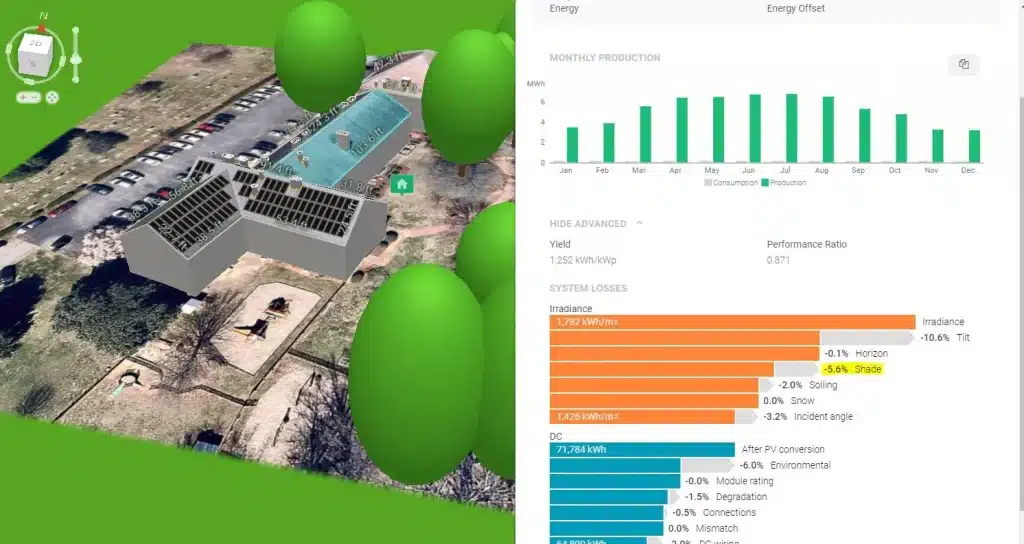
Modern solar design software creates detailed 3D models of your property, including every tree, building, and roofline feature. These programs use satellite imagery, LIDAR data, and advanced algorithms to simulate how shadows will fall on your roof throughout the entire year.
The software tracks the sun’s path from sunrise to sunset, season by season, calculating exactly when and where shade will impact your panels. This allows engineers to predict annual power losses down to tenths of a percentage point – for example, “5.6% estimated power loss from the oak tree in your neighbor’s yard.”
With this precision, installers can optimize panel placement, recommend tree trimming, or suggest technology upgrades that maximize your system’s efficiency despite shading challenges. The software helps determine the financial impact of different design choices, so you can make informed decisions about balancing system cost with performance.
On-Site Verification (Solar Pathfinder)
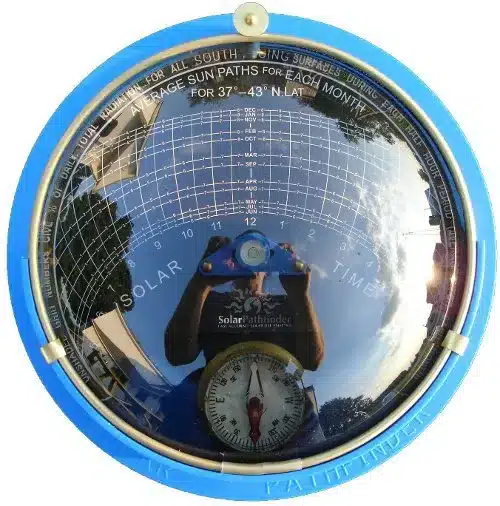
While computer modeling provides baseline data, experienced installers verify their designs with on-site measurements. Tools like the Solar Pathfinder use a transparent dome and reflection patterns to show exactly how shade will affect locations on your roof throughout the year.
This “boots-on-the-ground” verification guarantees that the software model matches real-world conditions and provides the most accurate efficiency projections for your investment. It’s valuable for properties with complex shade patterns or unusual geographic features that might not show up clearly in satellite imagery.
Frequently Asked Questions
Do Solar Panels Work in the Shade?
Yes, solar panels do produce some electricity in shaded conditions, but their efficiency drops. A fully shaded panel might only generate 10-25% of its potential output, depending on the type and density of the shade.
The bigger concern is how shade affects your entire system. In traditional string systems, shaded panels create bottlenecks that reduce production from unshaded panels too. This is why modern installations often use microinverters or power optimizers to maintain efficiency when shade is unavoidable.
How Much Efficiency Will I Lose If My Panels Are Partially Shaded?
The efficiency loss from partial shading isn’t proportional – it’s typically much worse than you’d expect. Due to the “chain reaction” effect in string systems, 10% shade coverage could cause 50% or more power loss for that string of panels.
The impact depends on several factors: the type of shading (hard vs. soft), time of day when shading occurs, and whether you’re using panel-level optimization technology. A professional shading analysis can provide projections for your property and help you understand the financial impact of different shade scenarios.
What Is the Most Efficient Type of Solar Panel?
Monocrystalline silicon panels offer the highest efficiency ratings for residential installations, ranging from 20-22% efficiency. However, the panel type is just one factor in your system’s overall performance.
Real-world efficiency depends more on site-specific factors like shading, orientation, and temperature. A less efficient panel in an ideal location will outperform a high-efficiency panel that’s partially shaded. This is why system design and shading analysis matter more than chasing the highest efficiency rating on paper.
Unlock Your Home’s True Solar Efficiency Potential
Solar panel efficiency isn’t just about the numbers on a spec sheet, it’s about how well your system performs in the real world, on your roof, with your property’s unique challenges. While laboratory efficiency ratings provide a useful baseline, solar performance comes from smart system design, modern technology, and professional analysis that addresses real-world obstacles like shading.
The key takeaway is this: even homes with trees, nearby buildings, or other shade challenges can be excellent candidates for professional solar installation. The difference lies in using the right technology and design approach to maximize efficiency despite these obstacles.
Modern solutions like microinverters, power optimizers, and advanced shading analysis allow solar installers to design systems that maintain strong performance even in challenging conditions. By addressing shade issues upfront, you can achieve excellent solar power production and maximize your return on investment.
Don’t let concerns about trees or shade prevent you from exploring solar energy for your home. With proper planning and the right technology, most properties can support highly efficient solar installations that deliver decades of clean energy and utility savings.
Ready to discover your home’s true solar potential? Learn more about our services and schedule your free, no-obligation solar efficiency and shading analysis today. Our expert team will evaluate your property’s conditions and show you how much you can save with a well-designed solar system.