
Yes, solar panels work exceptionally well in winter. This might surprise homeowners who assume that cold weather spells doom for solar energy production. The truth is, solar panels don’t need heat to function, they need light. In fact, cold temperatures actually boost panel efficiency, helping to offset the challenges of shorter winter days.
This balancing act between reduced daylight hours and increased efficiency makes winter solar performance stronger than most people realize. Let’s break down the science behind winter solar production and address the most common concerns homeowners have about their solar investment during the colder months.
Table of Contents
- How Do Solar Panels Handle Cold Winter Weather?
- What Happens When Solar Panels Are Covered in Snow?
- Should I Get on My Roof to Clear Snow Off My Panels?
- How 8MSolar Designs for Year-Round Performance
- Balancing Winter Production with Net Metering
- Common Winter Solar Myths Debunked
- Your Winter-Ready Solar Investment
How Do Solar Panels Handle Cold Winter Weather?
The Efficiency Boost: Colder is Better
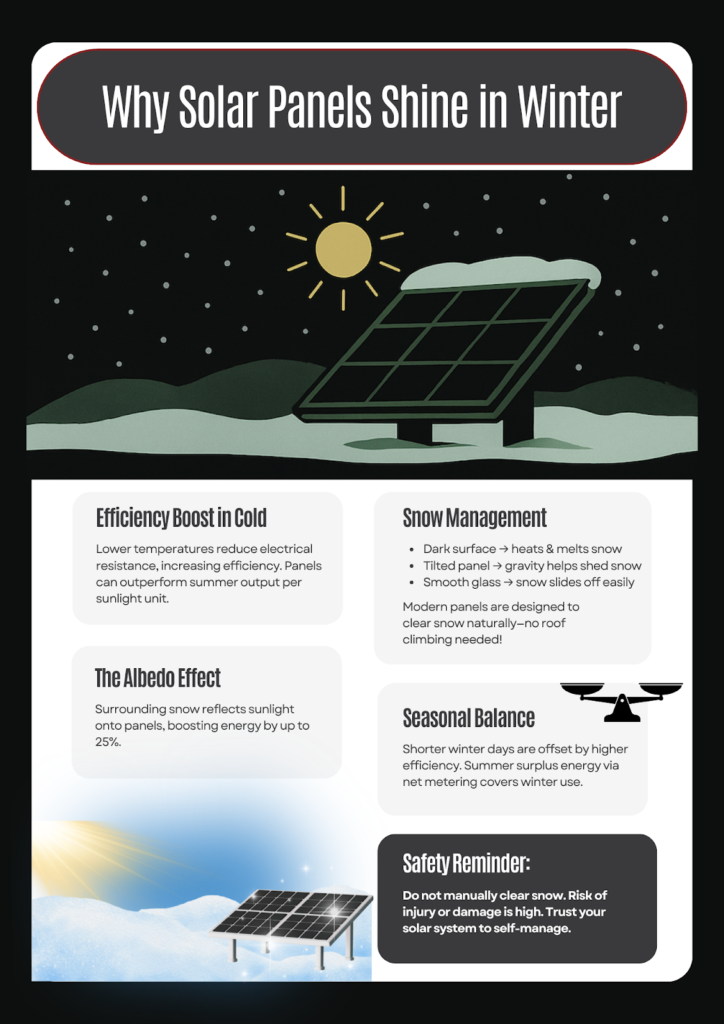
Solar panels operate like most electronic devices; they perform better when cool. As temperatures drop, the electrical resistance within the photovoltaic cells decreases, allowing for more efficient conversion of sunlight into electricity. This means that a 32-degree winter day will produce more power per ray of sunlight than a scorching 95-degree summer afternoon.
The temperature coefficient of solar panels ranges from -0.3% to -0.5% per degree Celsius. This means that for every degree below the standard test condition of 25°C (77°F), panels gain efficiency. On a cold winter day at 0°C (32°F), panels can operate up to 12% more efficiently than their rated capacity.
It’s About Light, Not Heat
The principle behind solar energy is photovoltaic conversion – the process of converting photons (light particles) into electricity through the photoelectric effect. Heat energy plays no role in this process. Excessive heat can actually hinder performance by increasing electrical resistance within the cells.
A crisp, sunny winter day with bright sunlight and cold temperatures creates ideal conditions for solar production. The intensity of sunlight matters more than the ambient temperature. Even with snow on the ground, direct sunlight can generate substantial electricity output.

What Happens When Solar Panels Are Covered in Snow?
Do Panels Produce Power When Completely Covered?
Let’s be direct: No. When solar panels are completely covered by a thick layer of snow, sunlight can’t reach the photovoltaic cells, and electricity production will temporarily stop. However, this complete coverage rarely lasts long due to the smart design features built into modern solar installations.
The Self-Shedding Effect
Solar panels are engineered to clear snow naturally through several design elements:
Dark, Heat-Absorbing Surface: The dark tempered glass on solar panels absorbs available sunlight and converts it to heat faster than surrounding roof materials. This warming effect helps melt snow from the bottom up, creating a layer of water that lubricates the snow’s removal.
Smooth, Slippery Surface: The non-porous glass surface of solar panels provides little friction for snow to grip. Once any melting begins, snow slides off easily compared to textured roofing materials.
Installation Angle: Professional solar installations position panels at an optimal tilt angle, between 30-45 degrees in most regions. This angle uses gravity to help shed accumulated snow once the self-warming process begins.
Most residential solar systems will clear light to moderate snowfall within a few hours of sunrise on sunny days. Heavy snowfall may take longer, but panels clear themselves within 24-48 hours of the storm’s end.
The “Albedo Effect”
Once panels are clear, the surrounding snow can boost energy production through the albedo effect. Fresh snow reflects up to 80% of sunlight, acting like a giant mirror that directs additional light onto your solar panels. This reflected light can increase energy output by 10-25% compared to normal ground conditions.
This phenomenon is pronounced in areas with consistent snow cover, where the reflective effect continues throughout the winter months.
Should I Get on My Roof to Clear Snow Off My Panels?
Our Official Recommendation: Safety First
8MSolar strongly advises against homeowners ever attempting to clear snow from their solar panels. The risks far outweigh any potential benefits, and manual snow removal can actually damage your system and void your warranty.
Understanding the Risks
The dangers of DIY snow removal include:
- Personal Injury: Rooftops covered in snow and ice create hazardous conditions. The risk of slipping and falling increases dramatically in winter conditions.
- Voiding Your Warranty: Using improper tools like metal rakes, shovels, or scrapers can scratch the tempered glass surface of panels, voiding the manufacturer’s warranty.
- Damaging Your Roof: Walking on an icy or snow-covered roof can damage shingles, gutters, or the roof structure itself.
- Damaging the Panels: Even proper tools can cause micro-fractures or damage to the aluminum frames or electrical connections.
Professional solar systems are designed to handle snow loads and clear themselves naturally. The small amount of additional energy gained from manual clearing is never worth the safety and warranty risks involved.
How 8MSolar Designs for Year-Round Performance
At 8MSolar, we understand that seasonal variations are normal and expected. Our design process accounts for these fluctuations using sophisticated modeling software that analyzes local weather patterns, historical snowfall data, sun angles throughout the year, and average seasonal production rates.
We use tools like PVWatts and Helioscope to model your specific location’s solar resource, incorporating decades of weather data from the National Renewable Energy Laboratory. This allows us to provide realistic annual production estimates that account for winter performance variations.
Our approach means we’d rather give you estimates that your system consistently outperforms rather than overpromise and underdeliver. When we design your system, we factor in:
- Local climate data and average snowfall
- Optimal panel placement and tilt angles
- Shading analysis throughout all seasons
- Equipment specifications and temperature coefficients
This approach ensures your solar investment delivers reliable, predictable performance year-round.
Balancing Winter Production with Net Metering
Solar energy’s financial benefits rely on annual production, not daily output. Net metering programs offered by utilities like Duke Energy function like a “solar savings account.” During long summer days when your panels produce more electricity than your home uses, the excess energy flows back to the grid, earning you credits on your utility bill.
These credits accumulate during peak production months and offset your electricity costs during winter months when production naturally decreases due to shorter days. This is why solar savings are always calculated on an annual basis. The seasonal variations balance out over the course of a year.
For most homeowners in North Carolina, solar systems generate 60-70% of their annual production during the six months from April through September. The remaining 30-40% comes during the six winter months, when panels operate more efficiently but have fewer daylight hours to work with.
Common Winter Solar Myths Debunked
Myth: Solar panels don’t work when it’s cloudy. Truth: Panels produce electricity from diffused light even on overcast days, generating 10-25% of their clear-sky output.
Myth: You need to heat solar panels to make them work. Truth: Heating panels would actually reduce their efficiency. Cold temperatures improve performance.
Myth: Winter solar production isn’t worth the investment. Truth: Modern systems are designed to be profitable based on annual production, with winter performance factored into financial projections.
Your Winter-Ready Solar Investment
Solar panels not only work in winter, they thrive in cold, sunny conditions. The temporary challenges of snow coverage and shorter days are offset by increased efficiency and the albedo effect of surrounding snow. Professional system design accounts for all seasonal variations, making sure your solar investment delivers consistent value throughout the year.
With net metering programs, your summer energy surplus carries you through the winter months, making solar a smart financial decision regardless of the season. The key is working with experienced professionals who understand how to design and install systems optimized for your local climate conditions.
Ready to discover how solar can work for your home year-round? Contact 8MSolar today for a free consultation and custom-designed solar energy system that maximizes your power production in every season. Our team of experts will analyze your situation and provide realistic projections based on local weather patterns and your home’s characteristics.
Don’t let winter weather myths keep you from energy independence. Let 8MSolar show you how to harness the sun’s power 365 days a year.