

Electric vehicles are a big leap toward cleaner transportation, but there’s a question many EV owners face: where does the electricity come from? If you’re charging from the grid, there’s a good chance that a portion of that power still comes from fossil fuels. That’s where solar panels change everything.
By pairing your electric vehicle with a home solar panel system you’re eliminating emissions from your daily commute entirely. You’re also taking control of your energy costs, insulating yourself from rising utility rates and volatile gas prices. This combination of environmental responsibility and financial independence is why solar-powered EV charging has become one of the most compelling reasons for homeowners to go solar.
This guide will walk you through everything you need to know about charging your EV with solar power. We’ll cover the benefits, help you determine how many panels you’ll need, explain the different charger options available, and show you how to integrate an EV charging solution into your solar system. Whether you’re planning a new solar installation or looking to add EV charging to your existing system, you’ll find the information you need to make an informed decision.
Table of Contents
- Why Power Your EV with Solar? 3 Major Benefits
- How Many Solar Panels Do You Need to Charge Your EV?
- Choosing the Right Solar EV Charger for Your Home
- Can You Charge Your EV at Night with Solar?
- Planning Your Solar + EV Charging System
- Frequently Asked Questions
- Drive on Sunshine: Get Your Solar and EV Charger Quote

Why Power Your EV with Solar? 3 Major Benefits
Achieve “Zero-Emissions” Driving
When you buy an electric vehicle, you’re making a statement about your commitment to reducing your carbon footprint. EVs produce no tailpipe emissions, which is a big improvement over gasoline-powered cars. The electricity used to charge your EV has to come from somewhere, and in many parts of the country, that means coal or natural gas power plants.
By charging your EV with solar panels, you complete the circle of clean energy. The sun’s rays hit your panels, convert to electricity, and power your vehicle all without burning a single fossil fuel. This is what zero-emissions driving looks like. You’re eliminating emissions from your transportation entirely. For environmentally conscious homeowners, this is the ultimate alignment between values and daily actions.
Drastically Reduce Your Fueling Costs
The financial case for solar-powered EV charging is compelling. Let’s break down the numbers in a way that makes the savings clear.
The average American drives about 13,500 miles per year. In a gas-powered car averaging 25 miles per gallon, that’s 540 gallons of gas annually. At $3.50 per gallon, you’re spending $1,890 on fuel each year. That number climbs even higher if you drive a less efficient vehicle or if gas prices spike.
Charging an EV from the grid is already cheaper than gasoline. The average cost of electricity in the United States is about $0.15 per kilowatt-hour. A typical EV uses about 0.3 kWh per mile, which means charging costs roughly $0.045 per mile, or $608 annually for that same 13,500 miles. That’s a savings of over $1,200 per year compared to gas.
Once your solar panels are installed and paid off, the sunlight that powers your EV is free. Your “fuel” cost drops to zero, aside from the minimal maintenance costs of your solar system. Even while you’re still paying off your solar installation, you’re generating your own electricity at a much lower cost than buying it from the utility. Over the 25-year lifespan of your solar panels, you could save tens of thousands of dollars on transportation costs alone.
Gain Total Energy Independence
Energy independence isn’t just about saving money—it’s about control and security. When you power your EV with your own solar panels, you’re no longer at the mercy of external forces that dictate your transportation costs.
Gas prices fluctuate based on global oil markets, geopolitical tensions, and supply chain disruptions. Utility rates rise steadily over time, and in some areas with time-of-use pricing, charging during peak hours can be expensive. With solar-powered EV charging, you’ve eliminated both of these variables from your budget.
This independence becomes even more valuable when you consider the long-term trajectory of energy costs. Electricity rates have increased by about 2-3% annually. Solar panels, on the other hand, have no ongoing fuel costs. The day you flip the switch on your solar system is the day you lock in your energy costs for the next several decades. For your EV charging, that means predictable costs that don’t change based on market conditions or utility rate increases.

How Many Solar Panels Do You Need to Charge Your EV?
This is one of the most common questions we hear from homeowners considering solar-powered EV charging. The answer depends on your situation, but we can walk through the calculation process to give you a clear understanding of what you’ll need.
Step 1: Know Your Car’s Efficiency (kWh/mile)
Every electric vehicle has an efficiency rating measured in kilowatt-hours per mile (kWh/mile). This is the electric equivalent of miles per gallon for gas cars. It tells you how much energy your vehicle consumes for every mile driven.
Different EV models have different efficiency ratings. Here are some examples from popular models:
- Tesla Model 3: 0.24 kWh/mile
- Ford Mustang Mach-E: 0.35 kWh/mile
- Chevrolet Bolt EV: 0.28 kWh/mile
- Rivian R1T: 0.50 kWh/mile
- Hyundai Ioniq 5: 0.28 kWh/mile
You can find your vehicle’s efficiency rating in the owner’s manual, on the EPA’s fueleconomy.gov website, or on the manufacturer’s specifications page. More efficient vehicles will require fewer solar panels to meet their charging needs.
Step 2: Calculate Your Daily Driving Needs
The next step is determining how much you drive on a daily basis. While the national average is about 37 miles per day, your personal driving habits might be different. Some people have short commutes and rarely exceed 20 miles per day, while others might drive 60-80 miles daily for work or personal activities.
Once you know your average daily mileage, you can calculate your daily energy needs using this simple formula:
Daily kWh Needed = Average Daily Miles ÷ Vehicle Efficiency (kWh/mile)

For example, if you drive 40 miles per day in a Tesla Model 3 (0.24 kWh/mile): 40 miles ÷ 0.24 kWh/mile = 9.6 kWh per day
Step 3: Determine the Number of Panels
The final piece of the puzzle is converting your daily energy needs into the number of solar panels required. This calculation depends on two factors: the wattage of the panels you’re installing and the amount of sunlight your location receives.
Most modern solar panels range from 350 to 450 watts. Your location’s peak sun hours—the number of hours per day when sunlight is strong enough for optimal solar production— ranges from 3 to 6 hours depending on where you live. North Carolina, for example, averages about 4.5 to 5 peak sun hours per day.
Here’s the formula:
Number of Panels = (Daily kWh Needed × 1,000) ÷ (Peak Sun Hours × Panel Wattage)
Let’s continue with our example from above. You need 9.6 kWh per day, you’re in an area with 5 peak sun hours, and you’re using 400-watt panels:
(9.6 × 1,000) ÷ (5 × 400) = 9,600 ÷ 2,000 = 4.8 panels
Since you can’t install 0.8 of a panel, you’d round up to 5 panels to meet your EV charging needs. This is in addition to any panels needed to power your home.
It’s important to remember that this is a simplified calculation. Real-world factors like panel orientation, shading, system losses, and seasonal variations in sunlight can affect your actual energy production. That’s why working with experienced solar professionals is valuable; they can account for all these variables and design a system that reliably meets your needs throughout the year.
Choosing the Right Solar EV Charger for Your Home
Once you’ve determined your solar panel requirements, the next step is selecting the right charging equipment for your EV. Not all chargers are created equal, and understanding your options will help you make the best choice for your situation.
Level 2 Chargers: The Home Charging Standard
For home EV charging, Level 2 chargers are the industry standard. These chargers operate on 240 volts (the same voltage as your electric dryer or oven) and can deliver between 7 and 19 kilowatts of power to your vehicle. This translates to charging speeds of 25-40 miles of range per hour of charging, depending on your vehicle and charger specifications.
Level 2 chargers strike the perfect balance between charging speed and electrical requirements. They’re fast enough to fully charge most EVs overnight, but they don’t require the expensive electrical upgrades and equipment needed for Level 3 (DC fast charging) stations. For the vast majority of homeowners, a Level 2 charger is the right choice.
Standard EV Chargers vs. Solar-Integrated Chargers
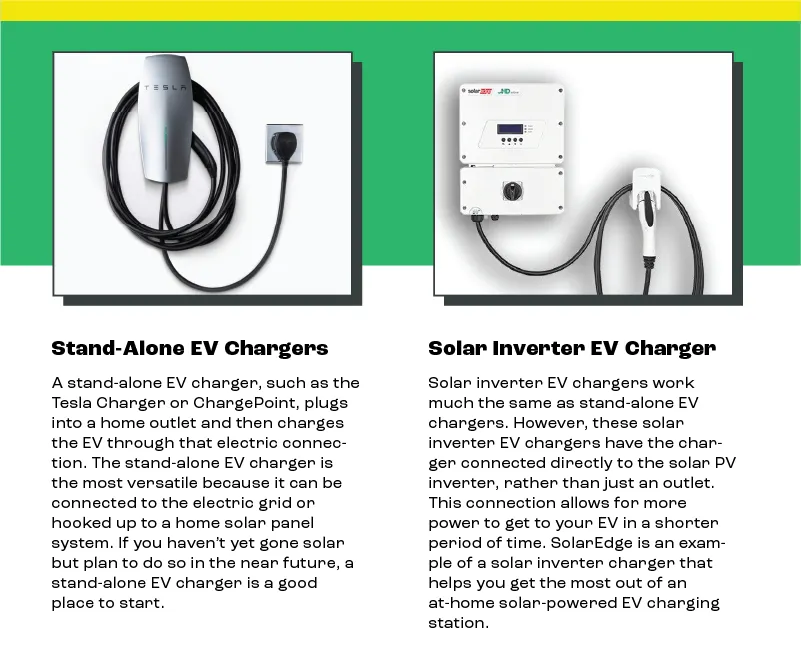
When it comes to integrating your EV charger with your solar panel system, you have two main options.
Standard EV Chargers are the most common type. These chargers connect to your home’s electrical system and draw power from whatever source is available at the moment – your solar panels when the sun is shining, or the grid when it’s not. They work well with solar systems, but they don’t have any special solar-specific features. You’re charging your EV with a mix of solar and grid power throughout the day, with the proportion depending on your solar production at any given time.
Smart Solar Chargers take integration a step further. Advanced models like the SolarEdge EV Charger can be programmed to prioritize or exclusively use excess solar power for charging. This maximizes your self-consumption of solar energy and ensures you’re getting the full benefit of your solar investment. These smart chargers can be configured to charge only when your solar panels are producing more energy than your home is using, storing that excess energy in your EV’s battery rather than sending it back to the grid.
The choice between these options depends on your priorities. If you want the simplest, most affordable solution, a standard Level 2 charger works well with solar. If you want to maximize your solar utilization and have more control over when and how your EV charges, a smart solar charger is worth the additional investment.
Can You Charge Your EV at Night with Solar?
This is one of the most frequent questions we hear, and it’s an important one to address. The short answer is: not directly, but yes with the right equipment.
The Role of Solar Battery Storage
Solar panels only generate electricity when the sun is shining. Without a storage solution, any solar energy you don’t use immediately either goes back to the grid (through net metering) or is lost. For many homeowners, this isn’t a problem—they can charge their EV during the day when the sun is out and their panels are producing power.
But what if you’re at work during the day and your car isn’t home? Or what if you prefer to charge overnight when you’re not using the vehicle? This is where solar battery storage becomes essential.
A solar battery system, like the Tesla Powerwall 3, Enphase IQ Battery, or LG Energy Storage System, stores excess solar energy produced during the day for use later. Your solar panels charge the battery while the sun shines, and then you can use that stored energy to charge your EV at night, power your home during peak rate hours, or maintain power during an outage.
The size of battery you’ll need depends on how much energy you want to store. If you’re only using the battery to charge your EV overnight, you’ll want enough capacity to cover your daily driving needs. If you want the battery to also power your home or provide backup during outages, you’ll need a larger system, potentially with multiple battery units.
Battery storage adds to the upfront cost of your solar system, but it provides flexibility and maximizes the value of your solar investment.
Planning Your Solar + EV Charging System
Whether you’re planning a new solar installation or looking to add EV charging to an existing system, planning will help you get the most value from your investment.
For New Solar Installations: Size Your System for the Future
If you’re installing solar panels for the first time and you either own an EV or plan to purchase one in the near future, the smartest approach is to size your system to accommodate your home energy needs and your EV charging requirements from the start.
Adding capacity later isn’t impossible, but it’s almost always more expensive than installing a larger system upfront. You’ll face additional permitting fees, installation costs, and potential complications if your roof layout or electrical service has changed. By planning ahead and installing a system sized for an EV from the beginning, you’ll save money in the long run.
Even if you don’t own an EV yet, it’s worth considering whether you might purchase one within the next few years. EV adoption is accelerating, and many automakers are phasing out gas-powered vehicles. Future-proofing your solar installation by adding a few extra panels when the marginal cost is lowest can save you expense and hassle down the road.
For Existing Solar Systems: How to Add EV Charging
If you already have a solar panel system and you’ve recently purchased or are planning to purchase an EV, the good news is that adding EV charging capability is straightforward. The main consideration is whether your existing system produces enough energy to cover your home usage and your EV charging needs.
Start by reviewing your system’s production and your home’s energy consumption. If you have excess solar production during the day, you may be able to install an EV charger without adding more panels. Your excess solar production will charge your vehicle instead of being exported to the grid.
If your current system is already producing at or near your home’s consumption level, you’ll likely want to expand your array. Adding 4-8 panels is sufficient for most EV charging needs, and the installation process is usually simpler than the original system installation since much of the infrastructure is already in place.

Frequently Asked Questions
What is the average cost to install solar panels for an EV?
The cost of adding solar panels for EV charging depends on how many panels you need, which is determined by your driving habits and vehicle efficiency. As we calculated earlier, most drivers need between 4-8 additional panels to cover their EV charging needs.
With installation, a 400-watt solar panel costs between $800 and $1,200. For 6 panels, you’re looking at roughly $4,800 to $7,200. When you factor in the fuel savings: over $1,200 per year compared to gasoline, you can see the payback period is quite reasonable, between 3-5 years.
Do I need a battery to charge my EV with solar?
No, you don’t need a battery to charge your EV with solar power. If you’re home during the day or your work schedule allows you to charge while the sun is shining, your solar panels can charge your EV directly. Many homeowners successfully charge their EVs with solar without battery storage.
However, a battery provides advantages. It allows you to charge your EV at night using solar energy stored during the day, provides backup power during outages, and maximizes your solar self-consumption by storing excess energy instead of sending it back to the grid. While a battery adds to the upfront cost, it increases the flexibility and value of your solar system.
Can I still use a public charger if I have a home solar charger?
Absolutely. Having a home solar EV charger doesn’t limit your ability to use public charging stations. Most EV owners use a combination of home charging for their daily needs and public fast chargers for longer trips or when they need a quick charge while away from home. Your solar system handles your routine charging, which represents 80-90% of your total charging needs, while public chargers provide flexibility for travel and emergencies.

Drive on Sunshine: Get Your Solar and EV Charger Quote
The combination of solar panels and electric vehicle charging is the pinnacle of energy independence and environmental responsibility. By generating your own clean electricity and using it to power your transportation, you’re eliminating emissions, slashing your energy costs, and insulating yourself from the volatility of fossil fuel markets.
The numbers speak for themselves. Solar-powered EV charging can save you over $1,200 per year compared to gasoline, and thousands more when you factor in the rising costs of grid electricity. Over the lifespan of your solar system these savings compound into tens of thousands of dollars.
Whether you’re planning a new solar installation or looking to expand your existing system, accounting for EV charging now will save you money and prepare your home for the future of transportation. The infrastructure is here, the technology is proven, and the financial case is compelling.
Ready to stop paying for gasoline and high electricity bills forever? Get a solar and EV charger quote from 8MSolar and start powering your drive with the sun. Our team of solar experts will assess your home’s solar potential, calculate your EV charging needs, and design a system that delivers maximum savings and energy independence. Contact 8MSolar to take the first step toward a cleaner, more affordable future.