Most homeowners spend weeks researching solar panels. They compare efficiency ratings, read about monocrystalline vs. polycrystalline, and request quotes from three or four companies. They dig into tax credits, check net metering policies, and spend a Saturday afternoon watching YouTube videos about panel warranties.
What they rarely think about is what happens five, ten, or twenty years after the installation is done, which is where the risk lives.
Across North Carolina, towns and counties have discovered a frustrating truth: the solar company that installed their system is no longer responding. Systems are underperforming. Panels need service. And the original installer? Gone. Wake County, the Town of Apex, and other local governments have had to reach out to new companies just to get existing systems back up and running. These are systems that were installed by companies that are, technically, still in business. They just stopped showing up.
This is not just a government problem, it happens to homeowners too. The family that went with the lowest quote, got their panels installed, and felt great about it for two years. Then the inverter started throwing error codes. Then one string of panels stopped producing. Then they called the installer and got voicemail. And more voicemail. And eventually, nothing.
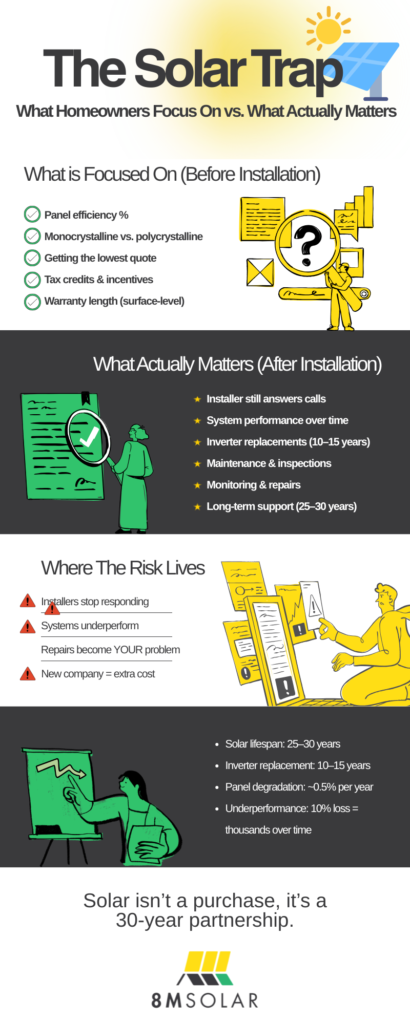
Choosing a solar installer is about choosing a partner you can count on for the lifetime of your system. A quality solar system should last 25 to 30 years. The company you hire needs to last just as long.
This guide will walk you through what to look for, what questions to ask, and how to avoid one of the most common and costly mistakes homeowners make when going solar.
What Does It Mean to Choose a Solar Installer?
Choosing a solar installer isn’t the same as hiring someone to replace your roof or repaint your house. Those are one-time jobs with a clear start and end. Solar is a decades-long relationship.
When you install a solar panel system, you are making a decision that will affect your home’s energy output for the next 25 to 30 years. Panels degrade slowly over time, losing about 0.5% of their efficiency each year. Inverters, which convert the DC electricity your panels generate into the AC electricity your home uses, usually need replacement after 10 to 15 years. Monitoring systems require attention. Connections, wiring, and mounting hardware need periodic inspection, especially after severe weather. The installer who puts the system on your roof needs to be the same company that answers the phone when something needs attention in year 12.
A full-service solar installer does more than install. They monitor, service, diagnose, repair, and advise. They are still around when your neighbor’s installer has long since moved on. That distinction sounds obvious. But when you are sitting across the table from a salesperson showing you a beautifully designed proposal with an attractive bottom line, it is easy to focus on the number and forget the question underneath it: will you still be here when I need you?
Why the Lowest Bid Can Cost You the Most
Here is a term worth knowing before you sign any solar contract: lifetime cost of ownership, sometimes called LCE. It refers to the total cost of a solar system over its entire life, not just the price on the installation day.
Think of it like buying a car. You can find a vehicle with a low sticker price, but if it spends three months a year in the shop, costs twice as much to maintain, and loses its value in five years, it was never a good deal. Solar works the same way.
A company that quotes $3,000 less upfront may cost you more over time if they:
- Use lower-quality components that degrade faster and fall outside warranty coverage sooner
- Subcontract the installation to crews who are not employed by or accountable to the company long-term
- Have no service infrastructure after the job is done
- Disappear or become unreachable when your system starts underperforming
- Leave you responsible for chasing down equipment manufacturers on your own when warranty issues arise
Multiple municipalities in the Research Triangle have dealt with exactly this scenario. Solar systems installed by companies that won contracts on price alone have been left without any servicing support. When those systems stopped working at capacity, local governments had to bring in a new company, pay to diagnose existing problems, and essentially start the relationship over. That is expensive, time-consuming, and completely avoidable.
For homeowners, the stakes are just as real. North Carolina sits in the Southeast region, where electricity averages about 12.8 cents per kilowatt-hour, below the national average of 15 cents. That sounds manageable, but Duke Energy has already implemented rate increases of around 10% in recent years, and more increases are expected. Every kilowatt-hour your solar system fails to produce because of an undetected issue is a kilowatt-hour you are buying from the grid at a price that keeps going up.
A solar system that underperforms by even 10% because it has never been properly inspected is costing you money every month. Over 10 years, that adds up to thousands of dollars in lost savings. The installer who gave you the low quote but disappeared after installation didn’t save you anything.
What to Look for in a Solar Installer
Not all solar companies operate the same way. Some are built to last, and some are built to close deals. Here is what separates the ones worth hiring from the ones worth skipping.
An In-House Engineering Team
This is the most important structural difference between a serious solar company and a solar sales operation.
Some solar companies are, at their core, marketing and sales organizations. They generate leads, close contracts, and then hand the job off to subcontracted installation crews. Those crews may do solid work. But when something goes wrong six months or six years later, no one is accountable. The company points to the subcontractor. The subcontractor has moved on to a different job, and you are left in the middle.
A company with in-house professional engineers is different. They designed your system. They know exactly how it was built, what components were used, and how it should be performing. When you call with a problem, they already have your file. They can send someone who knows your system. Over the life of a 30-year solar installation, that is everything.
In-house engineers also give you better design quality from the start. An engineer who is accountable for the long-term performance of your system has every reason to spec it correctly, size it accurately, and choose components that will hold up. A sales-driven process has every incentive to cut corners where you won’t notice until years later.
A Proven Local Track Record
How long has the company been operating? Can they point to systems they installed five or ten years ago that are still running well and still being serviced? Can they connect you with a homeowner in Wake County or the Triangle who has had their system for a decade?
References from long-standing customers are worth more than any sales presentation. A company with a strong local track record has skin in the game. Their reputation in the community depends on every system they install performing well for years. That creates a different incentive structure than a company chasing installation volume and moving on.
Ask about commercial and municipal projects too. Companies that have earned long-term O&M contracts with local governments have passed a level of scrutiny that most homeowner-facing sales processes don’t require.
Verified Certifications and Licensing
There are two credentials every solar installer in North Carolina should have. If they do not, the conversation should stop there.
The first is NABCEP certification, issued by the North American Board of Certified Energy Practitioners. NABCEP is the standard for professional solar installers. Earning it requires documented field experience, passing a rigorous examination, and ongoing education to maintain it. It is not easy to get, and installers who have it take their profession seriously.
The second is a valid contractor license through the NC Licensing Board for General Contractors. In North Carolina, solar installation is construction work, and it requires proper licensing. This means the company has met the state’s requirements for insurance, bonding, and professional accountability. If something goes wrong on your roof or in your electrical system, you have legal protections that only exist if the company is properly licensed.
Clear Post-Installation Support
Before you sign anything, you need an honest answer to one question: what happens after installation day?
Find out whether the company offers system monitoring, either included in the contract or as an add-on service. Monitoring systems track your system’s output and alert you or the company if it underperforms. Without monitoring, a failing panel string could go undetected for months or years.
Find out whether the company has a dedicated service team. A company serious about post-installation support has people whose main job is responding to service requests. Ask how long it typically takes to respond to a service call. Ask whether they carry common replacement parts in stock or whether repairs require weeks of waiting for parts to ship.
Operations and Maintenance Contracts
O&M contracts are standard practice in commercial and municipal solar. Any local government or business owner with a solar installation understands what they are: a formalized, ongoing service agreement that spells out what will be inspected, how often, what happens when something needs repair, and who is responsible for what.
Residential customers should ask about them too.
A residential O&M agreement gives you scheduled inspections and a clear understanding of what your installer will do for the life of your system. It also tells you something important about the installer. A company willing to offer O&M contracts to homeowners is a company that expects to be around to fulfill them. A company that only offers installation and then waves goodbye has already told you what your relationship with them will look like when something goes wrong in year eight.
Questions to Ask Before You Sign Anything
When you are meeting with a solar installer, you are interviewing them as much as they are pitching to you. Here are the questions that will tell you what you need to know:
- Do you have in-house engineers, or do you use subcontractors for installation and service?
- What does your post-installation service process look like?
- Can I speak with a customer whose system you installed five or more years ago?
- Do you offer operations and maintenance contracts for residential customers?
- What happens if my system underperforms in year eight or year fifteen?
- Are you a certified installer for the panel brands you are recommending?
- How do you handle warranty claims on equipment versus workmanship issues?
- What is your typical response time for a service call?
- What monitoring system do you install, and how will I track my system’s performance?
- Have you done installations in my specific neighborhood or with my roof type before?
A trustworthy installer will answer every one of these questions without hesitation. They have been asked them before, and should be proud of their answers. If an installer dodges the questions or makes you feel like you are being difficult for asking, pay attention.
How Red Flags Show Up in the Sales Process
Sometimes you can spot a low-quality installer before you get to the contract stage. Here are a few patterns that show up.
Pressure to sign quickly. Any installer who tells you the price is only good for 24 hours or that they have one installation slot left this month is using a sales tactic, rather than giving you real information. Good installers give you time to make a good decision. They want customers who are confident and informed, not customers who signed before they had a chance to think.
Vague warranty language. Panel manufacturers warranty their equipment. Installers warranty their workmanship. Make sure you understand both. A common move is to point you toward the panel manufacturer’s 25-year power output warranty as if it covers everything. It does not cover installation defects, roof penetrations, wiring errors, or anything the installer did wrong. Ask what the installer’s workmanship warranty covers, for how long, and what the claims process looks like.
No local references. If an installer cannot give you a single local customer reference from a system they installed more than two years ago, that is a problem. Either they are new to the market, their long-term customers aren’t happy, or they haven’t been around long enough to have a track record.
Subcontractor-heavy operations. Ask who physically installs the system? Are they your employees? If the answer is that they work with a network of installation partners or third-party crews, you are looking at a company that does not control the quality of its own work.
No monitoring offer. A company that installs your system and has no mechanism for knowing how it is performing afterward has no ability to identify and fix problems. That is not a sign of a long-term service partner.
Understanding Solar Panel Degradation Over Time
Here is something that rarely comes up in the sales process: solar panels do not perform the same in year 25 as they do in year one, and the gap between a well-maintained system and a neglected one widens every year.
All solar panels degrade over time. For quality monocrystalline panels, the industry standard is 0.5% degradation per year. That means a panel producing 400 watts at installation might produce around 350 watts by the end of its 25-year warranty period. That level of degradation is expected and should be built into any good system design.
What is not expected, and what a good installer actively helps you avoid, is accelerated degradation caused by installation errors, poor component choices, or undetected issues that compound over time.
A loose electrical connection that generates heat degrades the cell around it. A micro-crack caused by improper handling during installation spreads through thermal cycling as the panel heats up and cools down through seasons. A mounting issue that allows water infiltration leads to corrosion that can shorten the life of the entire system. None of these failures announce themselves loudly, rather they are quiet, slow, and expensive.
The difference between a system degrading at the expected 0.5% per year and one degrading at 1% or more isn’t small. Over 25 years, it can mean thousands of kilowatt-hours of lost production. At current electricity rates of around 12.8 cents per kilowatt-hour, and with rates trending upward, that lost production translates into lost savings.
This is why who installs your system matters as much as what they install. The best panels on the market, installed carelessly and never serviced, will underperform a mid-tier system installed with precision and maintained properly over the years.
Make Sure Your Installer Will Still Be Around in Year 25
The solar decision is a commitment to a long-term partnership, and who you choose to install your system will shape your experience for the next three decades and beyond.
The right installer shows up before installation to design a system that fits your home, your usage, and your goals. They show up during installation with licensed, in-house professionals who take their work seriously. And they show up after, year after year, when your system needs attention, when a component needs replacing, or when you want to know whether everything is running the way it should.
That kind of installer exists. They are the ones that will still answer your call in 2040 when one of your panels needs attention, and they are the ones whose work will still be performing the way it was designed to perform.If you are ready to find out what that kind of solar partnership looks like for your home, the team at 8MSolar is here to help. We have in-house engineers, a strong record of service across North Carolina, NABCEP certification, and a commitment to every system we install for its entire life. Give us a call at (919) 948-6474 or reach out online to get started. We will still be here.