You’ve made the leap to solar panels, and every sunny day feels like a small victory. Your panels are humming along, converting sunlight into clean electricity, and you’re watching your utility bills shrink. But there’s a catch, one you probably didn’t think much about until the first time the sun went down or a storm knocked out power in your neighborhood.
Solar panels only generate electricity when the sun is shining. Once it sets or clouds roll in, your system goes quiet, and you’re back to drawing power from the grid. During a blackout, even with a roof full of solar panels, you’re left in the dark just like everyone else. It’s a frustrating limitation, especially when you’ve invested in renewable energy with the goal of becoming more independent.
This is where solar energy storage changes everything. A solar battery allows you to capture the excess energy your panels produce during the day and store it for later use. Instead of sending that surplus back to the grid for minimal credit, you keep it for yourself, ready to power your home when the sun isn’t shining or when the grid goes down. Solar energy storage transforms your solar system from a daytime-only generator into a reliable, around-the-clock power source.
In this guide, we’ll walk you through everything you need to know about solar energy storage. You’ll learn about the benefits of achieving true energy independence including lowering your electricity bills and creating backup power during outages. We’ll explain how solar batteries work, help you understand if one is right for your home, and guide you through choosing the best system for your needs.
Why Store Solar Energy? The Benefits for Homeowners
Achieve Energy Independence & Reduce Grid Reliance
Energy independence helps you take control of your power supply and reduce your dependence on utility companies. With a solar battery, you can use your own clean energy 24/7. During peak evening hours when your family is cooking dinner, watching TV, and running the air conditioning, you’re drawing from your stored solar energy instead of paying premium rates to the utility company.
This shift offers more than just financial benefits. There’s peace of mind in knowing you’re not at the mercy of rising utility rates or grid instability. As electricity costs climb and aging infrastructure struggles to keep up with demand, homeowners with solar battery systems have insulated themselves from these concerns. You’ve created your own mini power plant, and that independence is empowering and practical.
Lower Your Electricity Bills & Save Money
Solar panels already reduce your electricity bills, but adding a battery takes those savings to the next level. Many utility companies use Time-of-Use (TOU) rates, which means electricity costs more during peak hours, like late afternoon and evening when demand is highest. Without a battery, you’re generating cheap solar power during the day but buying expensive grid power at night.
A solar battery flips this equation in your favor. You charge your battery with free solar energy during the day and use that stored power during expensive peak hours. The savings can be huge, especially if you live in an area with big rate differences between peak and off-peak times. You’re also protecting yourself from future rate increases. While your neighbors watch their bills creep higher year after year, your energy costs remain stable because you’re generating and storing your own power.
Some utility companies charge demand charges based on your highest usage during peak times. By using stored solar energy during these periods, you can reduce or eliminate these charges, leading to more savings on your monthly bill.
Never Be in the Dark
When the grid goes down, most solar systems go down with it. This safety feature prevents your panels from sending electricity into dead power lines, which could endanger utility workers making repairs. But it also means that even with solar panels on your roof, you’re left without power during an outage.
A solar battery with backup capability changes this completely. When the grid fails, your battery takes over, keeping your essential appliances running without interruption. Your refrigerator keeps food fresh, your lights stay on, your internet router keeps you connected, and if anyone in your household depends on medical devices, those stay powered as well.
Whether it’s a severe storm, equipment failure, or planned maintenance, power outages can disrupt your life in serious ways. For families working or learning from home, a few hours without power can mean lost productivity and missed deadlines. For those with medical needs, it can be a genuine emergency. A solar battery provides backup power when you need it most, and because it’s recharged by your solar panels each day, you don’t have to worry about running out of fuel like you would with a generator.
Maximize Your Solar Investment & Reduce Your Carbon Footprint
When you send excess solar energy back to the grid, you can receive a credit on your bill through a program called net metering. While this sounds good in theory, the credit you receive is often less than what you pay for electricity from the grid. In some areas, net metering policies have become less favorable over time, meaning homeowners get less value for their exported solar energy.
With a solar battery, you store that excess energy instead of sending it away for pennies on the dollar. You’re keeping every kilowatt-hour you generate and using it when it’s most valuable to you. This maximizes the return on your solar investment and ensures you’re getting the full benefit of your system.
From an environmental standpoint, using stored solar energy means you’re relying even less on fossil fuel-powered grid electricity. Every kilowatt-hour you pull from your battery instead of the grid is one less kilowatt-hour that needs to be generated by a natural gas plant or coal facility. If you’re committed to reducing your carbon footprint, a solar battery helps you use more of your clean, renewable energy and less electricity generated by burning fossil fuels.
How Does Solar Energy Storage Work?
The Role of the Solar Battery
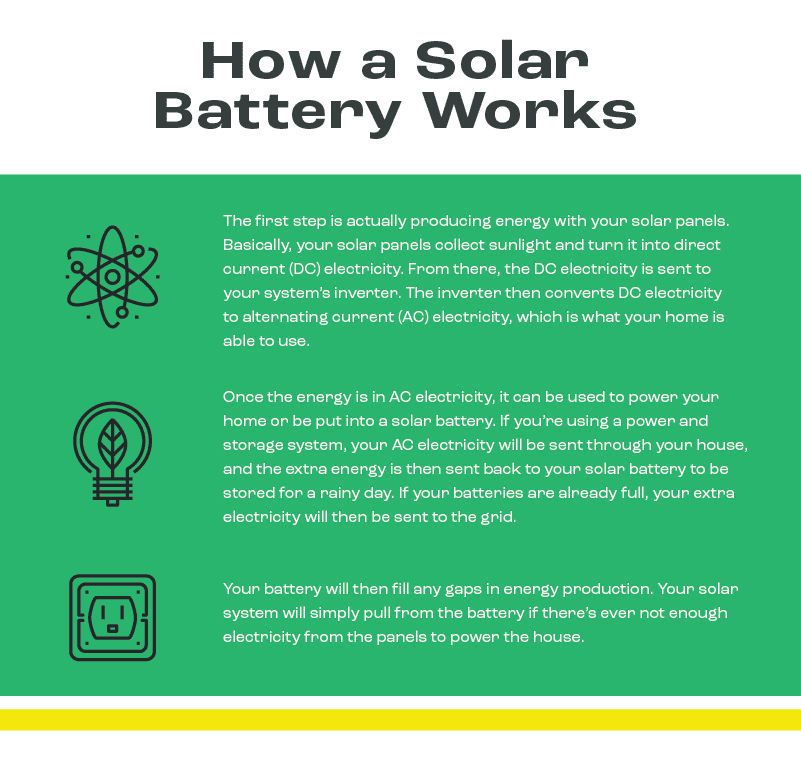
Understanding how a solar battery works doesn’t require an engineering degree. Think of it as a large rechargeable battery similar to the one in your phone, but much bigger and more powerful. During the day, your solar panels generate electricity in the form of direct current (DC) power. Any electricity your home doesn’t immediately use flows into the battery, where it’s stored for later.
When the sun goes down or your home needs more power than the panels are currently producing, the battery discharges, sending that stored DC electricity to an inverter. The inverter converts it into alternating current (AC) power, which is what your home appliances use. This entire process happens automatically, managed by smart technology that guarantees you have power when you need it.
Most modern solar batteries are designed to work seamlessly with your existing solar system and home electrical panel. They monitor your energy production and consumption in real-time, charging when there’s excess solar power and discharging when your home needs more electricity than the panels are producing. If the battery runs low and the sun isn’t shining, the system will draw from the grid, ensuring you never run out of power.
Types of Solar Batteries: What Are Your Options?
When it comes to solar batteries for residential use, you’ll encounter two main types: lithium-ion and lead-acid. While lead-acid batteries have been around longer and tend to cost less upfront, lithium-ion batteries have become the clear choice for most homeowners, and for good reason.
Lithium-ion batteries offer several advantages. They last longer, 10-15 years compared to 5-7 years for lead-acid batteries. They’re more efficient at storing and releasing energy, meaning less of your solar power is lost in the storage process. They can be discharged more deeply without damage, so you can use more of the battery’s capacity. They’re also more compact and require less maintenance.
The cost of lithium-ion batteries has dropped substantially in recent years, making them more affordable for homeowners. When you factor in their longer lifespan and better performance, the long-term value often exceeds that of cheaper lead-acid alternatives. This is why leading residential solar batteries like the Tesla Powerwall, LG Chem, and others all use lithium-ion technology.
Is a Solar Battery Right for Your Home?
Your Utility’s Net Metering Policy
Net metering is a policy that allows solar system owners to send excess electricity back to the grid in exchange for credits on their utility bill. The value of these credits varies depending on where you live. In states with favorable net metering policies, you might receive close to retail rate for your excess solar power. In others, the credits are less valuable.
If your utility offers poor net metering terms—or if you’re in an area where net metering is being phased out—a solar battery becomes a much more attractive investment. Instead of selling your excess solar energy at a discount, you’re storing it to use yourself when electricity is most expensive. The worse your net metering deal, the better the economics of a solar battery become.
Frequency of Power Outages in Your Area
If you live somewhere with reliable power, backup capability might be a nice-to-have feature rather than a necessity. But if your area experiences frequent outages, whether from severe weather, an aging grid, or planned shutoffs during fire season, a solar battery moves from optional to essential.
Consider how power outages have affected you in the past. Have you lost food when the refrigerator went out? Missed important work deadlines? Had to relocate to a hotel? These inconveniences and costs add up quickly. Having a solar battery means that the next time the grid fails, your home stays powered, protecting your comfort and your wallet.
Your Family’s Energy Consumption Habits
Take a look at when your family uses the most electricity. If you’re home during the day and use a lot of power while the sun is shining, you might be consuming most of your solar production in real-time, leaving less excess to store. On the other hand, if your home is empty during the day and energy use spikes in the evening, you’re generating surplus solar power during the day that goes to waste without a battery to store it.
Families with high evening energy consumption get the most benefit from solar batteries. You’re capturing all that unused daytime solar production and deploying it when you need it most, during those expensive peak evening hours.
Choosing the Best Solar Battery for Your Needs
Popular Solar Battery Brands
The solar battery market has expanded in recent years, giving homeowners more options than ever. The Tesla Powerwall remains one of the most popular choices, known for its sleek design, capacity (13.5 kWh), and seamless integration with Tesla and third-party solar systems. It offers reliable backup power and smart energy management through an intuitive app.
Beyond Tesla, other leading brands include the LG Chem RESU, Enphase IQ Battery, Generac PWRcell, and Panasonic EverVolt. Each has its own strengths—some excel in scalability, others in efficiency or warranty coverage. When evaluating options, focus on specifications like usable capacity (how much energy the battery stores), continuous power rating (how much power it can deliver at once), round-trip efficiency (how much energy is lost in the storage process), and warranty terms.
At 8MSolar, we work with multiple battery manufacturers to make sure we match each homeowner with the right solution for their specific needs and budget. The “best” battery is the one that fits your home’s energy requirements and your goals for backup power and energy independence.
How Many Solar Batteries Do You Need?
The number of batteries you need depends on two factors: how much energy you want to store and what you want to power during an outage. A single battery might be sufficient if you’re interested in powering essential circuits; lights, refrigerator, internet router, and a few outlets. If you want whole-home backup that includes air conditioning, electric vehicle charging, and all major appliances, you’ll likely need multiple batteries.
Your energy consumption patterns also matter. A home that uses 30 kWh per day will need more storage capacity than one that uses 20 kWh, especially if you want to store enough energy to get through cloudy days or extended outages.
This is why we recommend a professional consultation to properly size your battery system. Our team at 8MSolar can analyze your energy usage, understand your backup priorities, and design a system that meets your needs without overspending on unnecessary capacity.
Take Control of Your Power
Solar energy storage is the next evolution in home energy independence. By adding a battery to your solar system, you’re taking control of your power supply. You’ll save money by using your own solar energy during peak hours, protect your home with reliable backup power during outages, and maximize the value of every kilowatt-hour your panels generate.
A solar battery isn’t right for every homeowner, but for many families in North Carolina, it’s a smart investment that pays dividends in lower bills, greater security, and peace of mind. With tax credits available for battery storage and innovative financing options, there’s never been a better time to explore your options.
Ready to take the next step toward energy independence? Contact 8MSolar today for a quote for a solar battery storage system. Our experienced team will help you understand your options, size the right system for your home, and design a solution that delivers value for your family. Let’s work together to keep your power on—no matter what.