When homeowners start exploring solar energy, one term comes up again and again: efficiency. You’ll see it plastered across product brochures, mentioned in sales pitches, and debated in online forums. But what does solar panel efficiency mean for your home? More importantly, how do you know if solar panels will work efficiently enough to make the investment worthwhile?
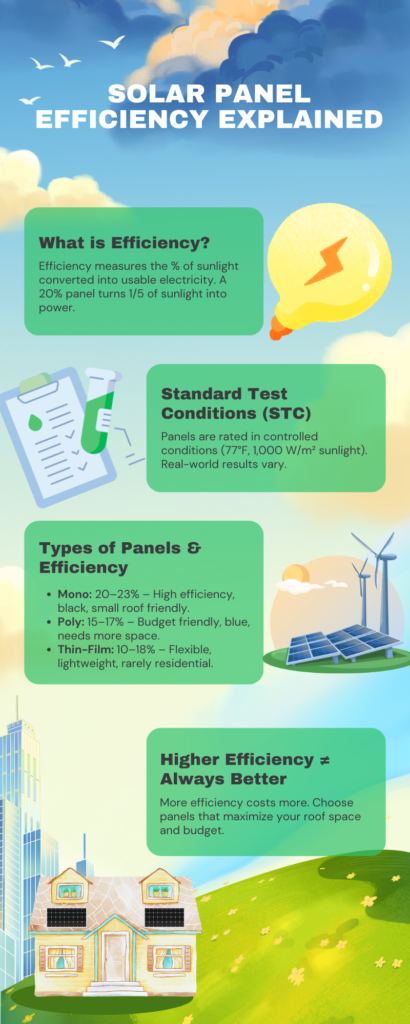
Solar panel efficiency refers to the percentage of sunlight that a panel can convert into usable electricity. A panel rated at 20% efficiency converts one-fifth of the sunlight hitting its surface into power you can use. While that might sound low, modern solar technology has come a long way. Today’s panels are more efficient, durable, and affordable than ever before.
Understanding what affects efficiency is the key to maximizing your solar investment. From your roof’s angle to the trees in your yard, multiple factors determine how much energy your system will produce. This guide breaks down everything you need to know about solar panel efficiency so you can make an informed decision about whether solar is right for your home.
What Does a Panel’s “Efficiency Rating” Mean?
Understanding Standard Test Conditions (STC)
When you see an efficiency rating on a solar panel—say, 21%—that number comes from testing in a controlled laboratory environment. Manufacturers test panels under what’s called Standard Test Conditions: 77°F temperature, 1,000 watts per square meter of sunlight, and an air mass of 1.5 (which represents sunlight passing through the atmosphere at a specific angle).
These controlled conditions allow for fair comparisons between different panels. However, your roof isn’t a laboratory. Real-world conditions vary constantly. Temperatures fluctuate, clouds pass overhead, and the angle of sunlight changes throughout the day. This means your panels won’t always operate at their rated efficiency, but that doesn’t mean they’re underperforming. It’s simply the reality of working with a natural energy source.
The Most Efficient Solar Panels on the Market Today
Not all solar panels are created equal. The three main types of solar panels each offer different efficiency levels and price points.
Monocrystalline solar panels are the efficiency leaders, achieving ratings between 20% and 23%. Made from pure silicon using the Czochralski method, these panels have a distinctive black appearance and work well in limited roof space. Their high efficiency means you can generate more power with fewer panels, which is valuable when every square foot counts.
Polycrystalline panels offer a more budget-friendly option, with efficiency ratings between 15% and 17%. These panels have a blue hue and are manufactured by melting silicon fragments together. While they require slightly more roof space to generate the same amount of power as monocrystalline panels, they provide excellent value for homeowners with ample installation area.
Thin-film solar panels represent the newest technology, with efficiency ratings ranging from 10% to 18% depending on the materials used. While they’re the least efficient type, they’re lightweight, flexible, and can work on unconventional surfaces. They’re rarely used in residential applications but have found success in commercial installations.
Is Higher Efficiency Always Better?
Higher efficiency doesn’t automatically mean a better investment. While a 23% efficient panel sounds more impressive than a 17% efficient one, that extra efficiency comes at a premium price.
The question you should ask is whether the additional efficiency justifies the extra cost for your situation. If you have limited roof space, investing in high-efficiency panels makes sense because you need to maximize every square foot. If you have a large, unobstructed roof, mid-efficiency panels might deliver better overall value. The goal is to generate enough electricity to meet your needs at the best possible price, not to have the highest efficiency rating.
6 Factors That Affect Real-World Solar Panel Efficiency
Factor #1: High Temperatures
It might seem counterintuitive, but solar panels don’t love extreme heat. While panels need sunlight to generate electricity, high temperatures can reduce their power output. This relationship is measured by the temperature coefficient, expressed as a percentage per degree Celsius.
Most monocrystalline and polycrystalline panels have temperature coefficients between -0.3% and -0.5% per degree Celsius. This means that for every degree above the standard test temperature of 77°F, the panel loses a small percentage of its power output. On a scorching 95°F day in North Carolina, panels might operate at 5-10% below their rated capacity.
This doesn’t mean solar doesn’t work well in hot climates—far from it. The abundance of sunny days more than compensates for the temperature-related efficiency loss. However, it’s an important factor to consider when calculating your expected energy production.
Factor #2: Shading from Trees and Obstructions
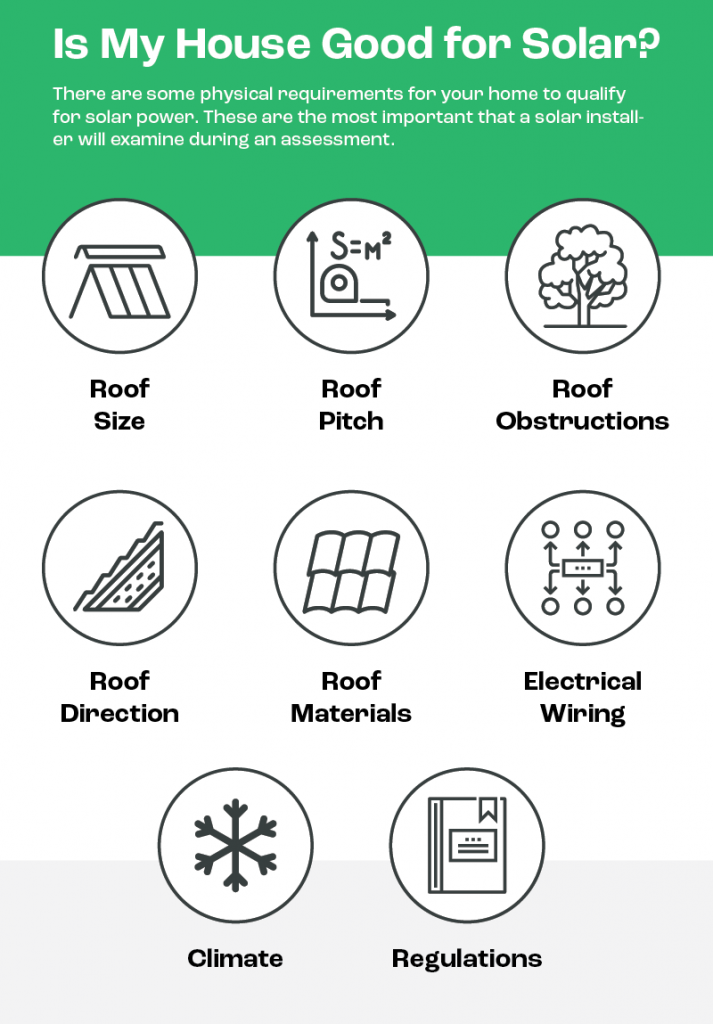
Shading is one of the biggest efficiency killers for solar systems. Even partial shade on a single panel can reduce the output of your entire array, depending on how your system is configured.
Traditional string inverter systems are vulnerable to shading. When panels are wired together in series, the shaded panel acts like a bottleneck, limiting the current flowing through the entire string. It’s like a chain that’s only as strong as its weakest link.
This is why professional solar installers carefully analyze your property for shading issues. Trees, chimneys, vent pipes, and neighboring buildings can all cast shadows that change throughout the day and across seasons. Sometimes, trimming a few branches or adjusting panel placement by just a few feet can make a substantial difference in your system’s annual energy production.
Factor #3: Panel Angle and Direction (Orientation)
The angle and direction of your solar panels directly impact how much sunlight they can capture. In North Carolina, south-facing roofs are ideal, allowing panels to track the sun’s path across the sky throughout the day. East and west-facing installations can still work well, though they’ll capture less total energy.
The tilt angle matters too. A roof pitch that matches your latitude (around 35-37 degrees in much of North Carolina) is considered prime for year-round production. Steeper angles favor winter sun when the sun sits lower in the sky, while shallower angles work better for summer production.
Even if your roof isn’t perfectly oriented, modern solar design can work around these constraints. Professional installers use sophisticated modeling software to calculate expected production based on your roof geometry, making sure your system is designed to maximize efficiency given your home’s unique characteristics.
Factor #4: The Age of the Panel (Degradation)
Solar panels are durable, but they do experience a slow, natural decline in efficiency over time. This is called the degradation rate, and it’s typically around 0.5% to 0.8% per year for quality panels.
What this means in practice is that a panel producing 100% of its rated power in year one might produce 99.5% in year two, 99% in year three, and so on. After 25 years, a well-maintained system should still operate at 85-90% of its original efficiency.
This gradual decline is factored into system designs and financial projections. When installers calculate your expected energy production and savings, they account for degradation to give you realistic expectations. Quality panels from reputable manufacturers like Q Cells, REC, and Panasonic tend to have lower degradation rates, which is one reason why choosing premium products can pay off over the long term.
Factor #5: Dirt, Dust, and Debris
A layer of dust, pollen, bird droppings, or leaves can block sunlight from reaching your solar cells, reducing efficiency. In most areas, rain provides enough natural cleaning to keep panels reasonably clear. In dry climates or during pollen-heavy seasons, manual cleaning may be necessary.
The good news is that solar panels are designed with smooth glass surfaces that shed debris relatively easily. Most homeowners find that occasional cleaning (maybe once a year) is enough to maintain peak performance. For panels that are difficult to access safely, professional cleaning services are available at modest costs.
Factor #6: The Quality of Your Inverter
Your solar panels only produce direct current (DC) electricity, but your home runs on alternating current (AC) power. The inverter bridges this gap, converting DC to AC. The efficiency of this conversion directly impacts your system’s overall performance.
Quality inverters from manufacturers like Fronius or Sunny Boy operate at 96-98% efficiency, meaning very little energy is lost in the conversion process. However, a failing or undersized inverter can reduce your system’s output.
There are also different inverter technologies to consider. String inverters are the traditional choice, but microinverters can improve performance in situations with shading or panels facing multiple directions. Your installer will recommend the best inverter configuration based on your roof layout and shading profile.
How to Maximize Solar Panel Output on Your Home
The Importance of Professional System Design
All the factors we’ve discussed come together during the system design phase. This is where working with experienced professionals makes all the difference.
At 8MSolar, our engineers don’t just slap panels on your roof and hope for the best. We conduct thorough site assessments, use advanced modeling software to simulate your system’s performance throughout the year, and design solutions that maximize efficiency while working within the constraints of your property. We consider your roof’s angle, identify and reduce shading issues, and select equipment that delivers the best performance for your situation.
A well-designed system accounts for all the variables that affect efficiency. We position panels to avoid shadows, select inverters that optimize power conversion, and size your system to meet your energy needs without over- or under-building. This attention to detail during the design phase pays dividends for decades to come.
Choosing the Right Technology (e.g., Microinverters for Shady Roofs)
Not every solar challenge requires the same solution. Modern solar technology offers various tools to address site-specific efficiency issues.
For roofs with unavoidable shading, microinverters or power optimizers can be game-changers. These devices allow each panel to operate independently, so shading on one panel doesn’t drag down the performance of the entire array. While they add to the upfront cost, the efficiency gains often justify the investment.
For homes with complex roof layouts involving multiple orientations or angles, microinverters again offer advantages by optimizing each panel’s output independently. Battery storage systems can enhance efficiency by allowing you to store excess energy produced during peak sun hours for use during evening hours when your panels aren’t producing.
Your installer should present options tailored to your home’s characteristics and your energy goals, explaining the trade-offs between cost and performance for each approach.
Simple Maintenance for Peak Performance
Once your system is installed, maintaining high efficiency doesn’t require much effort. Here are a few simple practices that can help:
Keep panels reasonably clean by hosing them off once or twice a year, or after dusty or pollen-heavy periods. Monitor your system’s production through your inverter or monitoring app to catch any performance issues early. Trim trees and vegetation that might grow to shade your panels over time. Schedule professional inspections every few years to check connections, mounting hardware, and system health.
These maintenance tasks help your system operate at peak efficiency throughout its 25-year-plus lifespan, protecting your investment and maximizing your energy savings.
Get Your Personalized Solar Efficiency Forecast
Solar panel efficiency depends on far more than just the rating printed on the spec sheet. Real-world performance is shaped by your roof’s characteristics, your local climate, the quality of your equipment, and how well your system is designed and maintained.
With proper planning and professional installation, solar panels can deliver excellent efficiency and strong financial returns in almost any location. Even homes with less-than-ideal conditions can benefit from solar energy when the system is thoughtfully designed.
At 8MSolar, we’ve installed solar systems throughout North Carolina, working with every roof type and situation imaginable. Our engineers know how to maximize efficiency regardless of your home’s specific challenges. We use the latest technology, premium equipment from manufacturers like Q Cells and REC, and decades of combined experience to design systems that deliver reliable, cost-effective energy for years to come.
Ready to discover how efficient solar can be on your home? Contact 8MSolar today for a free solar design and personalized efficiency forecast. We’ll analyze your property, calculate your expected energy production, and show you exactly what solar can do for you. Your journey to energy independence starts with understanding your home’s solar potential. Let’s explore it together.